
In the fast-paced world of FinTech, Software, and Media, speed is everything. The ability to innovate, adapt, and execute faster than the competition is what separates market leaders from the rest of the pack. Yet, many enterprises are unknowingly sabotaging their own success with a silent killer: a slow engineering hiring process. While it may seem like a minor administrative hurdle, the reality is that every day a critical engineering position remains unfilled, your organization is bleeding revenue, missing deadlines, and stalling its growth engine. This isn’t just a minor inconvenience; it’s a major strategic liability with a staggering price tag.
For US corporations, the race to secure top engineering talent has never been more intense. The rise of enterprise AI tools and the broader trend of corporate AI use have created an insatiable demand for skilled professionals who can build, implement, and maintain these transformative technologies. Companies are desperately looking to hire AI engineers, hire AI programmers, and hire AI coders to stay ahead of the curve. However, the traditional, slow-moving hiring practices of many large organizations are simply not equipped to compete in this hyper-competitive landscape. The result is a costly and frustrating cycle of missed opportunities, overworked teams, and a tangible impact on the bottom line.
This article will pull back the curtain on the hidden costs of slow engineering hiring. We will explore the quantifiable financial losses, the cascading impact on project timelines and team morale, and the long-term damage to your employer brand. We will also delve into the specific challenges of the AI talent crisis and provide actionable strategies for enterprises to streamline their hiring processes and win the war for talent. The data is clear: in the age of AI, slow hiring is a luxury no enterprise can afford.
The High Price of Empty Seats: Quantifying the Financial Drain
The most immediate and tangible impact of a slow hiring process is the direct financial cost. While many organizations focus on the cost-per-hire, the real financial drain comes from the lost productivity and revenue associated with an empty seat. The numbers are staggering and paint a clear picture of the urgency required in today’s talent market.
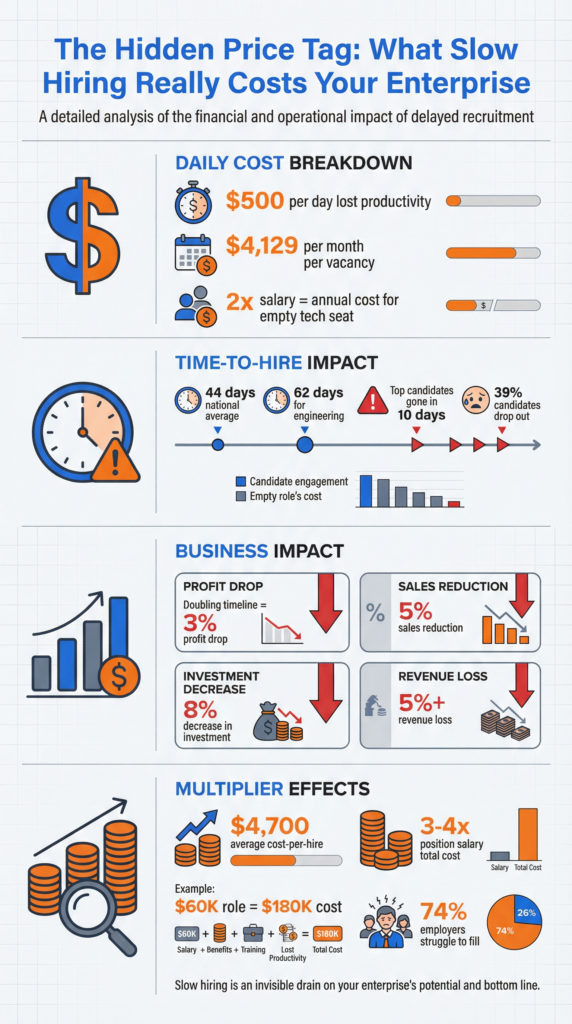
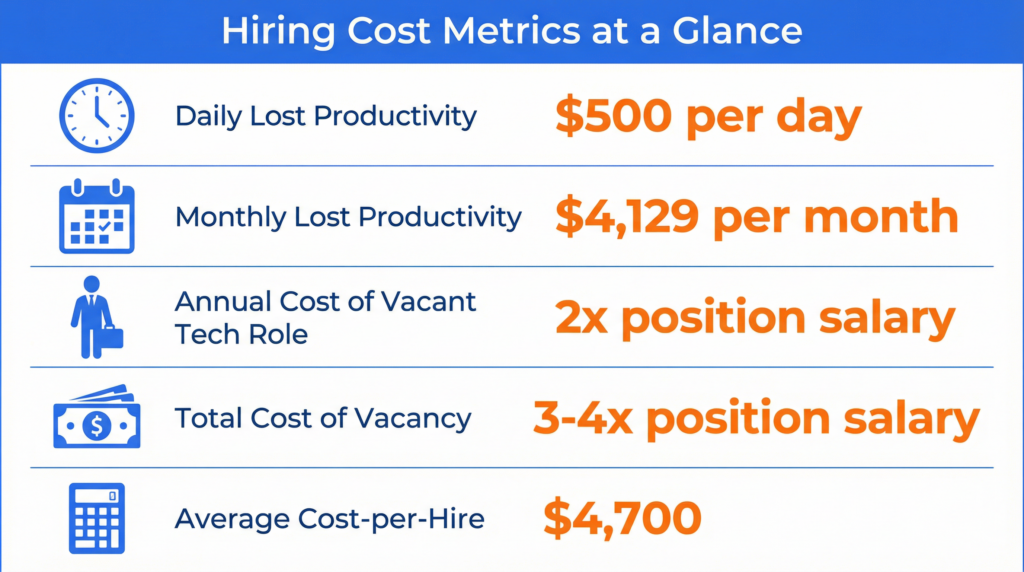
According to research, a vacant position can cost a company approximately $500 per day in lost productivity [1]. This figure can be even higher for specialized technical roles, such as software engineers, where the impact on project timelines and product development is more pronounced. Over the course of a month, this translates to an average loss of $4,129 per job vacancy [1]. When you consider that the average time-to-hire for an engineering role is 62 days, the costs quickly add up [1].
The True Cost of Slow Engineering Hiring
But the direct productivity loss is just the tip of the iceberg. The total cost of a vacant position can be as high as two to four times the position’s annual salary [1]. For a software engineer with a salary of $100,000, this means a slow hiring process could be costing your organization between $200,000 and $400,000 per year for that single unfilled role. This is a massive, and often unaccounted for, expense that directly impacts your bottom line.
The financial repercussions extend beyond just lost productivity. A slow hiring process can also lead to a 3% drop in profits and a 5% reduction in sales for companies facing hiring difficulties [1]. This is because unfilled engineering roles directly impact a company’s ability to develop and launch new products, improve existing services, and respond to market demands. In the competitive landscapes of FinTech, Software, and Media, this can be the difference between leading the market and falling behind.
The Domino Effect: How Slow Hiring Derails Growth and Innovation
The financial costs of slow hiring are significant, but the indirect costs can be even more damaging to an organization’s long-term success. A slow hiring process creates a domino effect that ripples through the entire organization, impacting everything from project timelines and team morale to innovation and competitive positioning.
When a critical engineering position remains unfilled, the workload doesn’t disappear. It gets redistributed to the existing team members, who are often already stretched thin. This increased workload can lead to burnout, decreased morale, and a decline in productivity. With 74% of employers globally struggling to fill open positions, it’s clear that many teams are already operating at or near capacity [1]. Piling on additional responsibilities only exacerbates the problem and can lead to a vicious cycle of employee turnover.
The impact on project timelines is another major concern. In the fast-paced worlds of FinTech, Software, and Media, a delay of even a few weeks can mean missing a critical market window or falling behind a competitor. When a key engineer is missing from a project, it can cause a cascade of delays that impact the entire product roadmap. This can lead to missed deadlines, unhappy clients, and a loss of competitive advantage.
Furthermore, a slow hiring process can stifle innovation. When engineers are overworked and focused on just keeping their heads above water, they have little time or energy for creative thinking and experimentation. This can lead to a culture of stagnation, where the organization is simply maintaining the status quo rather than pushing the boundaries of what’s possible. In industries that are constantly being disrupted by new technologies and business models, a lack of innovation is a death sentence.
The AI Talent Crisis: A New Frontier of Hiring Challenges
The challenges of slow engineering hiring are amplified when it comes to the highly specialized and competitive field of artificial intelligence. The demand for skilled AI engineers, AI programmers, and AI coders is exploding as companies across all industries rush to adopt enterprise AI tools and leverage the power of corporate AI use. However, the supply of qualified talent is struggling to keep up, creating a severe AI talent crisis that is making it incredibly difficult for enterprises to find and hire the people they need.
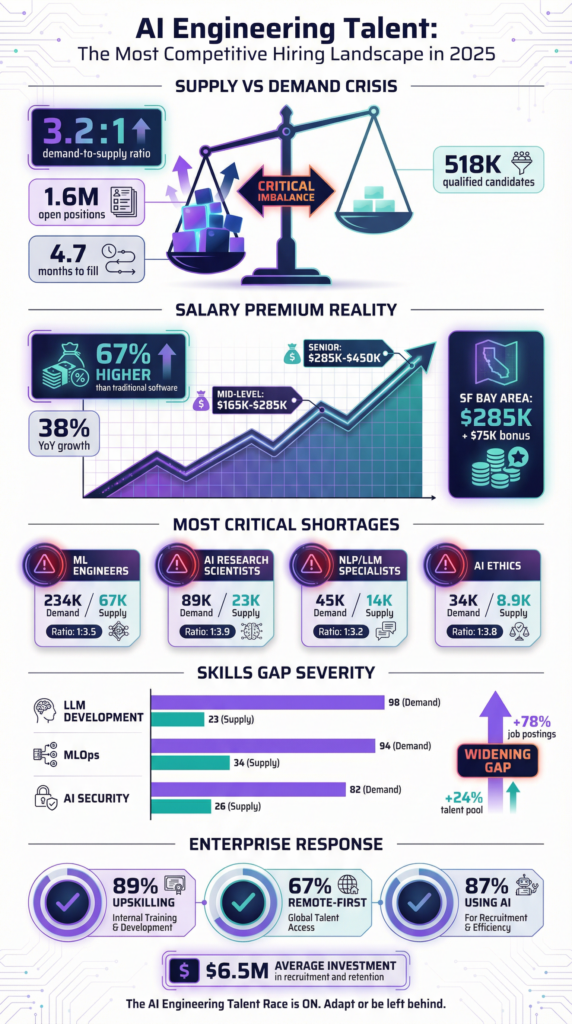
The statistics are stark. Globally, the demand for AI talent exceeds the supply by a ratio of 3.2 to 1 [5]. There are over 1.6 million open AI positions worldwide, with only 518,000 qualified candidates available to fill them [5]. This massive imbalance has created a hyper-competitive hiring landscape where top candidates are receiving multiple offers and can afford to be highly selective about where they work.
The AI Talent Crisis in Enterprise Hiring
This talent shortage has also led to a dramatic increase in salaries for AI professionals. AI roles command a 67% higher salary than traditional software engineering positions, with a 38% year-over-year growth in compensation [5]. For enterprises, this means that not only is it harder to find qualified candidates, but it’s also significantly more expensive to hire them. The average salary for a mid-level machine learning engineer in the US is now between $165,000 and $285,000, with senior engineers commanding salaries of $285,000 to $450,000 and beyond [5].
The challenges don’t stop there. The AI field is evolving at a breakneck pace, with new tools, techniques, and technologies emerging all the time. This has created a significant skills gap, where the skills that companies need are not always the skills that are available in the talent pool. The most critical skills gaps are in areas like Large Language Model (LLM) development, MLOps, and AI ethics, where the demand for expertise far outstrips the supply [5].
For enterprises in the FinTech, Software, and Media industries, the AI talent crisis presents a major threat to their ability to innovate and compete. Without the right talent, it’s impossible to develop and deploy the cutting-edge AI-powered products and services that customers are demanding. This is why it’s more important than ever for enterprises to have a fast, efficient, and effective hiring process that is specifically designed to attract and win top AI talent.
Your Employer Brand on the Line: The Reputational Cost of a Slow Process
In today’s transparent and interconnected world, a slow and frustrating hiring process can do more than just cost you money and time; it can also do significant damage to your employer brand. Your employer brand is your reputation as a place to work, and it’s a critical asset in the war for talent. A negative employer brand can make it much harder to attract and hire top candidates, not just for the role you’re currently trying to fill, but for all future roles as well.
Research shows that 72% of job seekers who have a negative experience with a company’s hiring process will share it with others [1]. This can be through word-of-mouth, social media, or on employer review sites like Glassdoor. With 76% of potential applicants being deterred by negative Glassdoor reviews, the impact of a poor candidate experience can be far-reaching and long-lasting [1].
A slow hiring process is one of the biggest contributors to a negative candidate experience. When candidates are left in the dark for weeks on end, with no communication or feedback, they quickly become frustrated and disengaged. In fact, 66% of candidates will move on to other opportunities if they don’t hear back within two weeks [1]. With top candidates being off the market in just 10 days, a slow process is a surefire way to lose out on the best talent [1].
The damage to your employer brand can also have a direct impact on your business. A study by CareerArc found that 64% of candidates who have a negative experience are less likely to buy products or services from that company [1]. This means that your slow hiring process could be costing you customers as well as candidates.
On the other hand, a positive candidate experience can be a powerful competitive advantage. 75% of employees accepted job offers specifically because of positive candidate experiences during the hiring process [1]. By creating a fast, transparent, and respectful hiring process, you can not only improve your chances of hiring top talent, but also enhance your employer brand and create a positive impression of your company in the market.
Winning the War for Talent: Actionable Strategies for Enterprises
The challenges of slow engineering hiring and the AI talent crisis are significant, but they are not insurmountable. By adopting a strategic and proactive approach to talent acquisition, enterprises can streamline their hiring processes, reduce their time-to-hire, and win the war for top engineering talent. Here are some actionable strategies that companies in the FinTech, Software, and Media industries can implement to gain a competitive edge:
1. Embrace a Data-Driven Approach:
The first step to improving your hiring process is to understand where the bottlenecks are. By tracking key metrics like time-to-fill, source-of-hire, and candidate drop-off rates, you can identify the areas that are causing delays and take targeted action to address them. This data-driven approach will allow you to make informed decisions about where to invest your time and resources to have the biggest impact.
2. Streamline Your Interview Process:
One of the biggest culprits of a slow hiring process is a long and convoluted interview process. While it’s important to be thorough in your evaluation of candidates, it’s also important to be respectful of their time. Aim to have a clear and concise interview process with a limited number of rounds. Use technology to your advantage, with tools for automated scheduling, video interviewing, and collaborative feedback. And most importantly, make sure that everyone involved in the interview process is trained on how to conduct effective and efficient interviews.
3. Leverage AI and Automation:
In the age of AI, it’s ironic that many companies are still using manual and outdated hiring practices. There are a wide range of enterprise AI tools available that can help you to automate and streamline your hiring process. From AI-powered sourcing and screening to automated interview scheduling and candidate communication, these tools can help you to save time, reduce bias, and improve the overall candidate experience. By embracing corporate AI use in your own HR department, you can gain a significant advantage in the race to hire AI engineers and other top talent.
4. Build a Strong Talent Pipeline:
Don’t wait until you have an open position to start looking for candidates. By proactively building a strong talent pipeline, you can significantly reduce your time-to-hire when a new role does open up. This can involve everything from attending industry events and networking with potential candidates to creating a talent community and engaging with passive candidates on social media. The goal is to have a pool of qualified and engaged candidates that you can tap into whenever you have a hiring need.
5. Partner with a Specialized IT Staff Augmentation Provider:
For many enterprises, the fastest and most effective way to overcome the challenges of slow hiring is to partner with a specialized IT staff augmentation provider like Correct Context. These firms have a deep understanding of the tech talent market and have a pre-vetted pool of qualified candidates that are ready to hit the ground running. By leveraging the expertise and resources of a staff augmentation partner, you can quickly and easily fill your open engineering roles, without the time, cost, and frustration of a traditional hiring process.
Conclusion: you cannot afford the cost of slow engineering hiring
In the high-stakes world of FinTech, Software, and Media, the cost of slow engineering hiring is a price that no enterprise can afford to pay. The financial drain of lost productivity and revenue, the domino effect of delayed projects and decreased morale, and the long-term damage to your employer brand are all significant and avoidable consequences of an inefficient hiring process. The AI talent crisis has only amplified these challenges, making it more important than ever for enterprises to adopt a fast, efficient, and strategic approach to talent acquisition.
By embracing a data-driven approach, streamlining your interview process, leveraging AI and automation, building a strong talent pipeline, and partnering with a specialized IT staff augmentation provider, you can overcome the challenges of slow hiring and win the war for top engineering talent.
References
[1] OpenArc. (2025, July 17). The Hidden Hiring Costs of A Slow Recruitment Process
[2] McKinsey & Company. (2025, November 5). The State of AI: Global Survey 2025.
[3] SecondTalent. (2025, October 16). AI Adoption in Enterprise Statistics & Trends 2025.
[4] The Pragmatic Engineer. (2025, October 7). State of the software engineering jobs market, 2025: what hiring managers see.
[5] SecondTalent. (2025, September 16). Top 50+ Global AI Talent Shortage Statistics 2025.
Table of content
- The High Price of Empty Seats: Quantifying the Financial Drain
- The True Cost of Slow Engineering Hiring
- The Domino Effect: How Slow Hiring Derails Growth and Innovation
- The AI Talent Crisis: A New Frontier of Hiring Challenges
- The AI Talent Crisis in Enterprise Hiring
- Your Employer Brand on the Line: The Reputational Cost of a Slow Process
- Winning the War for Talent: Actionable Strategies for Enterprises
- Conclusion: you cannot afford the cost of slow engineering hiring