
For any engineering leader, the realization hits like a ton of bricks: you’ve made a bad hire. The initial relief of filling a critical role has evaporated, replaced by a gnawing anxiety. The new engineer isn’t just failing to contribute – they are actively draining energy, slowing progress, and casting a shadow over the entire team. This isn’t just a personnel problem. It’s a business crisis in the making, a single point of failure that triggers a cascade of financial, productive, and cultural damage. For leaders at Fortune 5000 enterprises and high-growth Series A+ startups in competitive markets like the US East Coast, UK, DACH, and Nordics, the stakes are astronomical. The fear of long-term damage is real, and it forces a critical question: is a stricter, more resource-intensive vetting process truly worth it?
The short answer is an unequivocal yes. A single bad engineering hire is not an isolated mistake but a catalyst for a devastating ripple effect. The consequences extend far beyond the individual’s salary, infecting team morale, derailing product roadmaps, and ultimately eroding your competitive edge. Understanding the true cost is the first step toward building a more resilient and effective hiring strategy.
The Immediate Financial Fallout: More Than Just a Salary
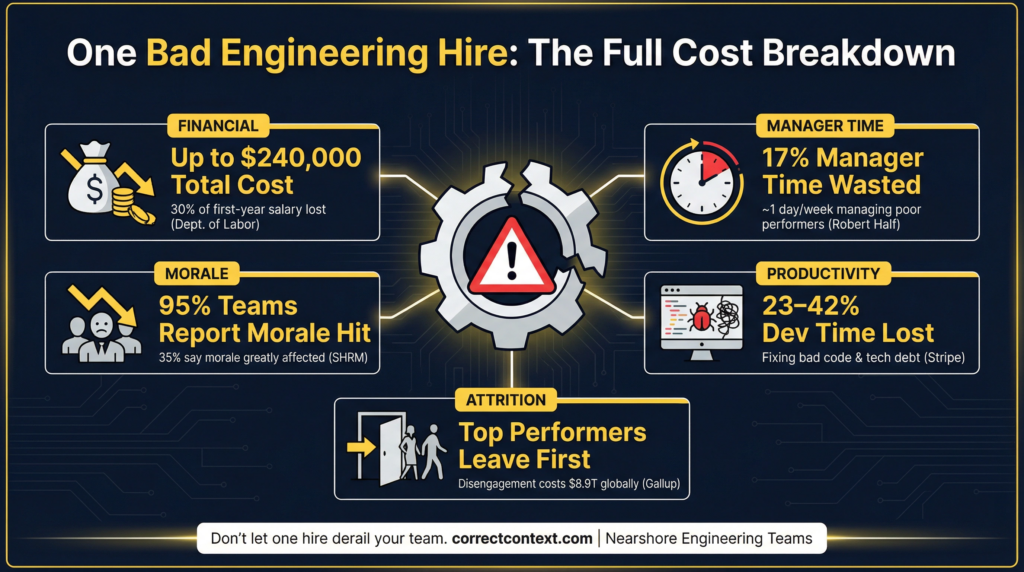
The most visible cost of a bad hire is the direct financial loss – a figure that is often grossly underestimated. The U.S. Department of Labor estimates that a bad hire can cost a company up to 30% of the employee’s first-year earnings [1]. For a senior software engineer with a competitive salary, this can easily exceed $50,000. However, this number only scratches the surface.
The full financial picture includes a host of hidden expenses that accumulate over the employee’s short and turbulent tenure: recruitment advertising and agency fees, onboarding and training costs that are entirely lost upon departure, salary and benefits paid for minimal productive output, and severance and legal fees associated with termination. When all these factors are considered, the total cost can skyrocket. A study by the Society for Human Resource Management (SHRM) found that the total cost of a bad hire can be as high as $240,000, depending on the role and salary level [2]. For specialized roles within a big data development team or an AI development team, where expertise is scarce and highly valued, the financial damage is even more severe.
Table 1: Estimated Cost of a Bad Engineering Hire ($150,000/year Senior Engineer)
| Cost Component | Description | Estimated Cost |
| Recruitment | Agency fees, advertising, internal recruiter time | $30,000 – $45,000 |
| Onboarding | HR time, manager time, training programs | $5,000 – $10,000 |
| Compensation | Salary + benefits paid during underperformance (6 months) | $75,000 + benefits |
| Lost Productivity | Team disruption and project delays | $50,000+ |
| Termination | Severance pay, legal consultation, offboarding | $15,000 – $25,000 |
| TOTAL ESTIMATED COST | $175,000 – $230,000+ |
Sources: U.S. Department of Labor [1]; SHRM [2]; Robert Half [3]. Estimates are illustrative and may vary by company size and location.
The Productivity Black Hole: How One Bad Hire Slows Everyone Down
Beyond the direct financial drain, a bad hire creates a significant drag on productivity that can bring an entire engineering team to a crawl. This productivity loss manifests in several interconnected ways, creating a vicious cycle of inefficiency and delay that is difficult to break once it takes hold.
First, there is the immediate impact on the team’s manager. A survey by Robert Half, based on interviews with more than 1,400 CFOs, revealed that supervisors spend an average of 17% of their time – nearly one full day per week – managing poorly performing employees [3]. This is time that should be spent on strategic planning, mentoring high-performers, and driving the team’s vision. Instead, it is consumed by damage control, performance reviews, and micromanagement.
Second, the bad hire introduces what is often called ‘negative work.’ This includes writing poor-quality code that is riddled with bugs and creates significant technical debt. Research from Stripe’s Developer Coefficient report and subsequent academic studies shows that developers can waste between 23% and 42% of their time dealing with the consequences of bad code and technical debt [4]. This means your best engineers are not building new features or innovating – they are cleaning up someone else’s mess. The team’s velocity plummets, sprint goals are missed, and product delivery schedules are pushed back, directly impacting revenue and customer satisfaction.
This slowdown is a silent killer for any startup development team trying to achieve product-market fit or an enterprise AI unit racing to deploy new tools. The opportunity cost of these delays – the features that don’t get built, the markets that aren’t captured – can be far greater than the direct financial cost of the bad hire itself.
Infographic 1: The Ripple Effects of One Bad Engineering Hire
Sources: U.S. Dept. of Labor [1], SHRM [2], Robert Half [3], Stripe [4], Gallup [6]
The Culture Killer: Eroding Morale and Trust
The most insidious damage caused by a bad hire is often the least quantifiable: the erosion of team morale and culture. A high-performing dedicated software team is built on a foundation of trust, collaboration, and mutual respect. A single toxic or incompetent individual can shatter that foundation with surprising speed.
When team members see a colleague consistently underperforming, missing deadlines, or refusing to collaborate, frustration and resentment build quickly. Your top performers – the very people you rely on to drive your business forward – are often forced to pick up the slack. This leads to burnout, disengagement, and ultimately, turnover. According to a SHRM report, 95% of employers agree that a poor hiring decision impacts the morale of the entire team [5]. More than one-third of respondents – 35% – said morale is ‘greatly affected.’
This is the nightmare scenario for any engineering leader. You don’t just lose the bad hire; you risk losing your best people, who become disillusioned and seek opportunities elsewhere. Gallup’s research on employee engagement highlights the staggering cost of this disengagement, which costs the global economy an estimated $8.9 trillion annually in lost productivity [6]. A bad hire is a direct contributor to this problem, creating a toxic environment that drives your most valuable assets away from the team.
Table 2: The Three-Layer Impact of a Bad Engineering Hire
| Impact Layer | Key Metric | Source |
| Financial | Up to $240,000 total cost per bad hire | SHRM, 2022 |
| Productivity | 17% manager time lost; 23–42% dev time on tech debt | Robert Half; Stripe |
| Cultural / Morale | 95% teams report morale impact; $8.9T global disengagement cost | SHRM; Gallup 2023 |
Sources: SHRM [2][5]; Robert Half [3]; Stripe [4]; Gallup [6].
The Strategic Alternative: Building a Resilient Team with a Nearshore Partner
So, how can engineering leaders avoid this catastrophic chain of events? The solution lies in a fundamental shift in hiring strategy, moving away from rushed, reactive hiring toward a more deliberate, proactive approach. This is where a strategic partnership with a nearshore development team in Poland or CEE can be a genuine game-changer for companies looking to scale engineering teams without the associated risk.
By leveraging an Employer of Record (EoR) in Poland, companies can tap into a deep pool of highly skilled, pre-vetted senior developers without the need to build local infrastructure. This model – which handles all the complexities of payroll services Poland, HR, compliance, and legal matters – allows you to hire employees without entity and focus on what you do best: building great products. This is the core of what Correct Context provides: a full-cycle, nearshore hiring and operational solution that eliminates the guesswork from building a dedicated development team in Europe.
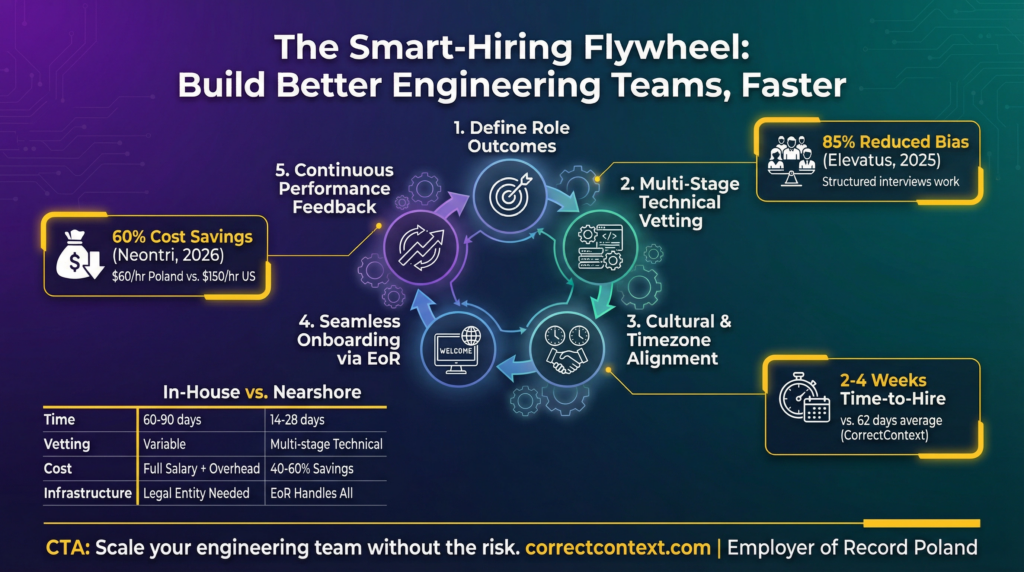
The advantages are compelling and measurable. Research by Neontri (2026) shows that Polish developers cost approximately $60 per hour versus $150 per hour in the US – a saving of up to 60% [7]. Critically, this cost advantage does not come at the expense of quality. Poland produces over 100,000 STEM graduates annually and is consistently ranked among Europe’s top tech talent hubs [8]. Specializations are deep and broad, covering Big Data analytics, Cloud (AWS, Azure, GCP), Artificial Intelligence / Machine Learning, and full-stack web development. For companies looking to hire AI engineers, build a cloud engineering team, or scale a data engineering team, Poland and the CEE region represent an unmatched combination of quality and value.
Furthermore, structured and rigorous vetting processes – the kind that a dedicated nearshore partner employs – have been shown to reduce hiring bias by up to 85% and dramatically improve the quality of hires [9]. This is the antidote to the bad-hire problem: not just faster hiring, but smarter hiring, backed by a proven process and a deep talent pipeline.
Infographic 2: The Smart-Hiring Flywheel – Build Better Engineering Teams, Faster
Sources: Neontri [7]; Elevatus [9]; Correct Context [10]
In-House vs. Nearshore: A Strategic Comparison
For engineering leaders weighing their options, the comparison between building an in-house team and partnering with a nearshore provider is stark. The table below illustrates the key differences across the dimensions that matter most to a CTO or VP of Engineering making a critical hiring decision.
Table 3: In-House Hiring vs. Nearshore via Correct Context
| Factor | In-House Hiring | Nearshore via Correct Context |
| Time to Hire | 60–90 days average | 14–28 days (pre-vetted pipeline) |
| Vetting Depth | Variable; often 2–3 interviews | Multi-stage: technical, behavioral, cultural |
| Cost | Full US/UK salary + overhead | 40–60% cost savings |
| Infrastructure | Legal entity, HR, payroll required | EoR handles all compliance & payroll |
| Talent Pool | Local market only | Poland + CEE: 100,000+ tech graduates/year |
Sources: Neontri [7]; Correct Context [10]; industry benchmarks.
Conclusion: Stop the Dominoes Before They Fall
The true impact of one bad engineering hire is a sobering reminder that people are the foundation of any successful tech company. The financial losses, productivity drains, and cultural damage can set a team back months, if not years. For engineering leaders at enterprise innovation units and fast-scaling startups, the pressure to hire quickly can be immense – but the cost of getting it wrong is far greater.
By embracing a more strategic approach to talent acquisition – including partnering with a trusted nearshore provider to scale engineering teams – you can break the cycle of bad hires. Whether you need to build a dedicated development team for a new AI initiative, scale a cloud engineering team on AWS or Azure, or rapidly onboard a data analytics team, the right partner makes all the difference. Investing in a rigorous, data-driven vetting process is not an expense; it is an investment in the long-term health and success of your team, your product, and your business.
Don’t wait for the dominoes to fall. Build a hiring process that ensures you are bringing on the right people, every time – and consider whether a nearshore engineering hub in Poland or CEE might be the strategic advantage your team has been missing.
About Correct Context
Correct Context is a full-cycle nearshore hiring and operational partner, specializing in building dedicated engineering teams in Poland and the CEE region for enterprises and startups in FinTech, Software, and Media. Services include recruitment, payroll services Poland, HR, accounting, legal compliance, and Employer of Record (EoR) in Europe – all without the client needing to build local infrastructure. Core specializations include Big Data analytics, Cloud (AWS, Azure, GCP), IT infrastructure, Web Development, and Artificial Intelligence / Machine Learning.
Contact us to get your winning core team.
References
[1] U.S. Department of Labor. “The Cost of a Bad Hire.”
[2] Society for Human Resource Management (SHRM). “The True Cost of a Bad Hire.” 2022.
[3] Robert Half International. “Survey: Managers Spend Nearly One Day a Week Managing Poor Performers.” November 8, 2012.
[4] Stripe. “The Developer Coefficient: The Business Impact of Developer Productivity.” 2018.
[5] SHRM / Robert Half. “Morale, Productivity Suffer from Bad Hires.” February 2, 2015.
[6] Gallup. “State of the Global Workplace: 2023 Report.”
[7] Neontri. “Software Nearshoring to Poland: The Honest Guide for CTOs.” February 6, 2026.
[8] Itelence. “IT Nearshoring to Poland: 30–50% Cost Savings in 2025.”
[9] Elevatus. “Structured Versus Unstructured Interviews – Which One Cuts Bias by 85%?” August 15, 2025.
[10] Correct Context. “The Hidden Cost of Slow Engineering Hiring.” January 14, 2026.