
As a startup CTO, you live under constant pressure. You’re not just building a product; you’re building a company, and the clock is always ticking. Your board wants to see velocity, your competitors are shipping features, and your roadmap is a battlefield of competing priorities. In this high-stakes environment, the single biggest bottleneck to scaling isn’t code—it’s people. The traditional, linear approach to hiring engineers one by one is a slow, expensive, and chaotic process that actively works against the speed and cohesion you need to win.
For Series A+ startups in the fast-moving FinTech, Software, and Media sectors, the decision of how to scale your engineering team is as critical as what you build. The fear of diluting quality, losing your engineering culture, and falling behind competitors is real. But what if you could hire an entire, high-performing team of five engineers in the time it normally takes to hire one? This isn’t a fantasy; it’s the strategic advantage of batch hiring, a model that replaces slow, fragmented team growth with a structured, parallel approach.
This article breaks down the crippling inefficiency of linear hiring and provides a data-backed playbook for how to hire 5 engineers at once by leveraging a dedicated development team model. We’ll explore why this strategy is a game-changer for startups looking to scale fast without sacrificing quality, and how partnering with an Employer of Record (EoR) in Poland or the CEE region can de-risk your global expansion.
The Crippling Inefficiency of Linear Hiring
Linear hiring—the familiar process of opening one role, screening, interviewing, and onboarding, then repeating for the next role—is a relic of a slower, more predictable corporate world. For a scaling startup, it’s a recipe for disaster. The numbers paint a stark picture of a broken system.
According to a 2024 report from Ashby, interview hours per hire for technical roles are a staggering 21% higher than for non-technical roles [1]. The average time-to-hire for a single software engineer is now 62 days, according to data from Correct Context [2]. If you need to hire five engineers, you’re looking at a 10-month-long, staggered hiring cycle. That’s nearly a year of fragmented team growth, constant onboarding disruptions, and five separate learning curves.
This slow pace isn’t just frustrating; it’s incredibly expensive. Research from the Society for Human Resource Management (SHRM) shows that a vacant position can cost a company around $500 per day in lost productivity [3]. For a high-impact engineering role, that figure is conservative. The total cost of a vacant position can climb to two to four times the role’s annual salary when you factor in lost revenue, missed deadlines, and the burden on the existing team.
The Chaos of Parallel Hiring
Some CTOs attempt to solve this by running multiple hiring processes in parallel. While faster than a purely linear approach, this often descends into chaos. Your internal talent team, if you even have one, is overwhelmed. Your senior engineers are pulled into an endless cycle of interviews, context-switching, and candidate evaluations, grinding their own productivity to a halt. The result is a frantic, disorganized process that burns out your best people and often leads to compromised hiring decisions.
Each new hire, onboarded individually, also resets the team’s dynamic. According to Bruce Tuckman’s widely-cited model of group development, every new member forces a team to cycle back through the “forming, storming, and norming” stages [4]. When this happens every two months, your team never reaches a state of high-performing “flow.” It’s in a constant state of low-grade disruption, which manifests as slower sprint velocity, a higher bug rate, and declining morale.
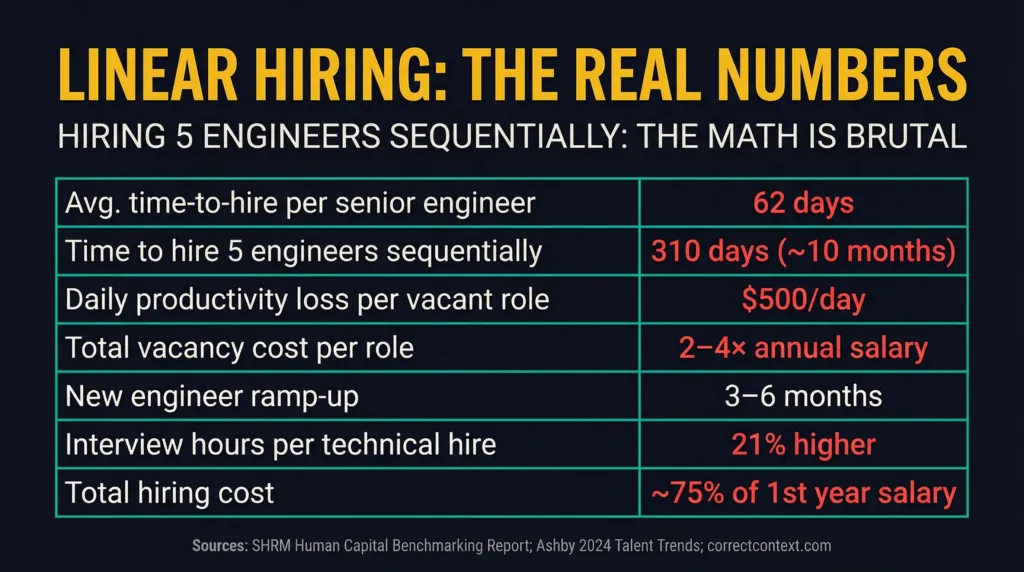
Figure 1: The Hidden Tax of Linear Hiring – Cost Breakdown
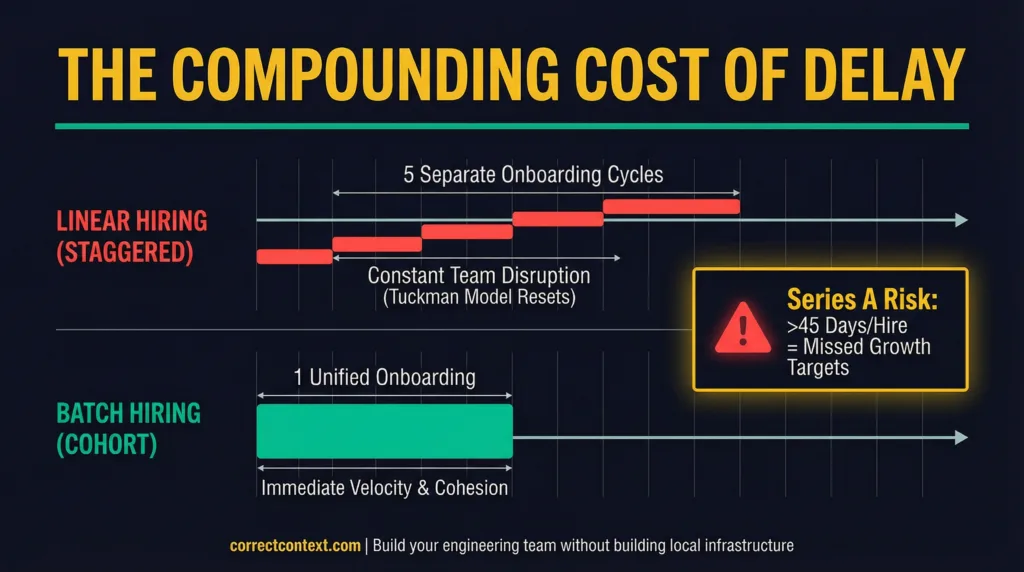
Figure 2: The Compounding Cost of Delay
The Strategic Advantage of Batch Hiring a Dedicated Team
Batch hiring flips the model on its head. Instead of hiring individuals, you hire a cohesive, pre-formed dedicated development team. This team is recruited, vetted, and onboarded as a single unit, designed to integrate seamlessly into your organization and start delivering value from day one. This approach isn’t just about speed; it’s about building a high-performance extended engineering team that is aligned from the start.
By partnering with a specialized firm, you can assemble a team of five engineers in 4 to 8 weeks, not ten months. This team is built to your exact specifications, whether you need a big data development team, an AI development team, or a cloud engineering team with deep expertise in AWS, Azure, or GCP.
The Power of Cohort Onboarding
One of the most significant advantages of batch hiring is cohort onboarding. Instead of five separate, time-consuming onboarding processes, the entire team is onboarded simultaneously. This dramatically reduces the burden on your engineering managers, with studies showing it can cut manager time spent on onboarding by up to 40% [5].
The new hires learn your codebase, your development practices, and your company culture together. This shared experience fosters a strong sense of camaraderie and mutual support, leading to faster integration and significantly higher retention rates. A team that onboards together, bonds together, and is far more likely to stay together.
The Batch Hiring Playbook: How to Hire 5 Engineers at Once
So, how do you execute a batch hire without creating chaos? It requires a structured, deliberate approach. Here is a five-step playbook designed for CTOs at scaling startups.
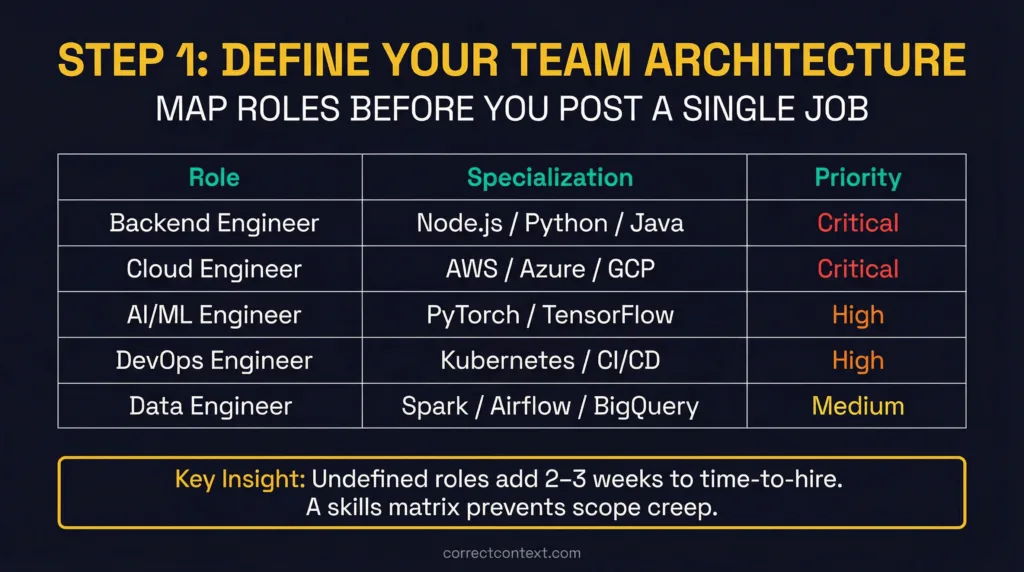
Figure 3: Step 1 – Define Your Team Architecture
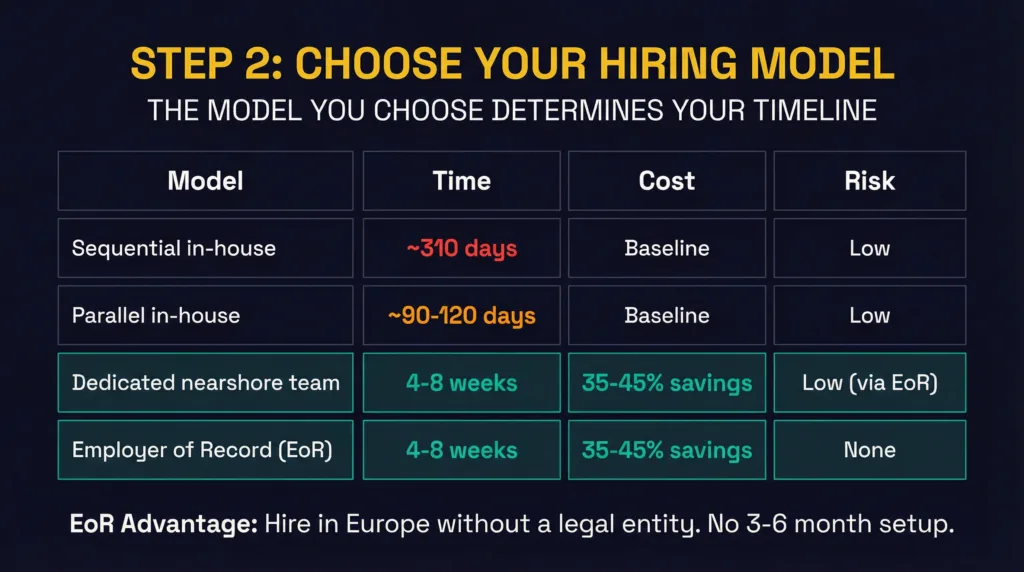
Figure 4: Step 2 – Choose Your Hiring Model
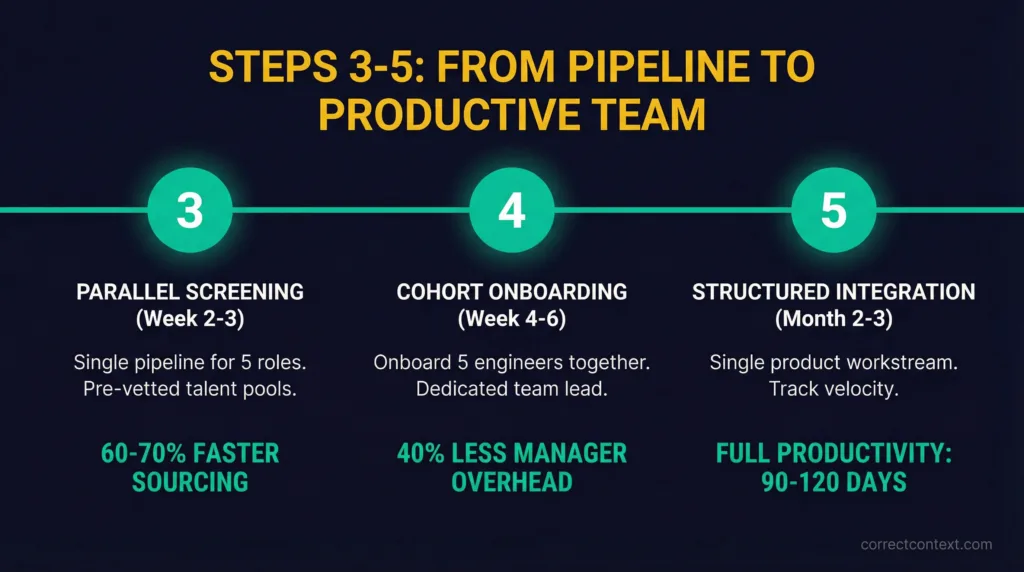
Figure 5: Steps 3-5 – Execute, Onboard, Integrate
Step 1: Define Your Team Architecture (Week 1)
Before you even think about writing a job description, map out the entire team structure. Don’t think in terms of individual roles; think in terms of the capabilities you need to achieve your product goals. Do you need a backend development team, a platform engineering team, or a specialized data analytics team? Create a skills matrix that clearly defines the required and desired competencies for the entire unit. This upfront architectural work prevents the “role drift” that can derail a hiring process and add weeks to your timeline.
Step 2: Choose Your Hiring Model (Week 1-2)
This is the most critical decision. You can attempt to run a parallel in-house process, but this is where most startups falter due to a lack of internal resources. The far more efficient path is to partner with a firm that specializes in building nearshore development teams.
This is where locations like Poland and the CEE region become a strategic superpower. The region boasts a massive talent pool of over 3.5 million ICT professionals, with Poland alone home to more than 550,000 tech specialists [6] [7]. You gain access to world-class engineers at a cost savings of 35-45% compared to the US or Western Europe [8].
Crucially, this model allows you to leverage an Employer of Record (EoR). An EoR in Poland allows you to hire employees without establishing a legal entity, saving you the 3-6 months and significant legal costs of setting up a foreign subsidiary. The EoR handles all payroll, HR, compliance, and legal complexities, allowing you to focus on building your product.
Step 3: Run Parallel Screening (Week 2-3)
Your hiring partner runs a single, unified recruitment pipeline for all five roles simultaneously. Because they are working with a pre-vetted talent pool, they can cut sourcing time by 60-70%. Structured interview panels, designed in collaboration with your team, ensure consistency and reduce bias, saving up to 30% of your engineers’ valuable interview time.
Step 4: Cohort Onboarding (Week 4-6)
Once the team is selected, they are onboarded as a single cohort. Your hiring partner, in conjunction with your internal team, develops a structured onboarding program that covers everything from your tech stack and coding standards to your company culture and communication protocols. A dedicated team lead is assigned from day one to act as a single point of contact and ensure a smooth integration.
Step 5: Structured Integration (Month 2-3)
To maximize cohesion and initial impact, assign the new team to a single, well-defined product workstream for their first 90 days. This allows them to build rapport, establish a workflow, and score an early win. Key metrics to track include time-to-first-commit, PR merge rate, and sprint velocity. With this structured approach, you can expect the team to reach full productivity in 90-120 days, compared to the 6+ months it often takes for staggered, individual hires.
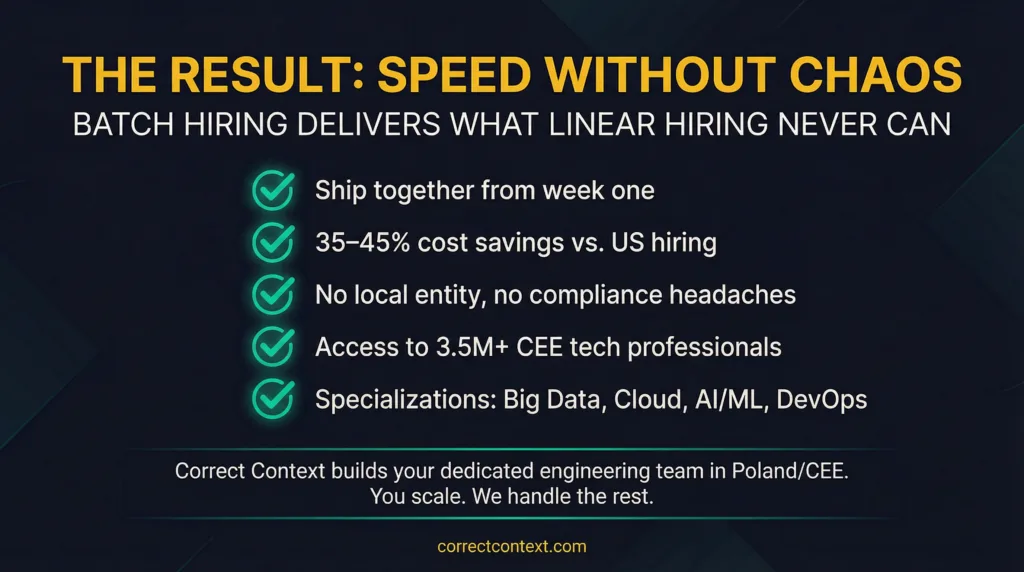
Figure 6: The Resuts of Batch Hiring
The Unfair Advantage: Speed, Quality, and Cost-Efficiency
In the hyper-competitive landscape of startups, speed is a weapon. But speed without quality and control is just recklessness. The traditional, linear hiring model forces CTOs to choose between moving fast and maintaining high standards. Batch hiring a dedicated software team through a nearshore partner offers a third way: a strategic approach that delivers speed, quality, and cost-efficiency.
By leveraging the deep talent pool of Poland and the CEE region, and the operational agility of an Employer of Record model, you can build the remote development team you need to execute your roadmap and outpace your competition. You get a high-performing, cohesive team that is productive in a fraction of the time, at a fraction of the cost, and without the administrative and legal headaches of global expansion.
Stop drowning in resumes and burning out your team with a broken hiring process. It’s time to stop hiring one by one and start building your engineering hub in Europe the smart way.
References
[1] Ashby. (2024). 2024 Recruiter Productivity Trends Report.
[2] Correct Context. (2026). The Hidden Cost of Slow Engineering Hiring.
[3] Society for Human Resource Management. (2022). Human Capital Benchmarking Report.
[4] Tuckman, B. W. (1965). Developmental sequence in small groups. Psychological Bulletin, 63(6), 384–399.
[5] Forbes. (2014). Multiple New Hires? Consider Batch Onboarding Now.
[6] SmartChoice International. (2025). Eastern European IT Talent Recruitment and Why It’s Leading the Way.
[7] NATEK. (2024). CEE IT Outsourcing and BPO Report 2024.
[8] Neontri. (2026). Software Nearshoring to Poland: The Honest Guide for CTOs.