
As enterprise innovation units and globally scaling startups push to deploy AI, scale cloud infrastructure, and build resilient platforms, the engineering talent gap has become a critical bottleneck. By 2025, the global IT talent shortage is expected to leave millions of roles unfilled, costing businesses trillions in unrealized revenue [1]. When internal hiring fails to keep pace, engineering leaders face a crucial decision: how to scale capacity without losing control or continuity.
For CTOs and VP Engineering leaders at Fortune 5000 companies and Series A+ startups, the debate often comes down to two models: staff augmentation vs dedicated teams. While both models leverage nearshore or offshore talent—such as a nearshore development team in Europe—they solve fundamentally different problems. Short-term staffing fixes don’t scale into stable teams, and choosing the wrong model can lead to fragmented codebases, management burnout, and lost IP.
This article breaks down the differences, costs, and risks of both models, helping you decide whether you need temporary capacity or long-term team ownership, particularly when building an engineering team Poland / CEE.
The Core Problem: Scaling Engineering Without Losing Control
The primary fear when scaling engineering externally is the loss of control and continuity. When you hire developers through an agency, who manages them? What happens to the knowledge when they leave?
According to Gartner’s 2026 talent acquisition trends research, organizations are increasingly prioritizing cost efficiency in their engineering talent strategies, with flexible models like augmentation outperforming fixed team structures for companies with mature internal leadership [2]. However, as the scope of work grows, the management overhead of augmentation can cripple internal tech leads.
Understanding the structural differences between staff augmentation vs dedicated teams is the first step to mitigating these risks.
What is Staff Augmentation?
Staff augmentation is a model where external engineers are embedded directly into your existing team. You own the management relationship—the augmented engineers report to your tech lead or engineering manager, attend your sprint ceremonies, and work inside your tools and workflows. The vendor handles payroll, HR, and compliance.
The Management Reality of Staff Augmentation
With staff augmentation, your internal managers are fully responsible for the day-to-day output. This means your tech leads must have the bandwidth to conduct standups, code reviews, and performance evaluations for the augmented staff.
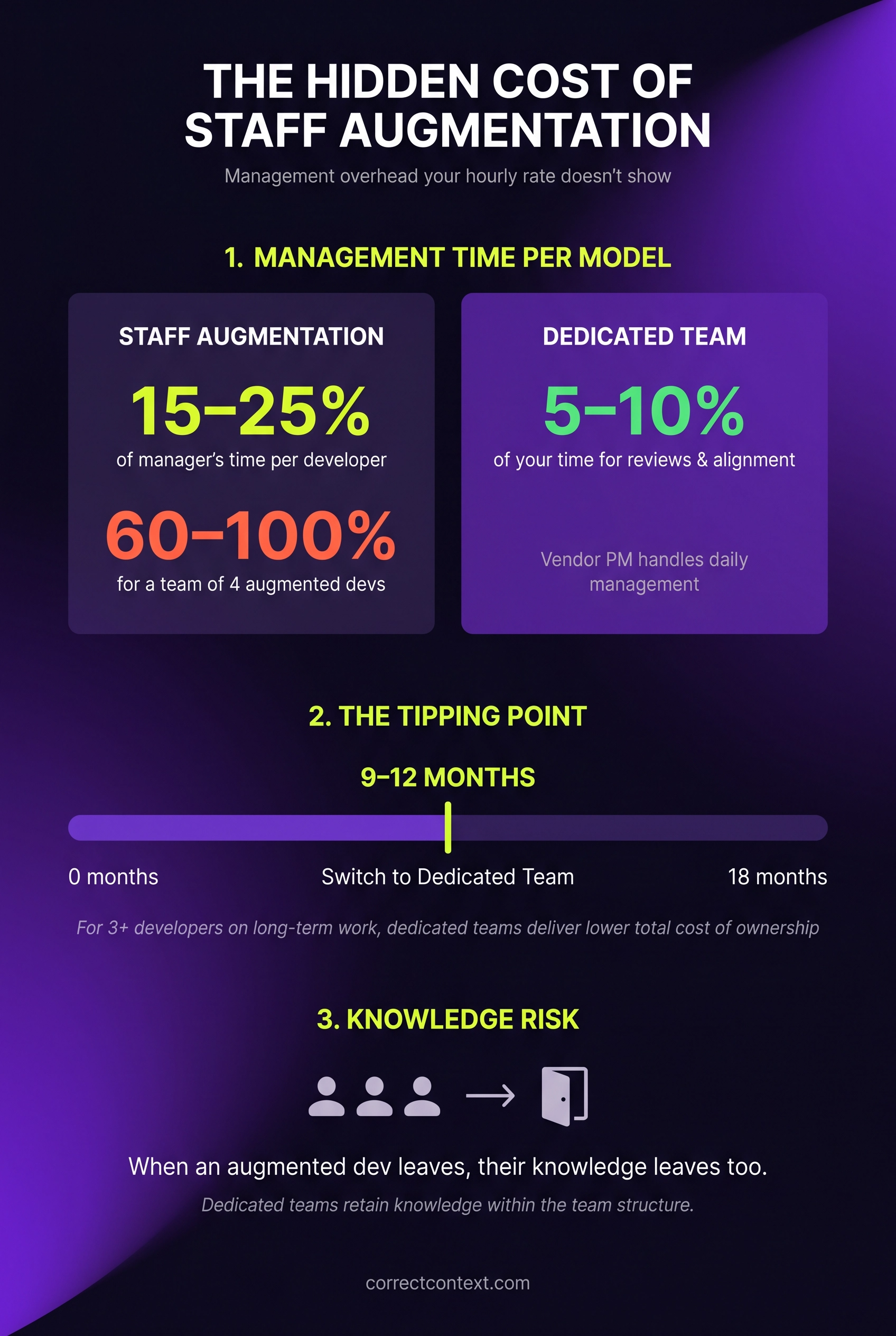
- Management Overhead: Expect 15-25% of a manager’s time to be consumed per augmented developer [3]. For a team of four augmented engineers, this can equal 60-100% of a manager’s capacity.
- Best For: Short-term needs (3-6 months), filling specific skill gaps (e.g., needing an AWS / Azure / GCP engineers team member for a migration), and scenarios where you have strong internal engineering leadership with available bandwidth.
- The Risk: Staff augmentation risks center around knowledge concentration and continuity. If an augmented engineer becomes the sole expert on a critical component and then leaves, the knowledge walks out the door with them [4].
What is a Dedicated Development Team?
A dedicated development team is a fully staffed unit—typically including developers, a tech lead, a project manager, and QA engineers—that operates as a self-contained group. The vendor provides the entire team structure, while you define the product vision, roadmap, and priorities.
The Strategic Value of Dedicated Teams
Unlike augmentation, where you manage individuals, with a dedicated software team, you manage outcomes. The vendor’s internal project manager handles daily task assignment, unblocking issues, and team cohesion.
- Management Overhead: Significantly lower. You can expect to spend only 5-10% of your time on progress reviews and priority alignment [3].
- Best For: Long-term product development (12+ months), building net-new capabilities (like an AI development team), and situations where your internal management is at capacity or non-existent.
- The Advantage: Team stability and knowledge preservation. Because the team operates as a cohesive unit, if one individual leaves, the knowledge is retained within the team structure provided by the vendor.
Comparing the Models: A Data-Driven Look
To make an informed decision, let’s compare the total cost of ownership and structural differences.
Cost and Overhead Comparison
While the hourly rate for an augmented developer might appear lower, the total cost of ownership tells a different story when management overhead is factored in.
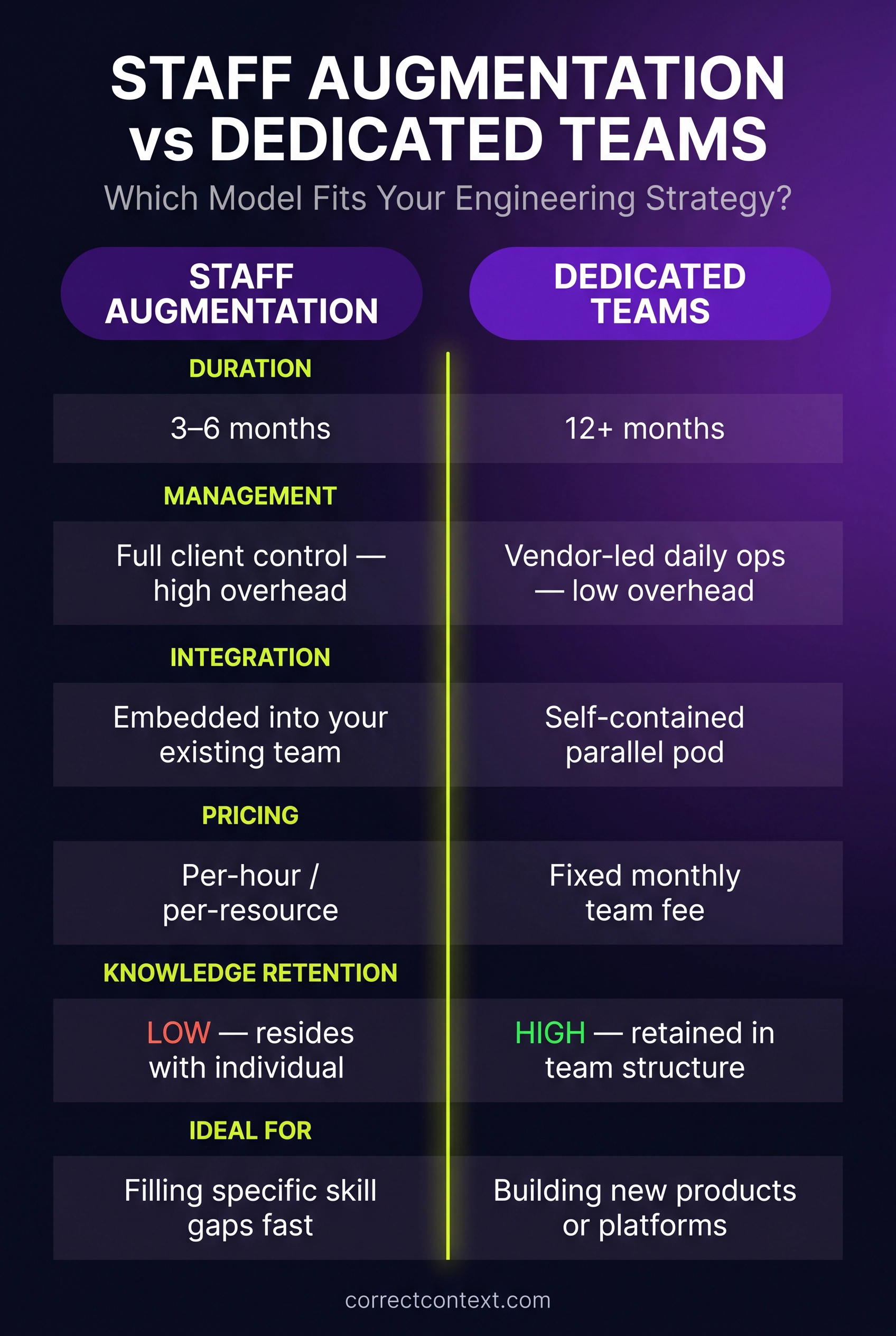
| Feature | Staff Augmentation | Dedicated Teams |
|---|---|---|
| Duration | Short- to mid-term (3-6 months) | Long-term (12+ months) |
| Management | Full control by client (High overhead) | Shared control, vendor manages daily tasks (Low overhead) |
| Integration | Deep integration into existing client team | Operates as a parallel, self-contained pod |
| Pricing Model | Pay per hour/month per resource | Fixed monthly fee for the entire team |
| Knowledge Retention | Low (resides with individual) | High (resides within the team structure) |
| Ideal Scenario | Filling a specific skill gap quickly | Building a new product or scaling a platform |
Data synthesized from industry comparisons on scaling engineering models [2] [3] [5].
The Tipping Point for Scaling
For US tech companies, especially in FinTech, Software, and Media, the tipping point between the two models usually occurs around the 9-12 month mark, or when the requirement exceeds three developers [3].
If you are a Series A+ startup looking to scale software development rapidly, a startup development team built on the dedicated model provides the necessary velocity without requiring you to hire layers of middle management first.
Why CEE and Poland are the Premier Hubs for Dedicated Teams
When deciding to build an extended engineering team, location is just as critical as the engagement model. For companies in the US East Coast, UK, DACH, and Nordics, building a tech hub Poland or a broader engineering team Poland / CEE offers unparalleled advantages.
The CEE Advantage
- Elite Technical Talent: Poland and the broader CEE region are recognized globally for top-tier engineering talent, particularly in complex domains like big data development, cloud engineering, and machine learning engineers.
- Cultural and Time Zone Alignment: The region shares strong cultural affinity and work ethics with Western markets. For East Coast US and European clients, the time zone overlap allows for seamless daily collaboration.
- Cost Efficiency: Engaging software developers Poland provides access to senior talent at highly competitive rates compared to onshore equivalents, without sacrificing quality.
Overcoming the Infrastructure Hurdle with Employer of Record (EoR)
Historically, setting up a remote development team in Europe required establishing a local legal entity, navigating complex employment laws, and managing local HR and payroll. Today, utilizing an Employer of Record Poland or EoR CEE eliminates this friction.
An EoR allows you to hire in Europe without a company. The EoR partner handles:
- Employment compliance Europe
- Payroll services Poland
- HR, accounting, law, and office management
This means you can focus entirely on product development while the EoR ensures your nearshore developers Europe are fully compliant and supported, effectively giving you a dedicated team without the infrastructural headache.
Making the Decision: Which Model Wins?
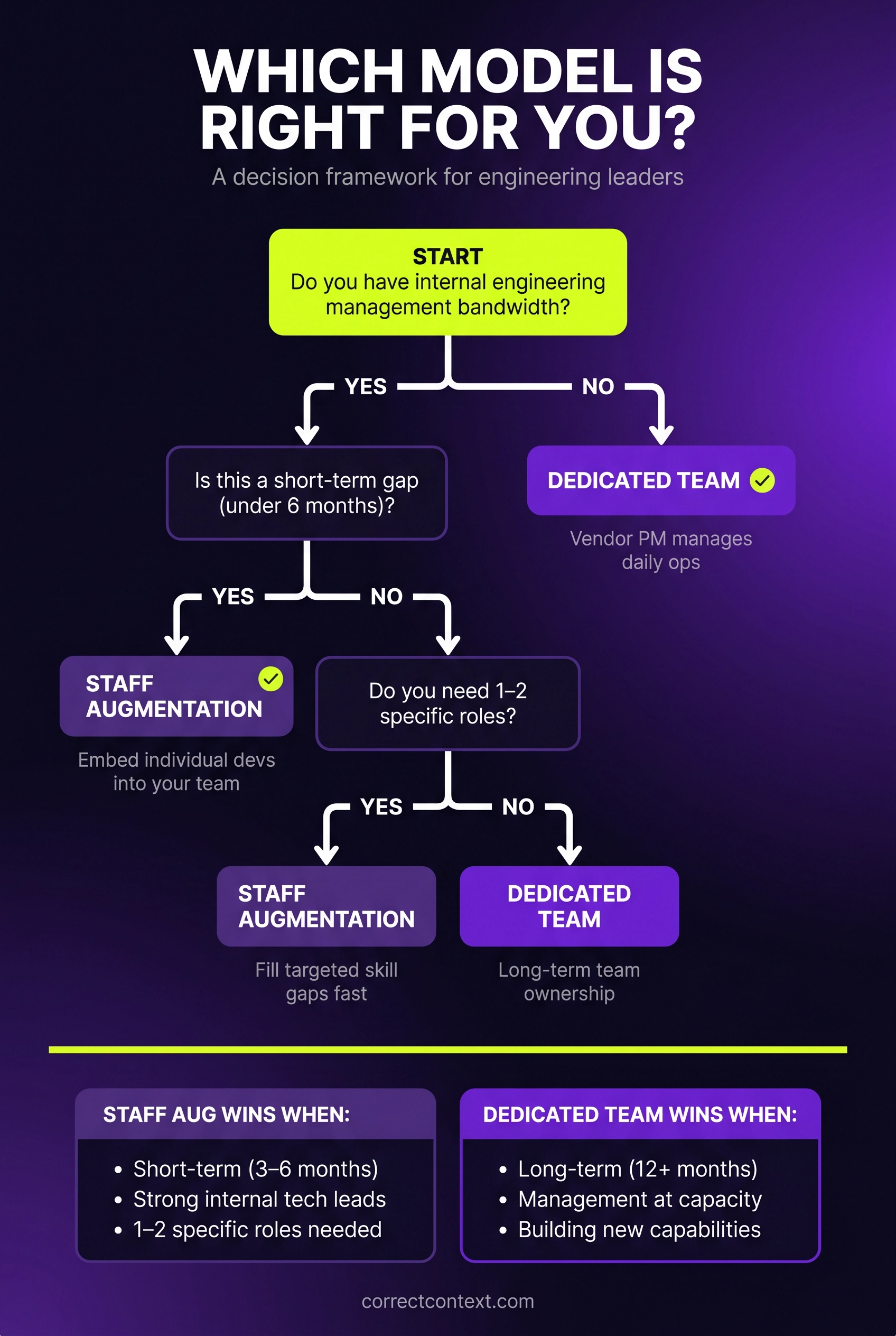
Choosing between staff augmentation vs dedicated teams comes down to your internal capacity and long-term goals.
Choose Staff Augmentation if:
- You have strong internal tech leads with the bandwidth to manage more direct reports.
- You need to temporarily fill a specific gap (e.g., needing an affordable senior developer for a 4-month sprint).
- You require deep, daily integration with your existing codebase and culture.
Choose Dedicated Teams if:
- You are building a new product or feature set from scratch.
- Your internal management is fully allocated and cannot take on more direct reports.
- You need a stable, long-term offshore development team where knowledge is preserved within the team structure.
- You want to leverage an EoR Europe to build a comprehensive engineering hub without legal overhead.
Conclusion
Short-term staffing fixes don’t scale into stable teams. While staff augmentation offers quick tactical relief, dedicated development teams provide the strategic foundation needed for long-term growth. For enterprise innovation units and globally scaling startups, partnering with a provider that can establish a dedicated backend development team or platform engineering team in Poland/CEE—handling all recruitment, EoR, and operational logistics—is the most effective way to scale engineering capacity while maintaining control and continuity.
References
[1] Kyanon Digital. “Top 7 IT Staff Augmentation Trends to Watch.” LinkedIn, June 19, 2025.
[2] ParallelStaff. “Staff Augmentation vs Dedicated Teams: Which Model Wins?” May 28, 2026. [3] Stratagem Systems. “Staff Augmentation vs Dedicated Development Team.” 2026.
[4] NGenious Solutions. “Staff Augmentation: What It Is, How It Works & When to Use.” Dec 22, 2025.
[5] Impala Intech. “Staff Augmentation Vs. Dedicated Teams: The Best Choice For MVP Development.” 2025.
Table of content
Related articles



About the Author: Marta