
Post-hire failure analysis is a critical yet chronically overlooked discipline in talent management. For enterprise HR and engineering leaders, the assumption that a standard probation period is sufficient to mitigate hiring risk is proving dangerously wrong. The tech industry, in particular, is hemorrhaging value through a silent epidemic of post-hire failures — engineers who sail through the interview process, pass probation, and then underperform, disengage, or leave within the first 12 to 18 months. This article breaks down why it happens, what it costs, and what the most forward-thinking enterprises and Series A+ startups are doing about it.
The Alarming Rate of Post-Hire Failure
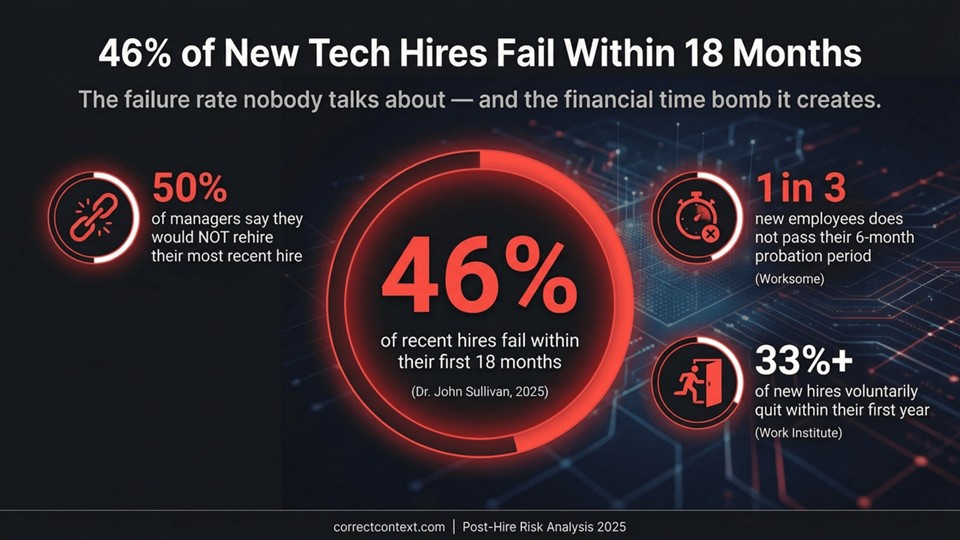
The numbers are stark. Research from talent management expert Dr. John Sullivan reveals that a staggering 46% of all new hires fail within their first 18 months on the job [1]. Even more alarming: 50% of managers say they would not rehire their most recent hire if given the choice. These are not edge-case statistics. They represent a systemic breakdown in how organizations assess, select, and integrate talent — and the three-month probation period is catching only a fraction of the problem.
According to research by Worksome, 1 in 3 new employees does not pass their six-month probation period [3]. Meanwhile, the Work Institute reports that over 33% of new hires voluntarily quit within their first year [2]. For companies hiring dedicated software teams, remote software engineers, or scaling engineering teams rapidly, these failure rates translate directly into delayed product roadmaps, cost overruns, and team morale damage that is difficult to quantify but impossible to ignore.
Table 1: Key Post-Hire Failure Statistics
| Metric | Statistic | Source |
| New Hire Failure Rate (within 18 months) | 46% | Dr. John Sullivan (2025) |
| Managers Who Would Not Rehire | 50% | Dr. John Sullivan (2025) |
| New Hires Quitting in First Year | Over 33% | Work Institute |
| Employees Not Passing 6-Month Probation | 1 in 3 | Worksome |
| Firms With Formal Post-Hire Failure Analysis | Fewer than 15% | Dr. John Sullivan (2025) |
The True Cost of a Bad Hire in Tech
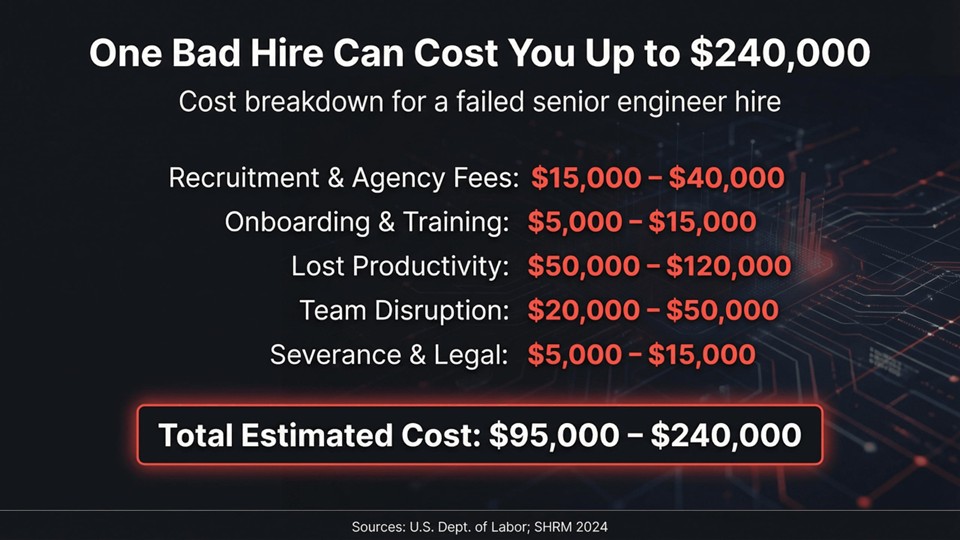
The financial impact of a failed hire extends far beyond the initial recruitment fees. According to the U.S. Department of Labor, the cost of a bad hire can reach up to 30% of the employee’s first-year salary [4]. For a senior engineer in the US or UK, that figure alone can exceed $40,000. But SHRM and CareerBuilder data from 2024 puts the total cost of a bad hire — when you factor in lost productivity, team disruption, and severance — at up to $240,000 per mistake [5]. CoderPad estimates the figure at three times annual salary, or roughly $300,000 per engineer [6].
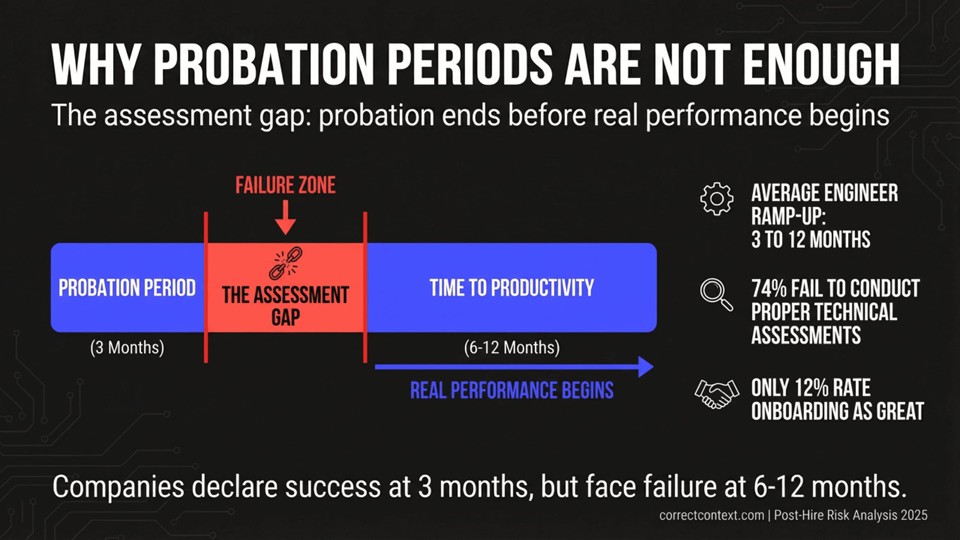
The productivity gap is a major driver of this cost. A new software engineer typically takes between 3 and 12 months to reach full productivity [7]. When a hire fails at month 9, the company has already absorbed the full cost of recruitment, onboarding, and months of below-capacity output — and then must restart the entire process. For enterprise innovation units and data engineering teams operating under tight delivery timelines, this is not just a financial problem. It is a strategic one.
Table 2: Estimated Cost Breakdown of a Failed Senior Engineer Hire
| Cost Category | Estimated Range |
| Recruitment & Agency Fees | $15,000 – $40,000 |
| Onboarding & Training | $5,000 – $15,000 |
| Lost Productivity (3–12 months ramp-up) | $50,000 – $120,000 |
| Team Disruption & Morale Impact | $20,000 – $50,000 |
| Severance & Legal Costs | $5,000 – $15,000 |
| Total Estimated Cost | $95,000 – $240,000 |
Sources: U.S. Department of Labor; SHRM/CareerBuilder 2024; CoderPad 2024
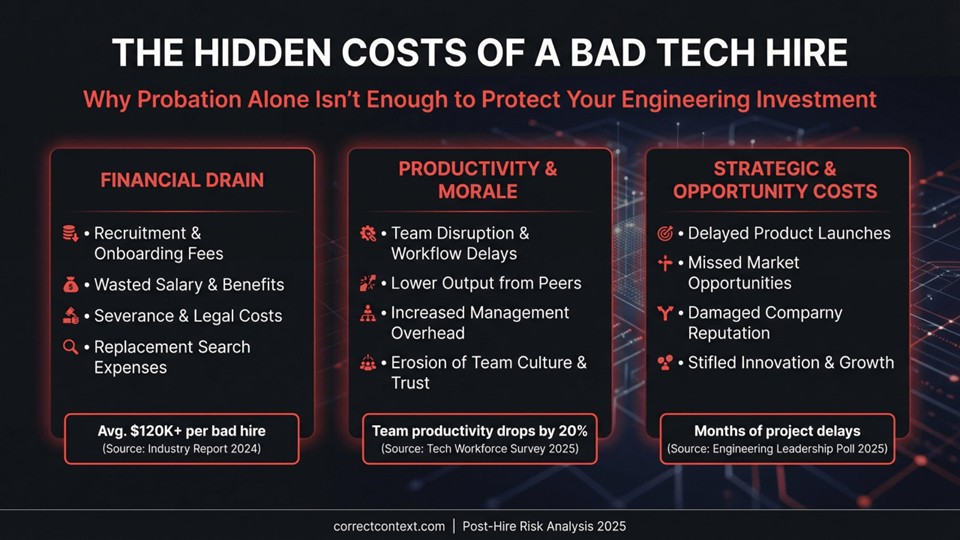
Infographic 1: The Hidden Costs of a Bad Tech Hire
-
- New hire failure rate statistics in tech (Source: Dr. John Sullivan, Worksome, Work Institute)
-
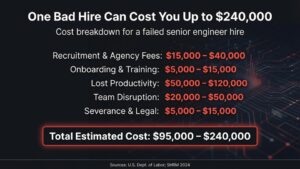
- Cost breakdown of a failed senior engineer hire (Source: U.S. Dept. of Labor, SHRM, CoderPad)
-
- The assessment gap — probation ends before real performance begins
Why Do Tech Hires Fail During Probation?
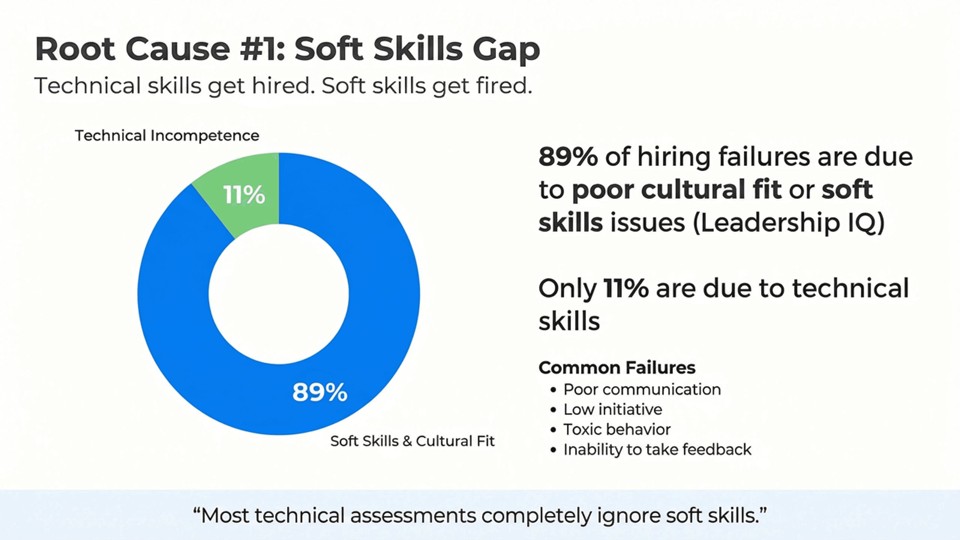
Understanding the root causes of probation failures is the first step toward preventing them. Contrary to popular assumption, technical incompetence is rarely the primary driver. Research from Leadership IQ found that 89% of hiring failures are attributable to poor cultural fit or soft skills deficiencies — not technical shortcomings. Only 11% of new hire failures are primarily caused by a lack of technical ability. The real culprits are more structural.
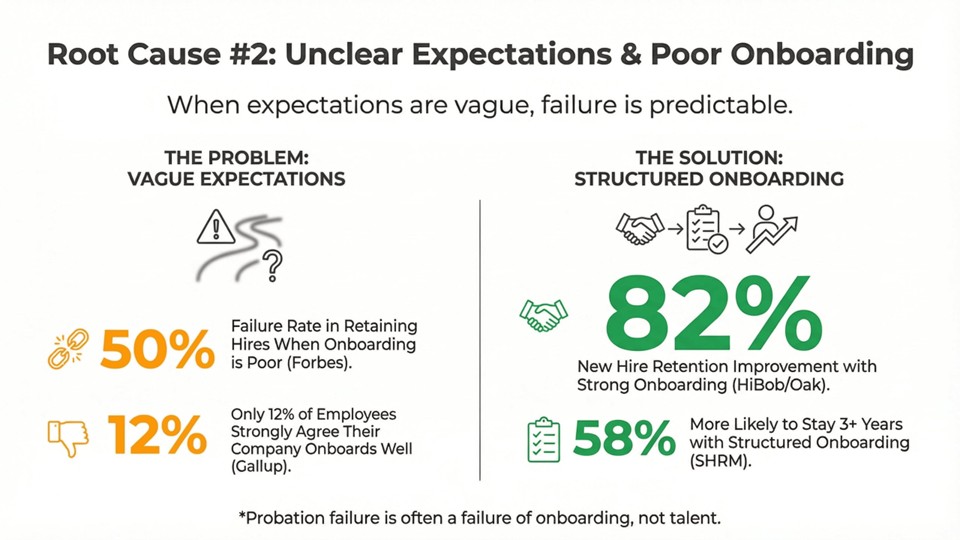
Poor onboarding is a critical and underappreciated factor. According to HiBob and Oak research, organizations with a strong onboarding process improve new hire retention by 82% and productivity by over 70%. SHRM data shows that employees who go through a structured onboarding program are 58% more likely to remain with the organization after three years. Yet Gallup finds that only 12% of employees strongly agree their company does a great job of onboarding new hires. The implication is sobering: most probation failures are not talent failures. They are process failures.
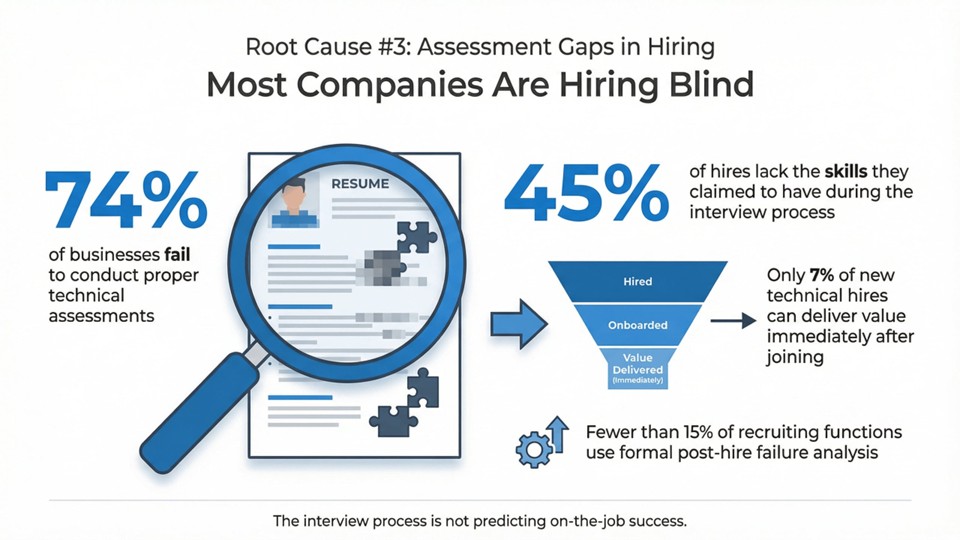
Assessment gaps in the hiring process compound the problem. According to lemon.io’s 2026 survey, 74% of businesses fail to conduct proper technical assessments, and only 7% of new technical hires can deliver value immediately after joining. A further 45% of hires lack the skills they claimed to have during the interview process. For companies hiring AI engineers, machine learning engineers, or data engineering teams, where specialized expertise is non-negotiable, these gaps are particularly costly. Hiring an AI development team or a cloud engineering team — whether on AWS, Azure, or GCP — requires a level of technical vetting that generic interview processes simply cannot provide.
Infographic 2: Top Reasons for Probation Failure in Tech
-
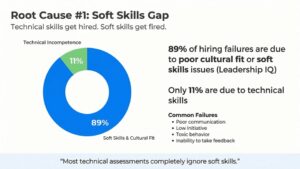
- 89% of hiring failures are due to soft skills and cultural fit issues (Source: Leadership IQ)
-
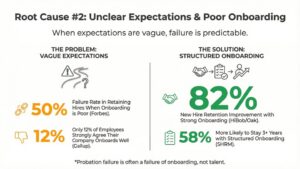
- Strong onboarding improves new hire retention by 82% (Source: HiBob/Oak, SHRM, Gallup)
-
- 74% of businesses fail to conduct proper technical assessments (Source: lemon.io 2026)
Beyond Probation: A More Effective Approach to Hiring
Given the high failure rates and the structural limitations of traditional probation periods, it is clear that a fundamentally different approach is needed. For companies looking to scale their engineering teams with senior talent while managing post-hire risk, building a dedicated development team in a nearshore location like Poland offers a compelling and increasingly well-validated alternative.
The Poland Advantage: Europe’s Largest Tech Talent Pool
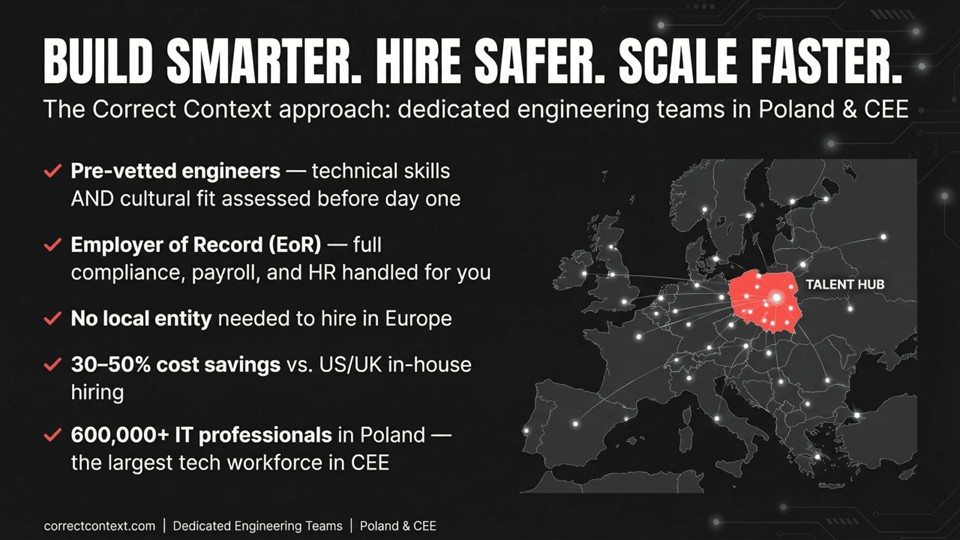
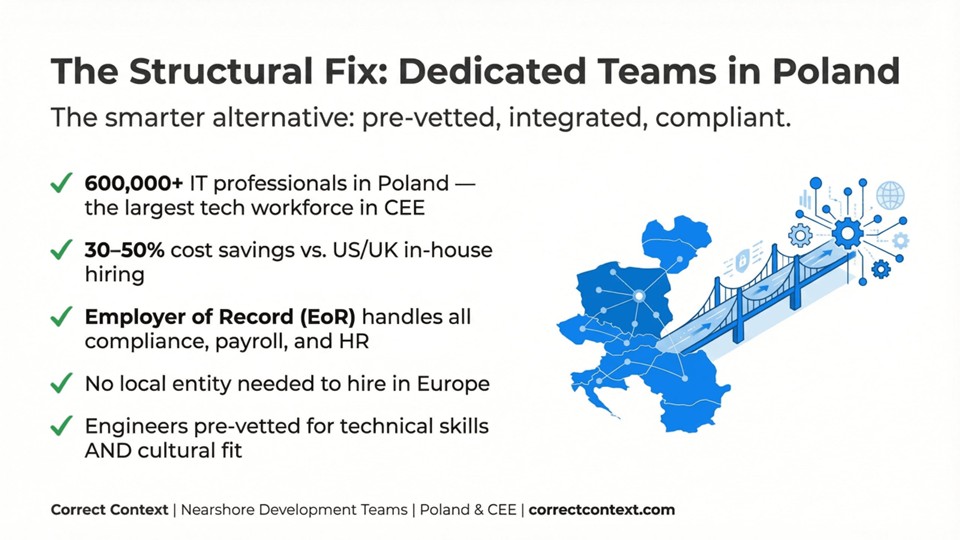
Poland has established itself as the premier destination for nearshore developers in Europe. With over 600,000 IT professionals — the largest tech workforce in Central and Eastern Europe (CEE) — Poland offers a depth of talent that rivals much larger markets [8]. The country’s strong STEM education system, combined with a mature and rapidly growing tech ecosystem, has produced a dense concentration of engineers specializing in Big Data analytics, Cloud platforms (AWS, Azure, GCP), AI/ML, web development, and DevOps. For companies looking to hire developers in Poland or build an engineering hub in Europe, the talent infrastructure is already in place.
Table 3: Poland & CEE Tech Talent Market Overview
| Metric | Statistic | Source |
| IT Professionals in Poland | 600,000+ | DevsData (2025) |
| Software Developers in Poland | 400,000+ | Intellias (2025) |
| CEE Tech Talent Pool | 2,000,000+ | PwC CEE |
| Cost Savings vs. US/UK In-House Hiring | 30–50% | nCube (2026) |
| Poland IT Market Value (2025) | PLN 74 billion+ | j-labs (2025) |
Mitigating Hiring Risk with an Employer of Record (EoR)
For companies looking to hire in Europe without establishing a local legal entity, an Employer of Record (EoR) provides the most efficient and compliant path forward. An EoR in Poland or across the CEE region acts as the legal employer on record, handling all aspects of employment compliance in Europe — including payroll services, tax obligations, benefits administration, and adherence to local labor law. This allows companies to tap into Poland‘s talent pool in weeks rather than months, without the administrative burden or legal exposure of setting up a foreign subsidiary.
The EoR model is particularly valuable for Series A+ startups in FinTech, Software, and Media that need to scale engineering teams rapidly across the UK, DACH, Nordics, and East Coast US markets. Rather than absorbing the full risk of direct hiring — with all the associated probation failure exposure — companies can engage a dedicated software team or extended engineering team through a structured, compliance-first model that dramatically reduces post-hire risk.
The Dedicated Team Model: Structural Risk Reduction
A dedicated development team is not a staffing agency arrangement. It is a long-term, deeply integrated collaboration with a team of engineers who are fully embedded in your company’s projects, processes, and culture. Unlike traditional outsourcing, the dedicated team model provides stability, scalability, and a level of institutional knowledge that is impossible to achieve with high-turnover in-house hiring.
By building a remote development team or offshore development team in Poland, enterprise innovation units and data units can achieve 30 to 50% cost savings compared to equivalent US or UK in-house hiring [11], while accessing a pool of senior developers who have been pre-vetted for both technical skills and cultural alignment. For companies building AI development teams, machine learning engineers teams, big data development teams, or platform engineering teams, this model offers a structural answer to the probation failure problem: engineers who are assessed more rigorously before they start, supported more systematically once they do, and retained more effectively over the long term.
Conclusion: Probation Is a Symptom, Not a Solution
The high rate of probation failures in the tech industry is a symptom of a deeper structural problem: hiring processes that prioritize speed and surface-level assessment over depth, cultural alignment, and long-term fit. For enterprise HR and engineering leaders, continuing to rely on a three-month probation period as the primary risk management tool is an increasingly expensive gamble. The data is unambiguous: nearly half of all new hires fail, and the cost of each failure can reach a quarter of a million dollars.
The most effective response is not to extend probation periods or add more interview rounds. It is to change the structural model of how engineering talent is sourced, assessed, and integrated. Building a dedicated development team or extended engineering team in Poland — supported by a full-service Employer of Record (EoR) in Europe — provides the compliance certainty, talent depth, and cost efficiency that enterprise innovation units and scaling startups need to compete in 2025 and beyond. It is not just a hiring strategy. It is a risk management strategy.
Correct Context builds dedicated engineering teams in Poland and CEE — with full HR, payroll, legal, and Employer of Record (EoR) support. No local entity. No compliance risk. Just great engineers. Grow your Core Tech Teams with us!
References
[1] Sullivan, J. (2025, December 14). Hiring Is Broken – Fix It By Learning From Your Hiring Failures. Dr. John Sullivan.
[2] Work Institute. Reduce New Hire Turnover & First Year Turnover Rates.
[3] ITExpert. (2024, February 28). Top Problems in the Probationary Period in the IT field.
[4] U.S. Department of Labor. As cited in: INOP. (2026, February 18). The True Cost of a Bad Hire in 2026.
[5] SHRM/CareerBuilder. (2024). As cited in: VIVA IT. (2025, December 22). The Cost of a Bad Tech Hire.
[6] CoderPad. (2024, December 9). The Problem With Today’s Tech Hiring Processes.
[7] Jenneke, K. (2019, June 13). When will my new Developer be productive? LinkedIn.
[8] DevsData. (2025, January 16). Software Development in Poland: Market Overview for 2025.
[9] Intellias. (2025, March 12). Software Development in Poland: Everything You Need to Know.
[10] PwC. (n.d.). How CEE can become a hub for Tech Talent.
[11] nCube. (2026, January 14). Nearshore Software Development Rates: Costs by Country.
[12] HiBob. (n.d.). The state of employee onboarding research.
[13] SHRM. (2017, August 10). Don’t Underestimate the Importance of Good Onboarding.
[14] Gallup. (2018, April 11). Why the Onboarding Experience Is Key for Retention.
[15] lemon.io. (2026, February 12). Software Engineer Shortage & AI Coding Survey.
[16] j-labs. (2025, October 8). The future of the IT industry in Poland.