
For founders and COOs, the dashboard glowing with the company’s remaining runway is a source of constant anxiety. Every dollar spent, especially on the typically largest budget item-engineering salaries-is scrutinized. The fear of overspending is real, but it often leads to a critical misunderstanding: confusing high spend with high output. You see the engineering burn rate climbing, but the product roadmap seems to be moving at a snail’s pace. This disconnect between expenditure and tangible results is a silent killer for many startups and a major headache for established enterprises.
This isn’t just about tightening the belt; it’s about spending smarter. It’s about understanding how to optimize your investment for real delivery, not just for a larger headcount. For leaders at Series A+ startups and enterprise innovation units in the US, UK, and Europe, the pressure to demonstrate efficient growth is immense. The answer isn’t just to cut costs, but to fundamentally rethink how you build and scale your engineering teams.
The Great Misunderstanding: Burn Rate vs. Tangible Output
Engineering burn rate is the total cost of your engineering department, including salaries, benefits, tools, and overhead. For years, especially in a bull market, a rapidly growing burn rate was often seen as a positive signal-a sign of a company aggressively pursuing growth and innovation. A large and growing engineering team became a vanity metric, a symbol of a well-funded, ambitious company. However, as market dynamics have shifted, investors and boards are now looking past the headcount and asking a tougher question: what are we actually getting for our money?
The hard truth is that a high burn rate does not guarantee proportional output. A 2024 analysis highlighted a growing concern among venture capitalists about “billions in inefficient engineering teams,” where bloated departments were failing to deliver on their promise. [1] This inefficiency stems from several factors, including communication overhead in large teams, lack of clear goals, and time wasted on non-productive tasks.
The High Cost of Inefficiency: What the Data Says
The numbers paint a stark picture of lost productivity. A 2024 report on the state of developer productivity found that 58% of companies report more than 5 hours per developer per week are lost to unproductive work [2]. For a team of 20 engineers, that’s 100 hours a week-the equivalent of two and a half full-time engineers-spent on work that could be automated, optimized, or eliminated. The top culprits for this productivity leak? Time spent gathering project context and waiting on approvals.
This wasted time translates directly into wasted money and a slower time to market. The pressure to curb this inefficiency is mounting.
“We are keeping headcount flat in 2024, so a big focus for me this year is striking a balance between individual development goals and organization needs with a major focus on efficiency.”
– Engineering Leader, Fintech, Late Stage ($300M+ ARR) – ICONIQ Capital, The State of Engineering [3]
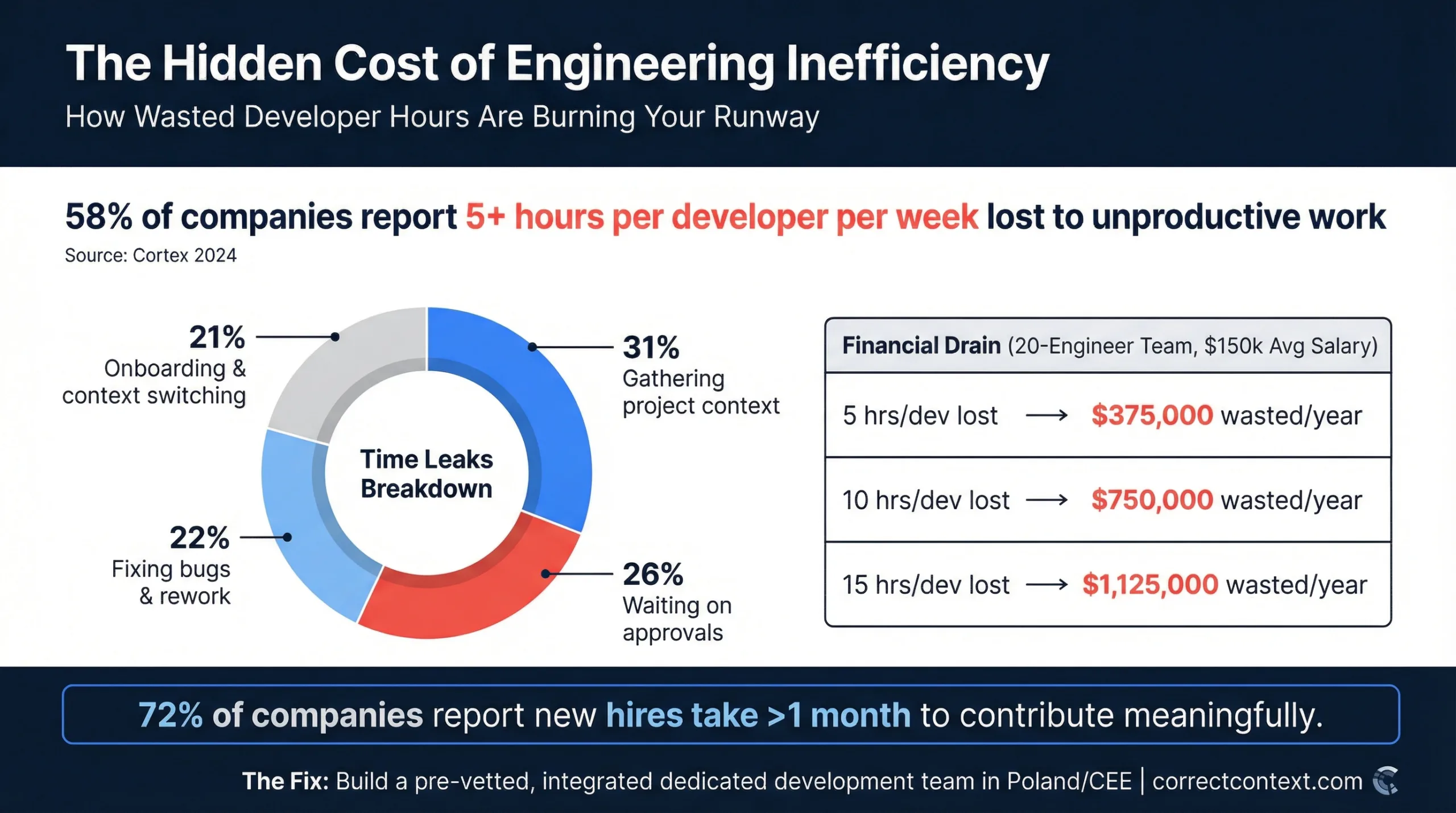
Infographic 1: The Hidden Cost of Engineering Inefficiency. Source: Cortex, 2024 State of Developer Productivity [2].
| Productivity Drain | Weekly Hours Lost / Developer | Annual Cost (20-Eng. Team, $150k avg.) |
| Gathering Context & Blockers | 5–15 hours | $375,000 – $1,125,000 |
| Inefficient Onboarding | >1 month to productivity | Significant, unquantified loss |
| Fixing Bugs & Rework | Significant portion of time | Delays and opportunity cost |
Table 1: The Financial Impact of Engineering Inefficiency. Data compiled from [2, 3].
Beyond Headcount: A Smarter Way to Scale Your Engineering Team
The old model of scaling-simply adding more engineers to the in-house team-is broken. The solution isn’t to stop growing, but to grow smarter. This is where the concept of a dedicated development team comes in. By partnering with a specialized firm, you can build a remote development team that is fully integrated with your company culture and goals, but located in a region with a deep talent pool and a more favorable cost structure.
This model allows you to tap into a global talent pool without the complexities and costs of setting up a foreign subsidiary. You get the expertise you need, when you need it, allowing your core in-house team to focus on strategic initiatives. This is not outsourcing in the traditional sense; it’s about building a long-term, integrated extended engineering team.
The Poland & CEE Advantage: The Epicenter of Tech Talent
When it comes to finding a location for your nearshore development team, Poland and the broader Central and Eastern European (CEE) region have emerged as a global powerhouse. The region boasts a massive pool of highly skilled and experienced software developers in Poland, with a strong focus on in-demand specializations like Big Data analytics, Cloud (AWS, Azure, GCP), and Artificial Intelligence / Machine Learning.
The most compelling factor, however, is the combination of top-tier talent and significant cost savings. A 2025 report found that companies can save up to 40% on total employment costs by hiring Polish developers compared to their US counterparts [4]. A senior AI/ML engineer in the US might cost $180,000 annually, while a similarly skilled professional in Poland would be around $102,480 [4].
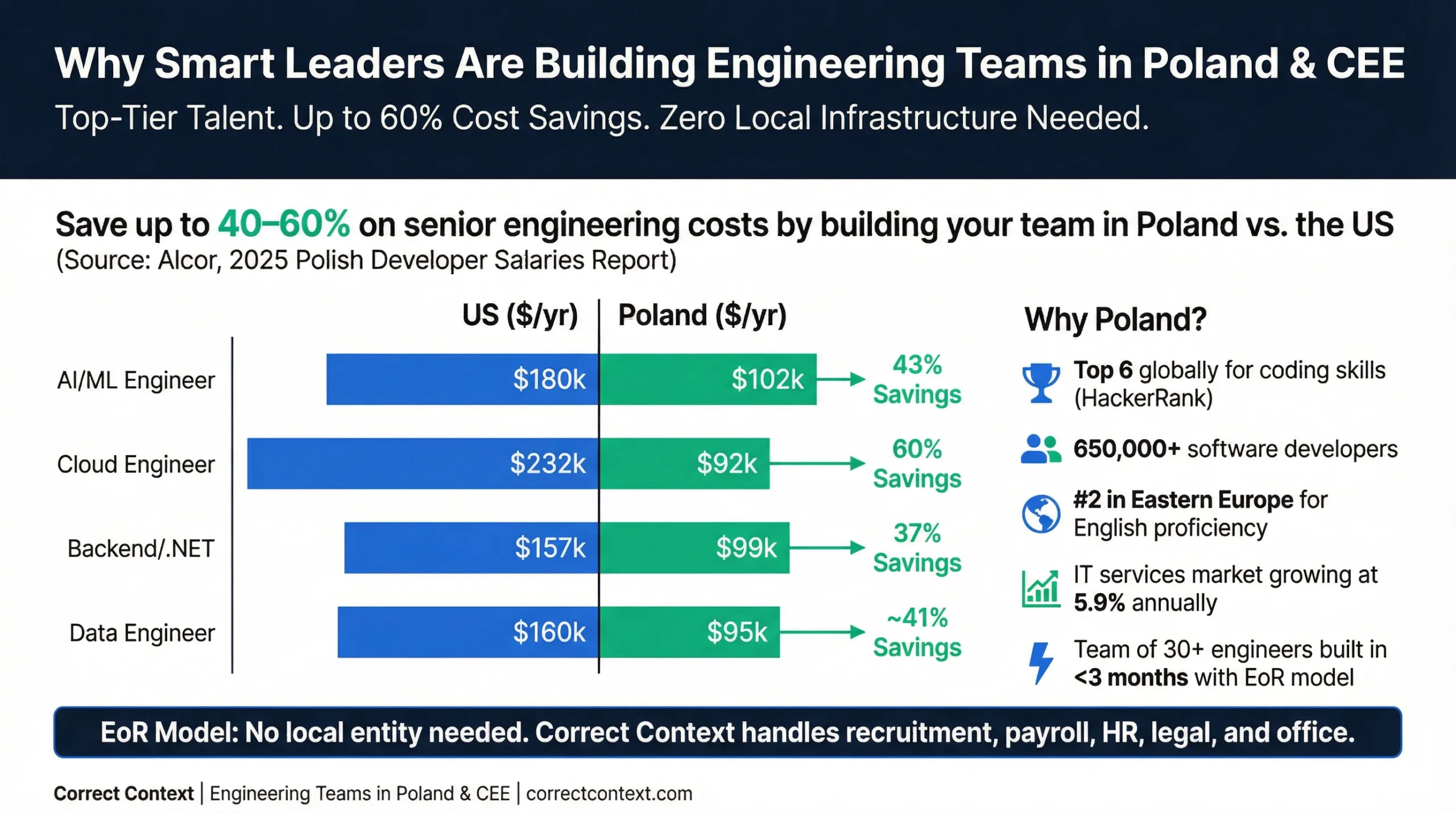
Infographic 2: The CEE Value Proposition – Cost vs. Quality. Source: Alcor, 2025 Polish Developer Salaries Report [4].
| Role | Annual Cost (USA) | Annual Cost (Poland) | Potential Savings |
| Senior AI/ML Engineer | $180,000 | $102,480 | 43% |
| Senior Cloud Engineer (AWS/Azure/GCP) | $232,500 | $92,400 | 60% |
| Senior .NET / Backend Developer | $157,500 | $99,600 | 37% |
| Senior Data Engineer | $160,000 | $95,000 | ~41% |
Table 2: Senior Developer Cost Comparison: USA vs. Poland. Source: Alcor 2025 [4].
This isn’t about finding cheap labor; it’s about finding incredible value. Polish developers are consistently ranked among the top 6 in the world for their technical skills and #2 in Eastern Europe for English proficiency, making collaboration seamless [4]. For companies looking to scale engineering teams efficiently, the CEE region offers an unparalleled advantage.
How to Build Your A-Team in CEE: The Employer of Record (EoR) Model
The prospect of navigating foreign labor laws, payroll, and HR can be daunting. This is where an Employer of Record (EoR) in Poland becomes an invaluable partner. An EoR service, like the one offered by Correct Context, allows you to hire employees without establishing a legal entity in the country. The full-service model covers:
- Sourcing and vetting top-tier talent that fits your specific technical and cultural needs.Recruitment:
- Ensuring your team is paid on time and receives competitive, locally compliant benefits.Payroll & Benefits:
- Navigating local labor laws and ensuring full employment compliance across CEE.HR & Compliance:
- Providing a modern and productive work environment for your team in Poland.Office Management:
This model allows you to build your engineering hub in Europe quickly and efficiently, without the massive overhead and administrative burden. It’s the fastest and most compliant way to build a tech hub in Poland and tap into the region’s incredible talent. Whether you need a data engineering team, a cloud engineering team, a specialized AI development team, or a DevOps team for hire, Correct Context builds it for you-without you needing to set up a local entity.
The Future is Efficient: AI, Lean Teams, and Global Talent
The tech landscape is shifting. The rise of AI development teams and the increasing adoption of enterprise AI tools are further accelerating the move towards leaner, more efficient teams. As a 2025 Carta report noted, startups are now prioritizing efficiency and lean hiring to extend runway, with the average seed-stage team size shrinking significantly since 2022 [5]. In fintech and consumer tech-two of Correct Context’s core verticals-this trend is most pronounced.
In this new paradigm, the ability to build a high-performing, cost-effective, and globally distributed team is no longer a luxury-it’s a necessity. The ICONIQ Capital 2024 State of Engineering report found that preliminary estimates of AI impact reveal notable productivity gains of 20% to 30% for companies that effectively embed AI into their engineering workflows [3]. Coupling this with a nearshore development team in Europe means you’re not just cutting costs-you’re multiplying output.
Stop letting your burn rate dictate your anxiety levels. It’s time to focus on what truly matters: building a world-class product with a world-class team. By embracing a smarter, more global approach to scaling-leveraging offshore development teams, nearshore developers in Europe, and the EoR model in Poland-you can turn your engineering spend from a source of stress into a powerful engine for growth.
References
[1] Forbes. The Great Tech Wake-Up Call: VCs Discover Billions In Inefficient Engineering Teams. November 27, 2024.
[2] Cortex. The 2024 State of Developer Productivity. November 2024.
[3] ICONIQ Capital. The State of Engineering. 2024.
[4] Alcor. Polish Software Developers: Salaries and Insights 2025. April 10, 2025.
[5] Carta. Why startup headcounts are getting smaller. April 22, 2025.