In an era where tech talent is globally dispersed, enterprise innovation units and globally scaling startups face a persistent challenge: how to build and maintain high-performing engineering teams without sacrificing velocity. While the theoretical benefits of global talent access are clear, the reality of managing distributed engineering teams across different time zones often involves coordination failures, communication delays, and hidden productivity taxes.
For enterprise engineering leaders and Series A+ startups in the US, UK, DACH, and Nordics, the decision to scale engineering teams globally is no longer optional. However, the operational model—specifically, whether to build an offshore development team with zero time zone overlap or a nearshore development team with significant overlap—can make or break product delivery. This article explores the true cost of time zone differences, the data behind productivity in distributed setups, and actionable strategies for leading a high-performing remote software engineers team.
The True Cost of Time Zone Misalignment
The instinct for many enterprises when looking to hire developers is to chase the lowest hourly rate, often leading them to deep offshore locations. However, the hidden costs of time zone misalignment quickly erode these initial savings.
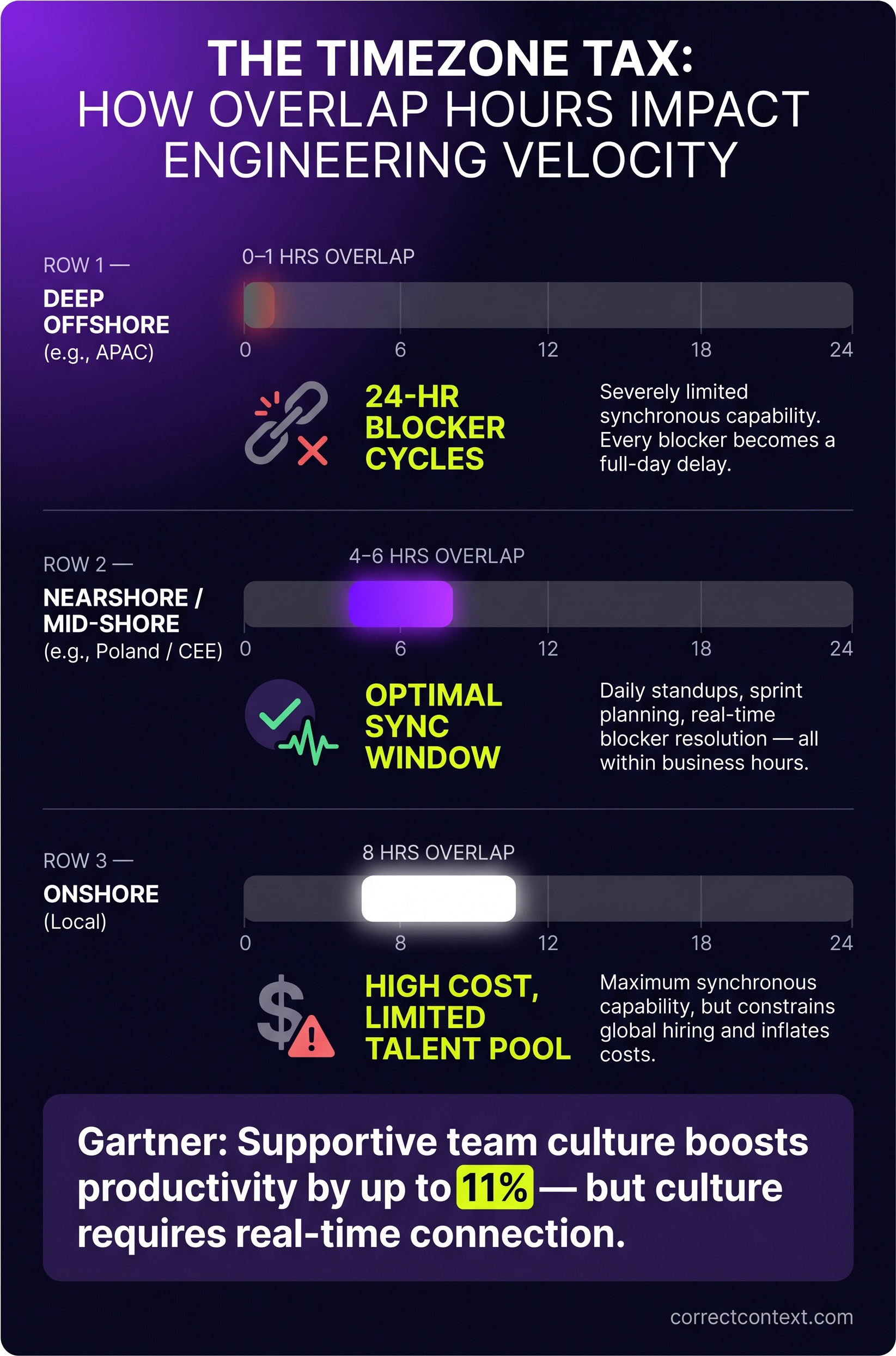
When a core team in the US East Coast collaborates with a team 10 to 12 hours ahead, synchronous communication becomes nearly impossible without forcing one side to work unreasonable hours. This lack of overlap leads to what industry experts call the “timezone tax.”
Research indicates that the bottleneck in most distributed setups is not the speed of individual developers, but the quality and speed of communication [1]. A simple blocker that could be resolved in a five-minute desk conversation can delay a feature by a full 24 hours if the teams do not share working hours. Over a two-week sprint, these daily delays compound, significantly reducing the overall velocity of the dedicated development team.
According to a 2024 Gartner survey of more than 1,900 managers of knowledge workers, direct HR and management involvement in shaping productivity metrics and team culture can increase employee productivity by up to 11% [2]. However, building that supportive culture is exponentially harder when teams never interact in real-time.
The Overlap-Productivity Relationship
Data from distributed teams consistently shows a non-linear relationship between overlap hours and productivity. Agile teams with any time zone overlap are demonstrably more productive than teams with zero shared working hours.
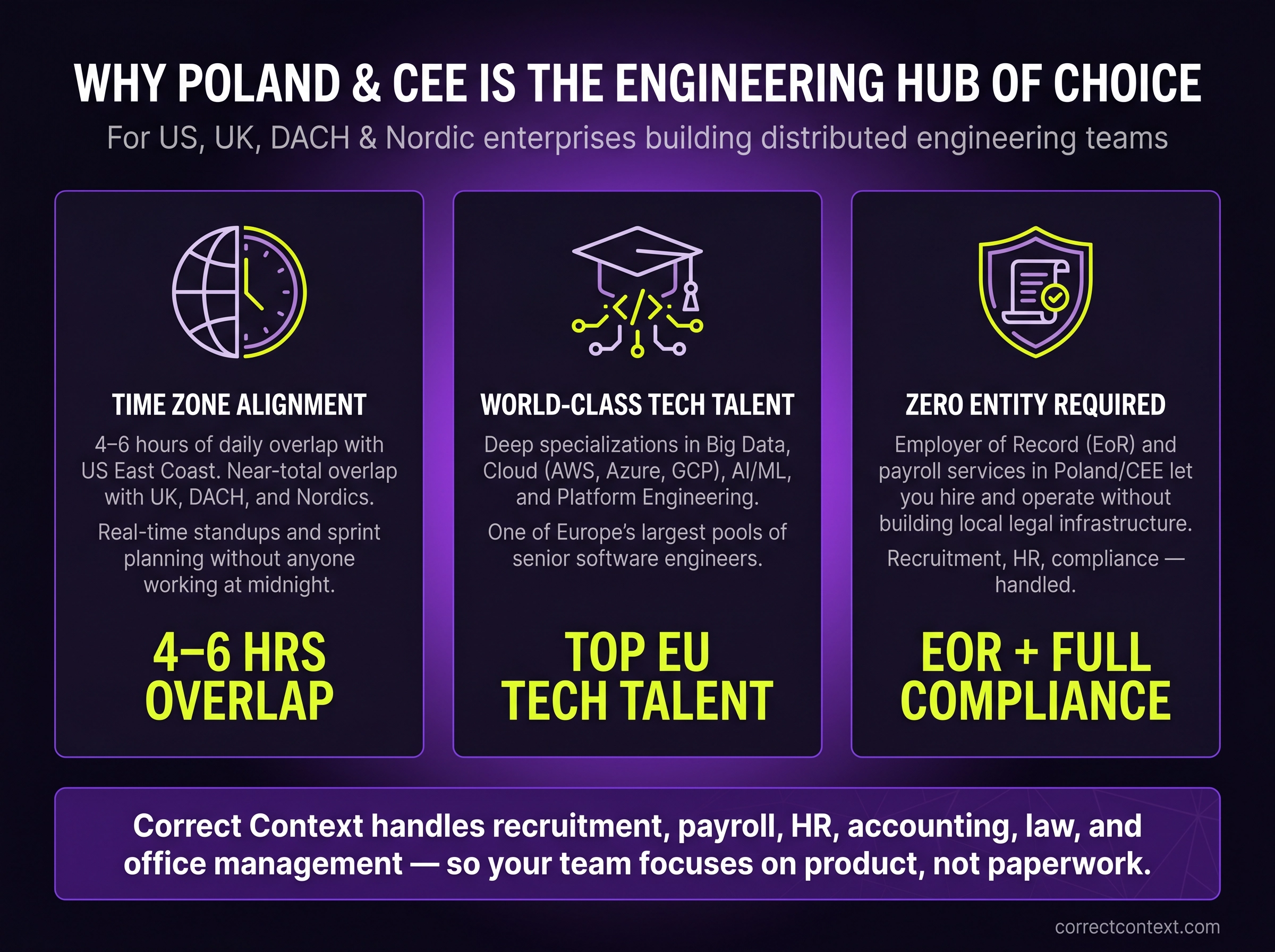
For enterprises based in the US East Coast, UK, or Nordics, establishing an engineering team Poland / CEE (Central and Eastern Europe) provides a strategic advantage. This nearshore or mid-shore model offers several hours of critical overlap with the US East Coast and near-total overlap with the UK and Nordics. This window allows for synchronous sprint planning, daily standups, and blocker resolution, while still enabling the deep, uninterrupted focus time that developers crave.
| Working Model | Time Zone Overlap (US East) | Synchronous Capability | Velocity Impact |
|---|---|---|---|
| Deep Offshore (e.g., APAC) | 0 – 1 Hours | Severely Limited | High risk of 24-hour blocker delays |
| Mid-Shore / Nearshore (e.g., Poland / CEE) | 4 – 6 Hours | Optimal | Balanced sync/async, high velocity |
| Onshore (Local) | 8 Hours | Maximum | High, but limits talent pool and increases costs |
Embracing the Async-First Engineering Culture
To effectively manage a remote development team, leaders must shift from a synchronous-default mindset to an async-first culture. Asynchronous work gives software engineers more focus time, fewer meetings, and better work-life balance [3].
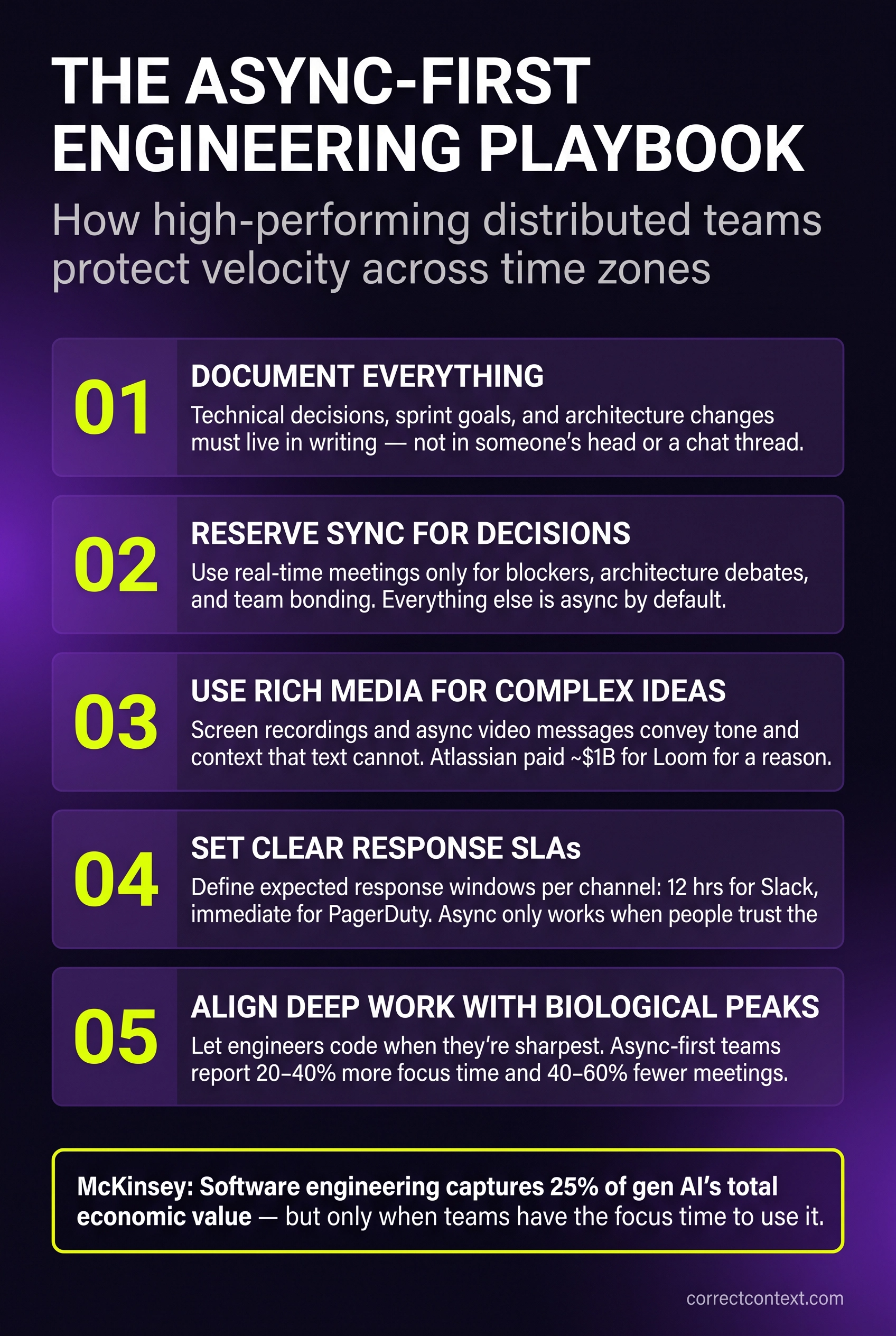
An async-first approach does not mean eliminating all meetings. Instead, it means reserving synchronous time for activities that truly require real-time interaction, such as complex architectural debates, team bonding, and urgent blocker resolution. Routine status updates, code reviews, and initial feature ideation should be handled asynchronously.
Best Practices for Asynchronous Workflows
- Document Everything: In a distributed setup, documentation is the lifeblood of the team. Technical decisions, architectural changes, and sprint goals must be documented clearly and made accessible to everyone. This prevents the “tap on the shoulder” interruptions that disrupt deep work.
- Use Rich Media for Complex Ideas: Instead of writing a lengthy email to explain a new feature, product managers and lead engineers should use asynchronous voice and video messaging. Recording a screen share with a voiceover can convey tone, nuance, and context much more effectively than text [3].
- Establish Clear Response SLAs: An async culture only works if team members trust that their messages will be read and addressed. Establish clear Service Level Agreements (SLAs) for different communication channels. For example, a Slack message might have a 12-hour response expectation, while an urgent PagerDuty alert requires immediate attention.
By normalizing asynchronous communication, organizations can minimize the number of times employees are interrupted, allowing them to align deep work with their biological peaks [3]. Morning people can code during early hours, while others might prefer late-night deep work sessions.
The Role of Collaborative Intelligence
As AI becomes more embedded in daily workflows—used by 58% of employees in 2025, up 107% since 2022 [4]—managing an AI development team or a data engineering team requires a nuanced approach.
McKinsey estimates that software engineering accounts for 25 percent of the total potential economic value from generative AI [5]. However, simply giving developers AI tools is not enough. To fully capture productivity gains, leaders must address awareness, adoption, and effective use. When organizations actively manage the adoption of GenAI, employees can be up to 8% more productive and are 2.7 times more likely to experience speed and quality gains [2].
In distributed setups, collaborative intelligence allows teams to work together without the constraints of regional working hours. For example, an extended engineering team can leverage AI-driven code review tools that provide instant, automated feedback, reducing the reliance on a senior engineer in a different time zone.
Structuring Meetings That Actually Work
When synchronous meetings are necessary, they must be executed flawlessly. The transition to remote work has highlighted the inefficiencies of traditional meetings, where attendees often interpret virtual gatherings as a license to multi-task [6].
To run a great virtual meeting with your dedicated software team, follow these fundamental practices [6]:
- Video is the New Norm: Use video conferencing to personalize the conversation and keep participants engaged. Ensure faces are visible to recreate the intimacy of an in-person meeting.
- Minimize Presentation Length: Meetings should be discussions, not lectures. Provide background information beforehand and prioritize conversation.
- Assign a Facilitator: It is harder to manage a virtual discussion. Assigning someone to guide the conversation ensures all voices are heard and keeps the meeting on track.
- Capture Real-Time Feedback: Use polling tools to gather high-quality input without people talking over each other.
Why the European Tech Hub Model is Winning
For globally scaling Series A+ startups and enterprise innovation units, the strategy of building a tech hub Poland or an engineering hub Europe has become the gold standard.
The Central and Eastern European (CEE) region, particularly Poland, offers a rare combination of world-class technical talent, cultural alignment with Western business practices, and a highly favorable time zone overlap with both the US East Coast and Western Europe.
Whether you need to hire AI engineers, build a platform engineering team, or scale a cloud engineering team with deep AWS, Azure, or GCP experience, the CEE region provides the necessary depth of talent.
Furthermore, utilizing an employer of record Poland (EoR) or payroll services Poland allows enterprises to hire employees without establishing a local legal entity. This employment compliance Europe solution enables companies to rapidly deploy a startup development team or an enterprise ai tools unit without the administrative overhead of traditional international expansion.
Partnering with specialized firms like Correct Context allows organizations to seamlessly integrate an offshore team for startup or enterprise needs. By handling recruitment, payroll, HR, accounting, and law, Correct Context enables clients to focus entirely on product delivery and team integration, effectively mitigating the risks associated with managing distributed engineering teams.
Conclusion
Managing distributed engineering teams across time zones is a complex but solvable challenge. The key is to move away from the false economy of deep offshore models with zero overlap and instead embrace nearshore or mid-shore strategies that provide critical synchronous windows.
By combining strategic time zone alignment with a robust async-first culture and the intelligent application of AI tools, enterprise leaders can build highly productive, globally distributed teams. The future of software development is distributed, but success belongs to those who intentionally design their operating models to bridge the distance.
References
[1] Locu. Async Communication Best Practices for Distributed Engineering Teams
[2] Gartner. Gartner HR Research Identifies Four Myths That Are Hampering Employee Productivity
[3] Forbes. 9 Ways Asynchronous Communication Can Improve Team Productivity
[4] Eptura. Rethinking productivity: 2025 Workplace statistics | Eptura
[5] McKinsey & Company. AI in the workplace: A report for 2025 | McKinsey
[6] Harvard Business Review. What It Takes to Run a Great Virtual Meeting