
In the fast-paced world of technology, speed is everything. Long hiring cycles are no longer just an HR problem; they are a business problem, directly delaying product delivery and stunting growth. For CTOs and Founders, the pressure to scale engineering teams quickly is immense, but the fear of sacrificing quality for speed is a significant barrier. This article explores how you can redesign your hiring process to be both fast and effective, enabling you to build a dedicated development team in 4–6 weeks without compromising on talent.
The Crippling Cost of a Slow Hiring Process
The traditional approach to hiring is often a long, drawn-out affair. While it may seem thorough, this lengthy process comes with substantial hidden costs that can hamstring a growing company. Research shows that the average time-to-hire for tech roles can stretch from 41 days to over five months, a delay that has a direct and quantifiable impact on your bottom line [1] [2]. For technical positions, the cost of a vacant role is estimated to be around $500 per day in lost productivity, a figure that doesn’t even account for the cascading effects on project timelines and team morale [3].
| Cost Component | Financial Impact | Business Impact |
|---|---|---|
| Lost Productivity | ~$500/day per vacant position | Delayed projects, missed deadlines |
| Recruitment Costs | Average cost-per-hire: $4,700 – $5,475 | Increased departmental spend |
| Team Morale | Unquantifiable | Burnout, decreased motivation |
| Competitive Disadvantage | Unquantifiable | Slower time-to-market, missed opportunities |
Table 1: The Hidden Costs of a Slow Hiring Cycle
These delays are not just a symptom of a competitive market; they are often the result of an inefficient and outdated hiring process. From poorly defined roles and unstructured interviews to a lack of a proactive talent pipeline, the bottlenecks are numerous. The result is a slow, frustrating experience for both candidates and hiring managers, and a significant drag on the company’s ability to innovate and grow.
Redesigning for Speed and Quality: A Four-Step Framework
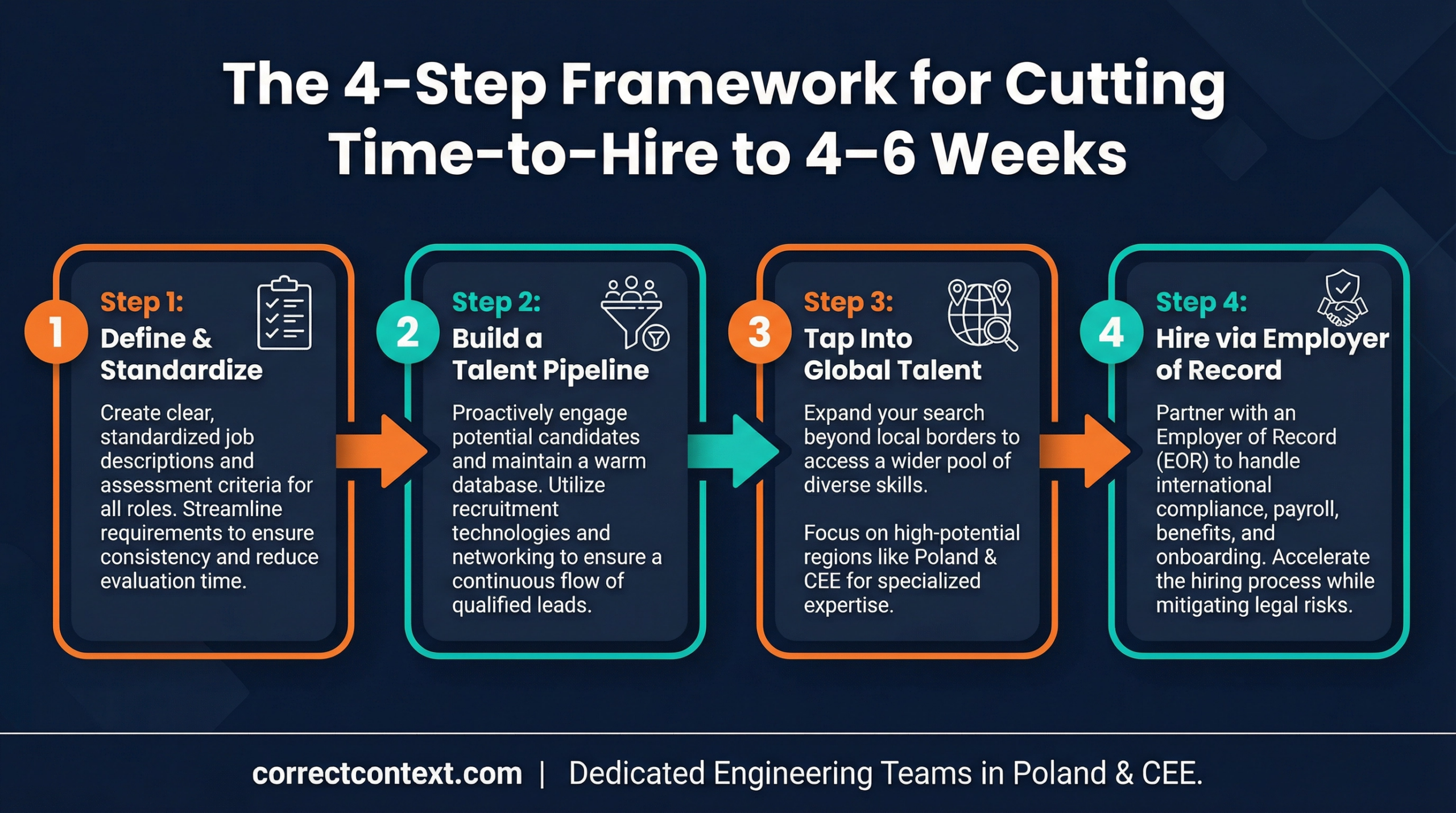
To break free from the slow hiring cycle, a fundamental redesign of the process is necessary. The goal is to create a structured, efficient, and repeatable system that allows you to move quickly without sacrificing the rigor needed to identify top talent. Here’s a four-step framework to guide your transformation:
- Define and Standardize: The first step is to bring clarity and consistency to your hiring process. This means creating detailed and accurate job descriptions, defining a structured interview process with standardized questions and evaluation criteria, and ensuring that everyone involved in the hiring process is aligned on the ideal candidate profile. A structured hiring process is not about creating a rigid, bureaucratic system; it’s about creating a fair and efficient one that minimizes bias and helps you make better, data-driven decisions.
- Build a Proactive Talent Pipeline: Don’t wait for a position to open up to start looking for candidates. Proactively build and nurture a pipeline of pre-vetted talent. This can involve everything from attending industry events and networking on social media to building relationships with universities and coding bootcamps. By having a pool of qualified candidates ready to go, you can significantly reduce your time-to-hire when a new role does become available.
- Leverage a Global Talent Pool: The talent you need may not be in your backyard. By expanding your search to a global talent pool, you can access a wider range of skills and experience. Nearshore development teams in regions like Central and Eastern Europe (CEE) offer a particularly compelling value proposition. Countries like Poland have a large and growing pool of highly skilled and experienced software developers Poland, often at a fraction of the cost of hiring in the US or UK.
- Embrace the Employer of Record (EOR) Model: Hiring internationally can be complex, with a web of legal and administrative hurdles to navigate. An Employer of Record (EOR) in Poland or another CEE country can handle all the legal, HR, and payroll complexities for you, allowing you to hire employees without an entity of your own. This dramatically accelerates the hiring process and ensures compliance with local labor laws, making it a powerful tool for companies looking to scale their remote development teams quickly.
The CEE Advantage: Accessing a World-Class Talent Pool
Central and Eastern Europe, and Poland in particular, has emerged as a global hub for tech talent. The region boasts a large and highly skilled workforce, a strong tradition of STEM education, and a thriving startup ecosystem. For companies looking to build a dedicated software team, the CEE region offers a number of significant advantages:
- A Deep and Growing Talent Pool: Poland alone has a tech talent pool of over 500,000 professionals, the largest in the CEE region [4]. This includes a large number of experienced AI engineers, machine learning engineers, and specialists in big data development, cloud engineering (AWS, Azure, GCP), and other high-demand fields.
- World-Class Technical Skills: Polish developers are consistently ranked among the best in the world for their technical skills. They are known for their strong problem-solving abilities, their expertise in a wide range of programming languages, and their commitment to quality.
- Significant Cost Savings: The cost of hiring a senior software developer in Poland is significantly lower than in the US or UK, often by as much as 40-50%. This allows you to build a larger, more experienced team for the same budget.
| Role | Average Annual Salary (USD) – US | Average Annual Salary (USD) – Poland |
|---|---|---|
| Senior Software Engineer | $129,600 | $70,800 |
| Mid-Level Software Engineer | $100,000 | $50,000 |
| Junior Software Engineer | $75,000 | $35,000 |
Table 2: Software Developer Salary Comparison: US vs. Poland (2024) [5]

The EOR Solution: Your Fast Track to a Global Team
For companies looking to tap into the CEE talent pool, the Employer of Record (EOR) model is a game-changer. An EOR in Europe acts as the legal employer for your international team members, handling everything from contracts and payroll to benefits and compliance. This allows you to:
- Hire in days, not months: An EOR can have a new employee legally hired and onboarded in a fraction of the time it would take to set up your own legal entity.
- Eliminate administrative burdens: The EOR handles all the administrative tasks associated with international employment, freeing you up to focus on building your team and your product.
- Ensure compliance: An EOR has deep expertise in local labor laws and regulations, ensuring that you are always in full compliance.
By partnering with an EOR, you can build a remote software engineers team in Poland or another CEE country quickly, efficiently, and with minimal risk. This is a powerful strategy for startups and established companies alike that need to scale their engineering teams to meet the demands of a rapidly growing market.
Conclusion: The Future of Hiring is Fast and Global
The old way of hiring is no longer sustainable. In a world where speed is a competitive advantage, long hiring cycles are a luxury you can’t afford. By redesigning your hiring process, embracing a global talent pool, and leveraging innovative solutions like the Employer of Record model, you can cut your time-to-hire to 4–6 weeks without sacrificing quality. The future of hiring is fast, global, and focused on building the dedicated development teams you need to win in the market.
References
[1] Paraform. (2024). What’s The Average Time To Hire Software Engineer? (2024).
[2] Montano, A. (2024). Average Job Search Time for Tech Roles in the U.S. (2024/2025). LinkedIn.
[3] OpenArc. (2025). The Hidden Hiring Costs of A Slow Recruitment Process [Real Numbers].
[4] Alcor. (2025). Technology and IT Industry in Poland in 2025.
[5] Alcor. (2025). Polish Software Developers: Salaries and Insights 2025.