
In the high-stakes world of tech, market timing isn’t just a buzzword—it’s the difference between leading the pack and watching a competitor capture the market you were aiming for. For startup founders and enterprise innovation leaders, the pressure to deliver is immense. Yet, a silent killer often sabotages the best-laid plans: the hiring delay. While the search for the “perfect” candidate is understandable, every day an engineering role remains unfilled, your product velocity slows, your team burns out, and your market window shrinks. This is not a time for perfectionism; it is a time for strategic speed.
This article explores the quantifiable and hidden costs of a slow hiring process, offering a clear-eyed view for leaders who are weighing the trade-offs between speed and perfection. We will demonstrate how delays in building your engineering team Poland / CEE can cripple momentum and how a strategic approach to building a dedicated development team can provide a powerful competitive advantage.
The High Cost of an Empty Chair: Quantifying the Damage
The cost of a vacant position goes far beyond the recruiter’s fee. It’s a daily drain on productivity, innovation, and revenue. Research shows that a single unfilled position can cost a company approximately $500 per day in lost productivity alone [1]. For specialized roles like a senior software engineer, this figure is conservative. Over a month, that’s over $10,000 in direct productivity loss, and as some studies suggest, it can be as high as $25,000 per month for a skilled IT professional [2].
Consider the financial impact on a project. For a software engineer with a base salary of $120,000, the total cost to the company is far greater. When you factor in lost productivity, delayed revenue, and the impact on the team, a slow hiring process can easily cost an organization between $200,000 and $300,000 for a single role that stays open for several months [9].
| Vacancy Duration | Cumulative Cost of One Unfilled Senior Engineer Role |
| 1 Month | $25,000 |
| 3 Months | $75,000 |
| 6 Months | $150,000 |
These direct costs are just the beginning. The indirect consequences are often more damaging.
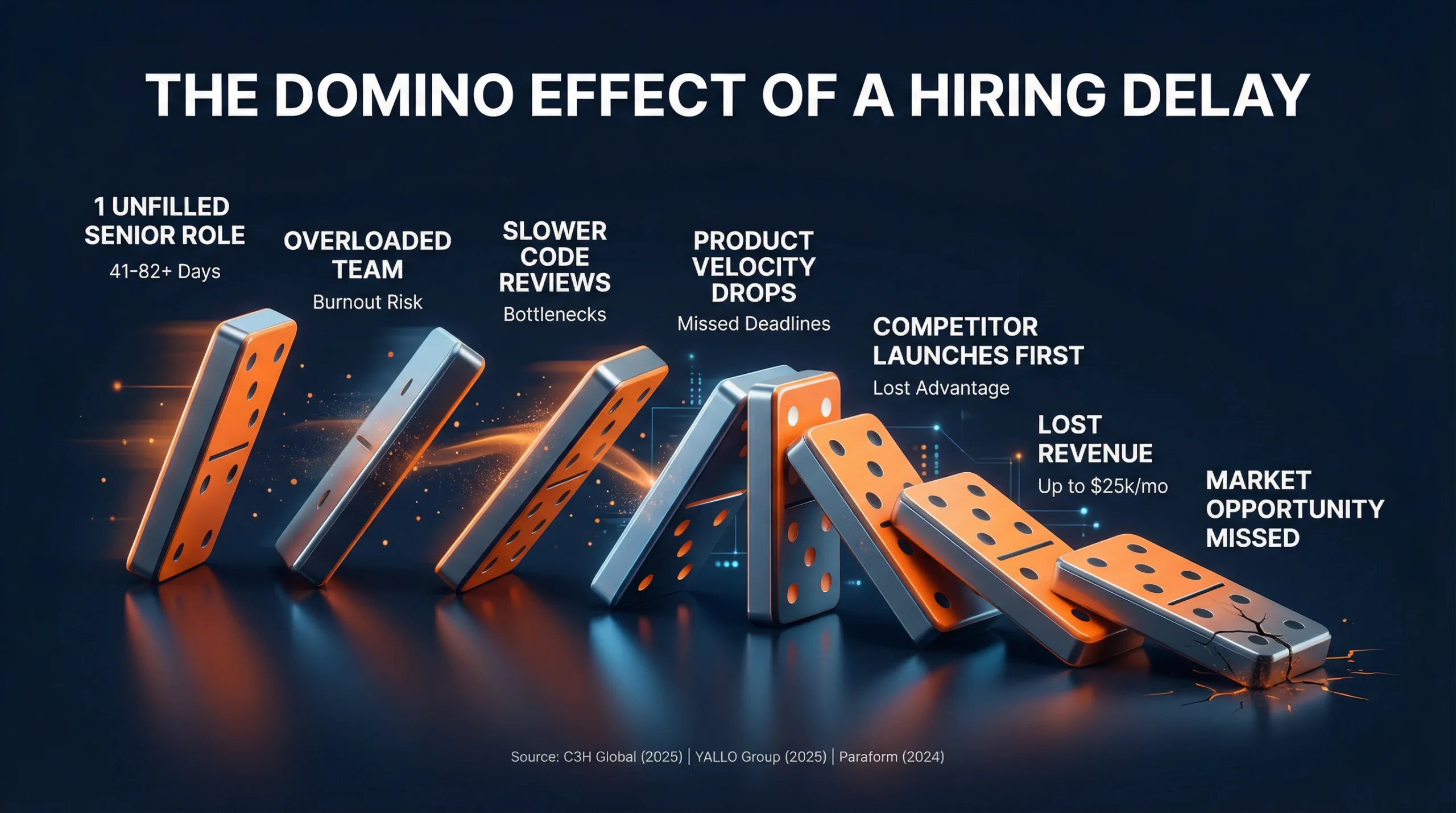
The Domino Effect of a Hiring Delay
Delivery Pressure and Team Burnout
When a critical role remains open, the workload doesn’t disappear; it gets redistributed to the existing team. This creates immense delivery pressure. Your best engineers, already working at capacity, are now stretched thin, juggling their own responsibilities while trying to cover the gaps. This isn’t sustainable. It leads directly to burnout, decreased morale, and a higher risk of employee turnover. The very people you rely on to drive your product forward become disengaged and exhausted. The result is a vicious cycle: a slow hiring process increases the workload on your team, which in turn can lead to more people leaving, creating even more open roles.
Product Velocity Slows to a Crawl
Modern software development is a finely tuned machine. DevOps teams rely on continuous flow, AI development teams need a constant cycle of experimentation, and data engineering teams build the pipelines that feed the entire organization. A missing engineer is like a missing cog in this machine. It creates bottlenecks that ripple across the entire development process.
In fast-moving cloud, DevOps and AI environments, the pace of hiring has simply failed to keep up with the pace of the work… Slow hiring creates a subtle chain reaction: teams cut corners, technical debt increases, documentation slips, architectural decisions become short-term and future improvements get pushed aside. [1]
For a DevOps team for hire, a missing engineer means pipeline failures take longer to resolve and release cycles slow down. For an AI development team, a lack of data engineers or ML specialists means postponing crucial experiments because the foundational data work isn’t getting done. Your product velocity—the speed at which you deliver value to customers—inevitably grinds to a halt. The features you promised your investors and customers are delayed, and your product roadmap becomes a document of broken promises.
Losing the Race: The Missed Market Window
For a startup development team, speed is everything. Being the first to market with an innovative solution can create a lasting advantage. Hiring delays put this critical advantage at risk. While you spend months searching for the perfect candidate, a more agile competitor can launch their product, capture market share, and define the narrative. By the time you finally have your team in place, the opportunity may have passed. This is especially true in rapidly evolving fields like enterprise AI tools, where the landscape changes in a matter of months, not years.
The Founder’s Dilemma: Speed Over Perfection
Every founder wants to build an A-team. The temptation to hold out for the “perfect” candidate—the mythical 10x engineer who ticks every box—is strong. But the data shows that this pursuit of perfection is a costly luxury. The median time-to-hire for a software engineer is already 41 days, with the slowest 10% of hires taking up to 82 days [3]. In the current market, it’s not uncommon for this process to stretch to five or six months.
Can you afford to wait that long? The answer, in most cases, is no. In a fast-moving market, a “good enough” team that is shipping product today is infinitely better than a “perfect” team that will be assembled six months from now. The key is to find a way to accelerate hiring without sacrificing quality. This is where a strategic approach to team building becomes a game-changer.
The Strategic Advantage: Building a Nearshore Development Team in Poland
Instead of getting bogged down in a slow, expensive, and hyper-competitive local hiring market, smart startups and enterprises are turning to a powerful alternative: building a nearshore development team in a global tech hub like Poland. This isn’t about outsourcing in the traditional sense; it’s about building a fully integrated, extended engineering team that operates as a seamless part of your organization.
Companies like Correct Context specialize in helping you hire developers in Poland and the CEE region, providing a full suite of services that eliminates the operational headaches. This model offers a powerful combination of speed, cost-effectiveness, and access to a deep pool of talent.
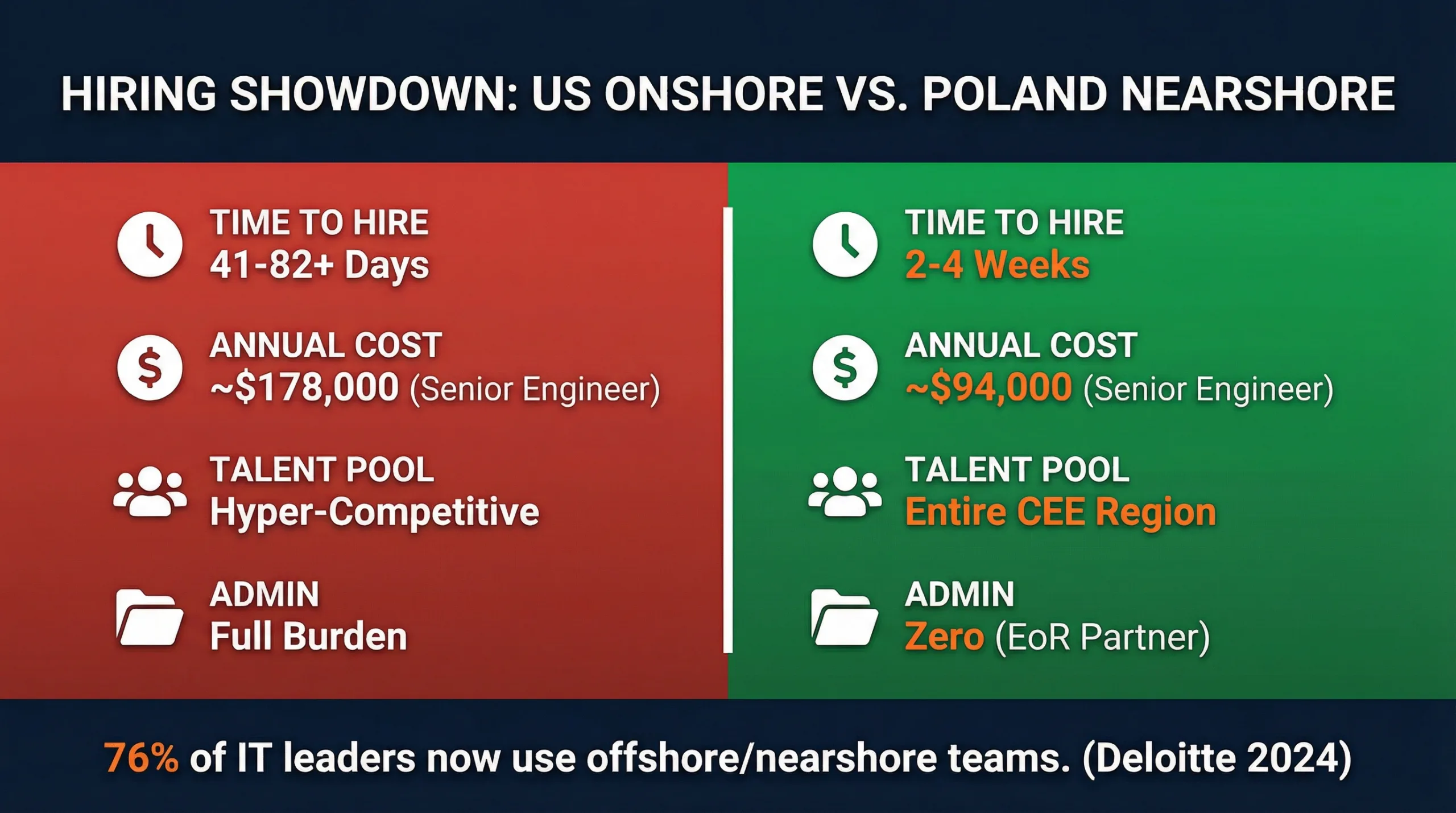
Onshore vs. Nearshore Hiring Comparison
Unmatched Speed and Scalability
While a typical US-based hiring process can take months, a specialized partner can help you build a remote development team in a matter of weeks. They handle the entire recruitment lifecycle—sourcing, vetting, and onboarding—allowing you to scale engineering teams with incredible speed. Instead of hiring one engineer every two months, you can onboard an entire team in that same timeframe.
Significant Cost Savings
The financial advantages are compelling. The average rates for a nearshore development team are often 46% lower than onshore rates [10]. A senior software engineer in Poland, for example, has a total annual employment cost of around $94,190, compared to over $178,000 in the United States [7]. This allows you to hire two or even three top-tier engineers for the price of one, dramatically increasing your development capacity without bloating your budget. This is how you find affordable senior developers without compromising on quality.
Access to a World-Class Talent Pool
Poland and the CEE region have emerged as a global powerhouse for tech talent. The region boasts a highly educated and skilled workforce, with deep expertise in the most in-demand specializations, including:
- Big Data Development Team
- Data Analytics Team
- Cloud Engineering Team (AWS, Azure, GCP)
- AI / Machine Learning Engineers Team
- Backend Development Team
These are not junior coders; they are experienced professionals who have worked on complex projects for global companies. You are not sacrificing quality for cost; you are accessing a different, more efficient talent market.
The Power of Employer of Record (EoR)
One of the biggest barriers to global hiring is the legal and administrative complexity of setting up a local entity. This is where an Employer of Record (EoR) in Poland becomes invaluable. An EoR partner like Correct Context acts as the legal employer for your team, handling all HR, payroll, and employment compliance in Europe. This allows you to hire employees without an entity, effectively giving you an instant presence in a new market without the associated cost and bureaucracy. It’s the fastest and most compliant way to build a tech hub in Poland.
Conclusion: Reclaim Your Momentum
Hiring delays are a tax on your startup’s ambition. They drain your resources, burn out your team, and hand a critical advantage to your competitors. In today’s market, you cannot afford to let a slow hiring process dictate your pace. The debate over speed versus perfection is a false choice. The real solution is to change the game.
By building a dedicated software team in a nearshore location like Poland, you can achieve both. You get access to world-class talent at a fraction of the cost, and you can build your team in weeks, not months. This is how you reclaim your product velocity, meet your delivery commitments, and seize your market opportunity. Don’t let the search for the perfect engineer kill your momentum. Build the team you need now, and win the race.
References
[1] YALLO Group. (2025, November). The Hidden Costs of Delayed Hiring in Cloud, DevOps and AI Projects. Medium. Retrieved from
[2] C3H Global. (2025, October). The Hidden Cost of Unfilled Positions for Employers. Retrieved from
[3] Paraform. (2024, April). What’s The Average Time To Hire Software Engineer?. Retrieved from
[4] SHRM. (2022, April). The Real Costs of Recruitment. Retrieved
[5] Deloitte. (2024). 2024 Global Outsourcing Survey.
[6] CCS Learning Academy. (2025, December). The True Cost of Unfilled Tech Positions. Retrieved
[7] Alcor BPO. Hire Rare Developers in Poland up to 100 a Year.
[8] LinkedIn/Antonio Montano. (2024). Average Job Search Time for Tech Roles in the U.S. (2024/2025).
[9] CorrectContext. (2026, January). The Hidden Cost of Slow Engineering Hiring.
[10] HatchWorks. (2025, December). 25 Nearshore Software Development Statistics to Know in 2025