In the high-stakes race for technological supremacy, enterprises in the FinTech, Software, and Media sectors are facing a stark reality: the methods used to hire AI engineers and top tech talent are fundamentally broken. Companies are pouring unprecedented resources into building their corporate AI use cases, yet the very process designed to identify skilled engineers-the traditional technical interview-is often a barrier to success. This rigid, puzzle-oriented approach not only fails to predict real-world engineering performance but also actively filters out qualified, innovative thinkers. The result is a costly cycle of bad hires, missed opportunities, and stalled progress in an era where speed and expertise are paramount.
For corporations navigating the latest AI trends for enterprise, the cost of a flawed hiring process is more than just a line item; it’s a strategic liability. As businesses pivot to integrate enterprise AI tools, the demand for talent that can build, deploy, and maintain these systems has created a global crisis. The old way of hiring is no longer sufficient. It’s time to look beyond the whiteboard and embrace a new paradigm for building world-class engineering teams.
The Billion-Dollar Blind Spot: The Dual Costs of a Broken Hiring Process
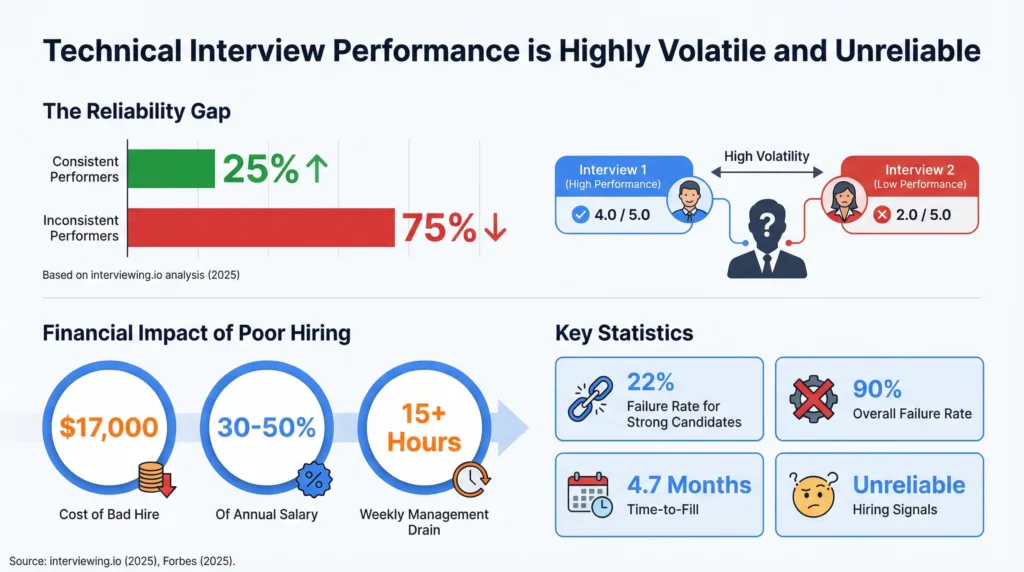
The financial repercussions of a poor hiring decision are staggering. According to the U.S. Department of Labor, a single bad hire aka False Positives, can cost a company up to 30% of that employee’s first-year earnings [1]. Research from 2025 places the average direct cost at $17,000, with real-world examples soaring to over $47,000 when accounting for recruitment fees, salary, training, and severance [2].
However, the direct costs are only the tip of the iceberg. The hidden tolls—drained management time, plummeting team morale, and lost productivity—can cripple a project. For every wrong hire, managers can lose over 15 hours per week in remedial coaching, pulling focus from strategic initiatives. But there is an even more insidious cost: the false negative. This is the highly skilled engineer your company rejected because they faltered on an arbitrary algorithm puzzle under pressure. In a market where the average time to fill an AI role is nearly five months, turning away qualified talent is a luxury no enterprise can afford [3].
| Cost Category | Financial Impact | Operational Impact |
| Bad Hires (False Positives) | $17,000 average direct cost | 15+ hours/week management drain |
| 30-50% of annual salary | Decreased team morale & productivity | |
| Missed Hires (False Negatives) | Lost opportunity for innovation | Extended project timelines |
| Increased recruitment spend | Ceding ground to competitors |
The Unreliable Signal: Why Technical Interviews Don’t Predict Performance
The central flaw of the traditional technical interview is its volatility. Groundbreaking research from interviewing.io, which analyzed hundreds of interviews, found that 75% of candidates perform inconsistently from one interview to the next [4]. A candidate who scores a perfect 4/4 in the morning might score a failing 2/4 in the afternoon with a different company.
“Generally, when we think of interviewing, we think of something that ought to have repeatable results and carry a strong signal. However, the data we’ve collected… tells a different story.” – interviewing.io [4]
This isn’t an anomaly; it’s the norm. The study revealed that even strong candidates have a 22% chance of failing any given interview. This randomness makes the process less of a skills assessment and more of a lottery, where success often depends more on the luck of the draw—the specific question asked, the interviewer’s mood, or the candidate’s stress level—than on their actual engineering ability.
This approach fails because it tests for a very narrow, academic skill: solving abstract puzzles under pressure. It doesn’t measure a candidate’s ability to collaborate, debug complex systems, navigate legacy code, or make pragmatic architectural decisions—the very skills that define effective engineers in a real-world corporate AI use environment.
The AI Talent Crisis: A Compounding Problem
This broken interview process is colliding with the most acute talent shortage in modern history. As enterprises rush to use AI tools inside corporations, the demand for skilled professionals has created a global crisis. A 2025 report on the AI talent market highlights a staggering 3.2-to-1 demand-to-supply ratio, with 1.6 million open AI positions globally and only 518,000 qualified candidates to fill them [3].
This chasm is driving salaries to unprecedented levels, with AI roles commanding a 67% premium over traditional software positions. The demand for roles like AI Research Scientists and NLP/LLM Specialists has grown by over 130% and 198% year-over-year, respectively. Yet, companies continue to use outdated interview methods that incorrectly filter out the very talent they desperately need.
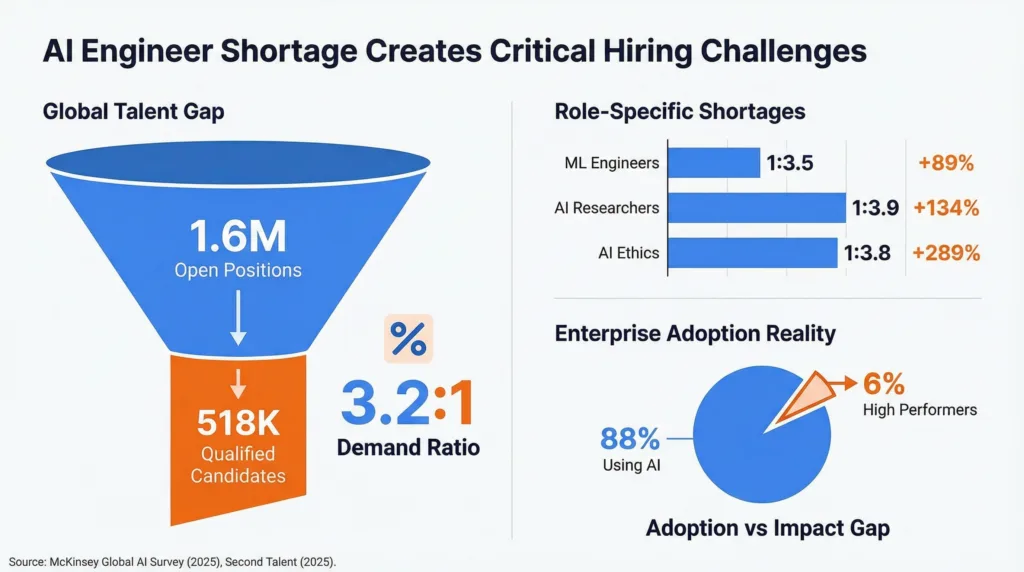
Furthermore, while enterprise AI adoption is widespread, its impact is shallow. A 2025 McKinsey Global AI Survey found that while 88% of organizations use AI, only 39% report any impact on their bottom line, and a mere 6% qualify as “AI high performers” [5]. This gap between adoption and value realization is a direct consequence of the talent bottleneck. Without the right engineers to scale projects from pilot to production, even the most promising enterprise AI tools will fail to deliver a return on investment.
A Better Way Forward: From Puzzles to Performance-Based Hiring
Leading organizations are recognizing the limitations of traditional interviews and are pivoting to a more effective, evidence-based approach: skills-based hiring. Instead of asking candidates to solve abstract puzzles, this method evaluates them on tasks that mirror the actual work they would be performing.
Research from Harvard Business Review shows that employees hired based on skills have 25% higher performance ratings and 40% lower turnover rates [6]. Work-sample tests, where a candidate is given a small, self-contained project to complete, have been shown to be the single best predictor of on-the-job performance—far more reliable than whiteboard coding or brain teasers [7].
This approach allows companies to assess the skills that truly matter:
- Problem-Solving in Context: How does a candidate approach a real-world bug or feature request?
- Code Quality and Craftsmanship: Can they write clean, maintainable, and well-documented code?
- Collaboration and Communication: How do they incorporate feedback and explain their technical decisions?
By shifting the focus from abstract knowledge to demonstrated ability, companies can not only make better hires but also broaden their talent pool to include skilled engineers who may not have a traditional computer science degree or who don’t perform well in high-pressure, abstract interview settings.
The Strategic Advantage: IT Staff Augmentation for the AI Era
For enterprises in the fast-moving FinTech, Software, and Media landscapes, overhauling an internal hiring process can be a slow and resource-intensive endeavor. In the race to hire AI programmers and build out AI capabilities, there is a more immediate and strategic solution: IT staff augmentation.
Partnering with a specialized firm like CorrectContext.com allows enterprises to bypass the broken internal hiring funnel and gain immediate access to a curated pool of elite, pre-vetted AI and software engineers. We have already done the hard work of identifying top talent through robust, performance-based evaluation methods. Our engineers are not just masters of algorithms; they are proven problem-solvers with experience building and scaling real-world applications.
By leveraging staff augmentation, your company can:
- Accelerate Time-to-Market: Onboard skilled AI engineers in days, not months, and immediately advance your key projects.
- Reduce Hiring Risk: Eliminate the financial and operational costs of bad hires by accessing talent that has already been rigorously vetted for real-world skills.
- Maintain Flexibility: Scale your team up or down based on project needs without the overhead of traditional hiring and long-term commitments.
- Access Specialized Skills: Instantly tap into a global talent pool with expertise in niche areas like LLM development, MLOps, and AI ethics—skills that are nearly impossible to find through conventional recruitment.
Conclusion: Build for the Future, Not for the Interview
The traditional technical interview is a relic of a bygone era. It’s an unreliable, costly, and ineffective way to build the high-performing engineering teams required to compete in the age of AI. The data is clear: performance in a coding puzzle has little correlation with the ability to deliver value to your business.
Enterprises that continue to rely on this outdated model will find themselves outmaneuvered by competitors who have adopted a more agile and effective approach to talent. As you look to harness the power of AI trends for enterprise, the most critical decision you’ll make is how you hire AI coders and engineers. Stop filtering for candidates who are good at interviews and start building teams with engineers who are proven to be good at their jobs. The future of your business depends on it.
References
[1] U.S. Department of Labor, as cited by multiple sources including Forbes and SHRM.
[2] Forbes. (2025, June 30). The True Cost Of A Bad Hire—And How To Avoid Making One.
[3] Second Talent. (2025, September 16). Top 50+ Global AI Talent Shortage Statistics 2025.
[4] interviewing.io. (2016, February 17). Technical interview performance is kind of arbitrary. Here’s the data.
[5] McKinsey & Company. (2025, November 5). The State of AI: Global Survey 2025.
[6] Harvard Business Review, as cited by Madison Approach. (2025, July 2). The Rise of Skills-Based Hiring.
[7] Forbes. (2017, February 23). Work Sample Tests Should Be The Future Of Software Engineering Interviews.
Table of content
- The Billion-Dollar Blind Spot: The Dual Costs of a Broken Hiring Process
- The Unreliable Signal: Why Technical Interviews Don’t Predict Performance
- The AI Talent Crisis: A Compounding Problem
- A Better Way Forward: From Puzzles to Performance-Based Hiring
- The Strategic Advantage: IT Staff Augmentation for the AI Era
- Conclusion: Build for the Future, Not for the Interview