
There is a quiet crisis playing out in engineering hiring rooms across the US and Europe. A senior developer candidate breezes through a dynamic programming puzzle, reverses a linked list in under four minutes, and walks out with an offer. Six months later, the same engineer is struggling to articulate why a microservices boundary was drawn incorrectly, can’t explain a trade-off between eventual consistency and strong consistency, and has never once asked what the business actually needs from the system they are building. The LeetCode score was a ten. The engineering impact is a three.
This is not a talent shortage problem. It is a measurement problem — and it is costing companies far more than they realize.
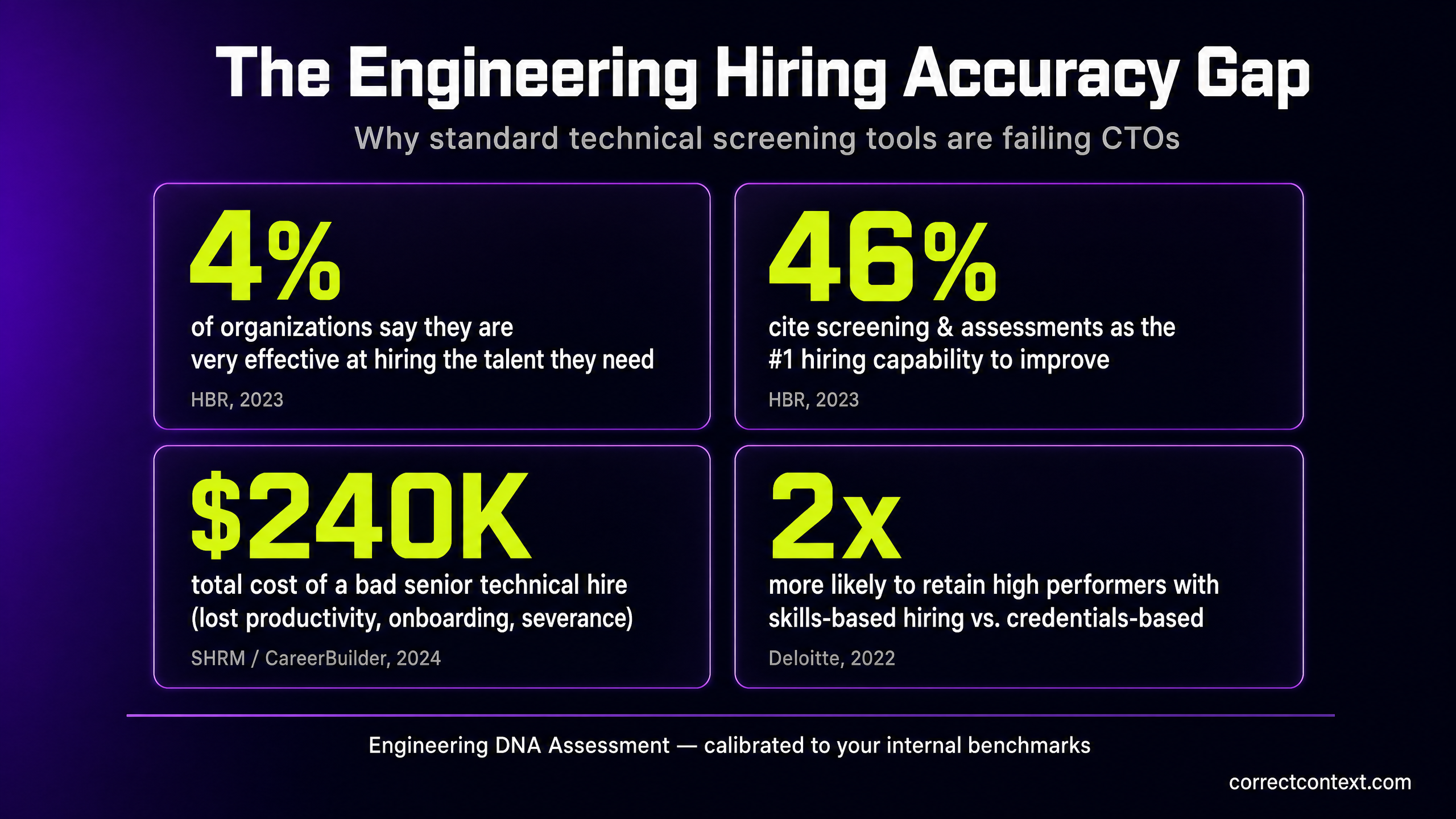
According to a study highlighted by SHRM and CareerBuilder, the total cost of a bad technical hire can reach up to $240,000 when factoring in lost productivity, onboarding, severance, and re-hiring cycles.[1] For senior engineers at Series A+ startups or enterprise data units scaling fast, that number is not a rounding error — it is a funding round. The root cause, in most cases, is a screening process that was never designed to evaluate what actually matters at the senior level.
Why Standard Tests Fail Senior Engineers
The premise of algorithmic coding tests made sense in a world where most software engineering work was greenfield, isolated, and execution-focused. That world no longer exists. Today’s senior engineers are expected to make architectural decisions that affect system reliability for years, mentor junior developers, translate business requirements into technical strategy, and operate in ambiguous, high-stakes environments where there is rarely a single correct answer.
A senior developer testing framework built on syntax recall and graph traversal does not measure any of those capabilities. Research from McKinsey’s Developer Velocity Index confirms that the most impactful engineering organizations measure performance across multiple dimensions simultaneously — including collaboration, optimization, and contribution to business outcomes — rather than through single-axis assessments.[2] Yet most technical screening tools in use today remain fundamentally one-dimensional.
The data is stark: according to HBR research conducted with 326 senior business and HR leaders, only 4% of organizations describe themselves as “very effective” at hiring the talent they need, and 46% cite screening and assessments as the capability they most want to improve.[3] That is not a niche frustration. It is an industry-wide admission that the current approach to technical screening tools is broken.
Introducing the Engineering DNA Assessment Framework
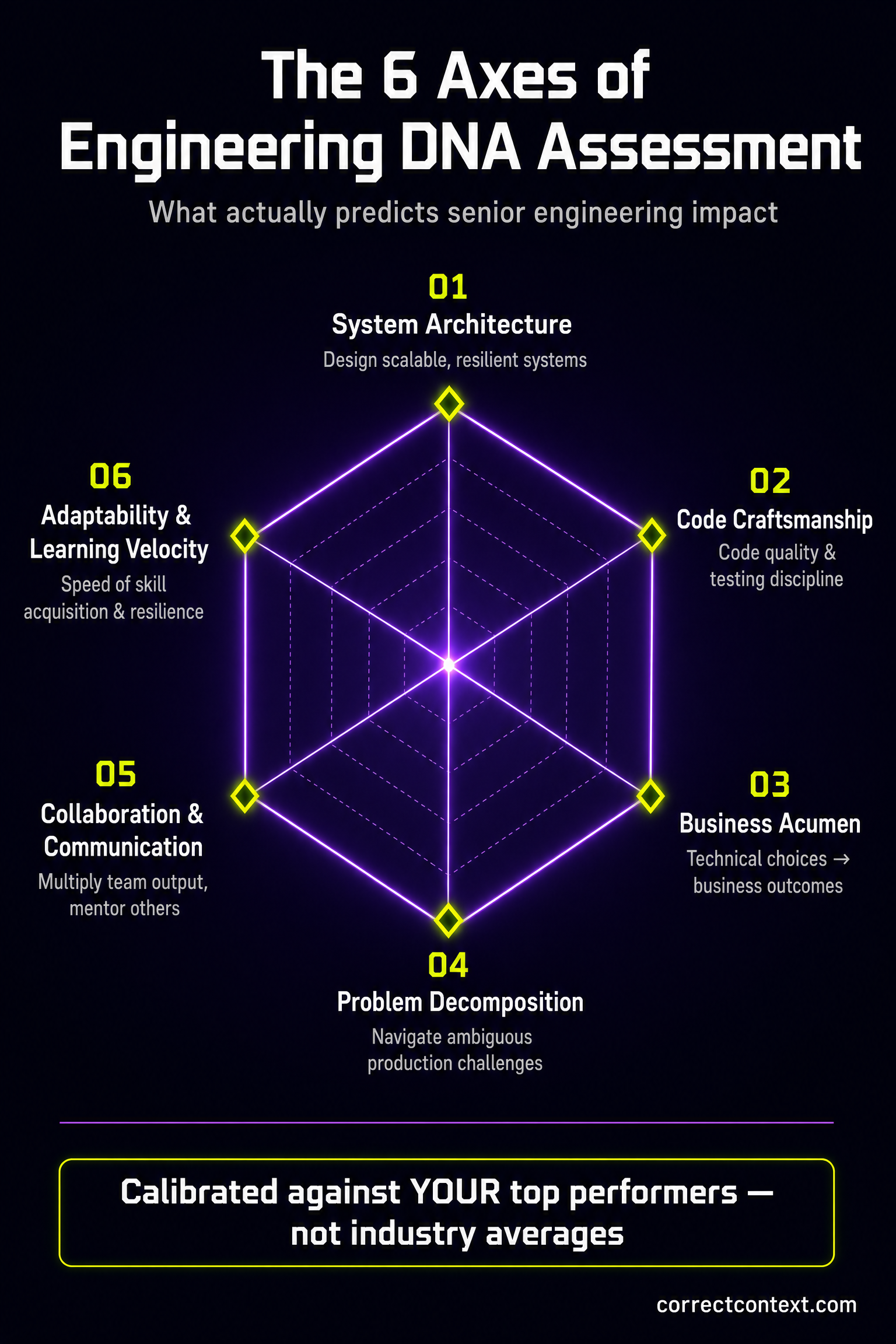
The Engineering DNA assessment is a multi-dimensional evaluation model designed specifically for senior and staff-level engineers. Rather than testing whether a candidate can recall a sorting algorithm under pressure, it evaluates the six core axes that actually predict long-term engineering impact. The framework is calibrated against internal benchmarks — meaning the bar is set by your own top performers, not by abstract industry averages.
The six axes are as follows:
| Axis | What It Measures | Why It Matters at Senior Level |
|---|---|---|
| System Architecture | Ability to design scalable, resilient, and maintainable systems | Senior engineers own architectural decisions that outlast their tenure |
| Code Craftsmanship | Code quality, testing discipline, readability, and refactoring instinct | Poor craft compounds technical debt exponentially at scale |
| Business Acumen | Understanding how technical choices affect product outcomes and revenue | Engineers who ignore business context build the wrong things correctly |
| Problem Decomposition | Navigating ambiguous, production-grade challenges without hand-holding | Real engineering work is rarely well-specified |
| Collaboration & Communication | Mentoring capacity, cross-functional fluency, and async communication quality | Senior engineers multiply team output; they are not just individual contributors |
| Adaptability & Learning Velocity | Speed of skill acquisition, openness to new paradigms, and resilience under change | In AI-accelerated environments, the half-life of hard skills is shrinking fast |
Each axis is weighted and scored against a benchmark profile derived from your highest-performing engineers. The result is a calibrated Engineering DNA assessment that surfaces not just whether a candidate is technically capable, but whether their engineering profile matches the specific demands of your team, stack, and growth stage.
The Architecture Axis: Where Most Screening Processes Fall Shortest
Of the six axes, architecture is the one most consistently underweighted in standard technical interviews — and the one with the highest downstream impact. A developer who cannot evaluate software architecture skills at the system level will make decisions that seem locally correct but are globally catastrophic: tight coupling that prevents horizontal scaling, missing abstraction layers that make the codebase impossible to test, or data models that cannot evolve without full rewrites.
The Engineering DNA assessment addresses this through scenario-based architecture challenges that mirror real production environments. Candidates are not asked to implement a binary search tree. They are asked to design a data ingestion pipeline for a multi-tenant SaaS platform, explain how they would handle schema evolution across a distributed system, or articulate the trade-offs between a monolith and a service-oriented architecture for a company at a specific growth stage. These scenarios have no single correct answer — which is precisely the point. The evaluator is not scoring correctness; they are scoring reasoning quality, trade-off awareness, and the ability to communicate architectural intent clearly.
According to Deloitte’s landmark research on skills-based organizations, companies that make hiring decisions based on demonstrated skills and capabilities rather than job titles or credentials are nearly twice as likely to place talent effectively and retain high performers.[4] Architecture assessment is where the skills-based approach pays its highest dividend in engineering hiring.
No-Code Assessment: Removing the Syntax Filter
One of the most significant advances in senior developer testing is the emergence of no-code, scenario-driven assessment formats. These tools remove the syntax filter entirely — the artificial barrier that eliminates strong architects and systems thinkers simply because they haven’t memorized the API for a data structure they would look up in production anyway.
No-code assessments present candidates with system diagrams, incident reports, architecture review documents, or product requirement briefs and ask them to respond in natural language or through structured decision frameworks. The output is evaluated not by a compiler but by a calibrated rubric aligned to the six-axis Engineering DNA assessment model.
This approach is particularly powerful for evaluating candidates for roles on dedicated development teams and extended engineering teams where collaboration, communication, and architectural judgment matter as much as raw implementation speed. For CTOs building remote software engineers teams across geographies — including engineering hubs in Poland and CEE — no-code assessments also remove the language and cultural bias that can distort performance on syntax-heavy tests.
Forrester’s research on skills-based talent practices confirms that this approach is “dramatically more effective than traditional methods such as recruiting for specific job titles or academic credentials,” particularly in technology organizations navigating rapid skill evolution driven by AI and cloud infrastructure shifts.[5]
Calibrating to Internal Benchmarks: The Missing Step
Most organizations that adopt multi-axis assessments make one critical mistake: they calibrate against industry averages rather than internal benchmarks. An industry average tells you where a candidate sits relative to the broader market. An internal benchmark tells you whether that candidate will perform at the level your specific team requires.
The calibration process is straightforward but requires intentional design. Begin by running the Engineering DNA assessment across your current senior engineers — particularly those identified as high performers by their managers and peers. This creates a benchmark profile that reflects the actual skills distribution, architectural patterns, and collaboration norms of your engineering culture. New candidates are then assessed against this profile, not against a generic rubric.
McKinsey’s research on developer productivity measurement found that organizations using talent capability scores — summaries of individual knowledge, skills, and abilities benchmarked against an internal standard — were able to move 30% of their developers to the next level of expertise within six months of implementing targeted development programs.[2] The same principle applies to hiring: when you know exactly what your top performers look like across six axes, you can identify candidates who match that profile with far greater precision than any LeetCode score provides.
Scaling Engineering Teams Without Scaling Risk
The Engineering DNA assessment framework is not just a hiring tool. It is a risk management instrument for CTOs who are under pressure to scale engineering teams fast without compromising quality. When you are building a dedicated software team or expanding an offshore development team in a high-velocity environment, the cost of a single misaligned senior hire is not just financial — it is architectural. One engineer with poor systems thinking embedded in a core platform team can introduce design decisions that take years and millions of dollars to unwind.
For enterprise innovation units and Series A+ startups scaling into European markets, this risk is compounded by the complexity of building cross-cultural, distributed remote development teams. The six-axis framework provides a common evaluation language that works across geographies, removing the inconsistency that plagues traditional technical interviews when conducted across time zones and hiring managers with different standards.
Correct Context specializes in helping companies build high-performance engineering teams in Poland and CEE — including Big Data analytics teams, cloud engineering teams (AWS, Azure, GCP), AI development teams, and platform engineering teams — without requiring clients to establish local legal entities. Our Employer of Record Poland and EoR Europe model handles employment compliance, payroll services, and HR infrastructure, while the Engineering DNA assessment framework ensures that every engineer placed meets the calibrated benchmark of your internal top performers.
What This Means for Your Hiring Process
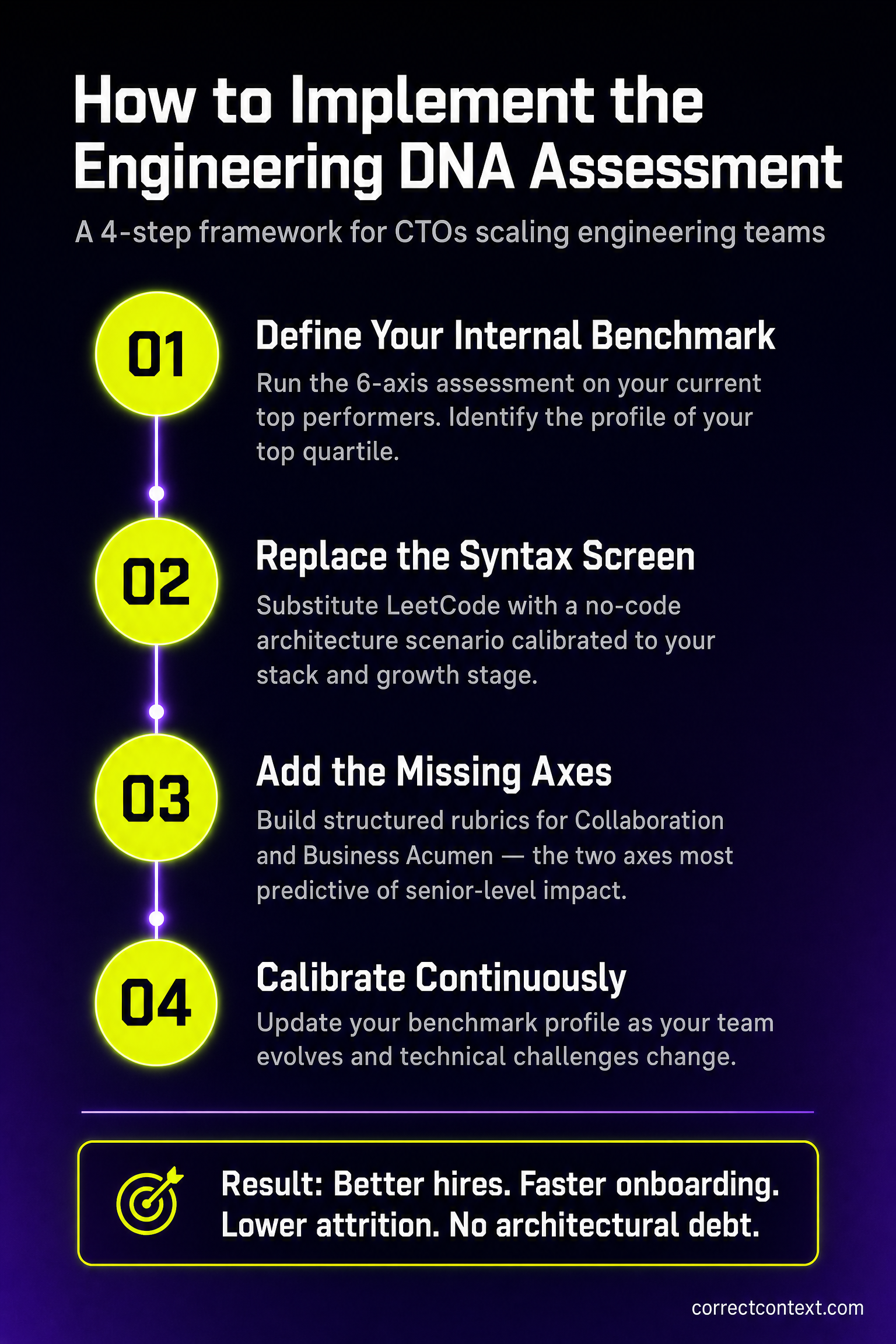
The shift from LeetCode to Engineering DNA assessment does not require a complete overhaul of your hiring process. It requires a reorientation of what you are measuring and why. The practical steps are as follows.
First, define your benchmark by running the six-axis assessment on your current senior engineers and identifying the profile of your top quartile. Second, replace or supplement your existing coding screen with a no-code architecture scenario calibrated to your stack and growth stage. Third, add structured evaluation rubrics for the collaboration and business acumen axes — these are almost always missing from technical interviews and are the axes most predictive of long-term impact at the senior level. Fourth, calibrate continuously: as your team evolves and your technical challenges change, update your benchmark profile to reflect the new standard.
The goal is not to make hiring easier. The goal is to make it more accurate — to ensure that the engineers you bring onto your extended engineering team or dedicated development team are evaluated on the dimensions that actually determine whether they will succeed in your specific environment.
In a market where 91% of business leaders believe optimizing hiring with better assessment practices is necessary for long-term success,[3] the organizations that move first to adopt calibrated, multi-axis Engineering DNA assessments will build a compounding advantage: better hires, faster onboarding, lower attrition, and engineering teams that scale without accumulating the architectural debt that slows everyone else down.
References
[1] Salary vs Total Cost of Hiring Engineers: What Leaders Miss
[2] Yes, you can measure software developer productivity
[4] The skills-based organization: A new operating model for work and the workforce
[5] Use Skills-Based Talent Practices To Future-Proof Your Tech Organization
Table of content
- Why Standard Tests Fail Senior Engineers
- Introducing the Engineering DNA Assessment Framework
- The Architecture Axis: Where Most Screening Processes Fall Shortest
- No-Code Assessment: Removing the Syntax Filter
- Calibrating to Internal Benchmarks: The Missing Step
- Scaling Engineering Teams Without Scaling Risk
- What This Means for Your Hiring Process
Related articles



About the Author: Marta