
A four-page technical CV can hold the evidence a startup needs to make a great hire – and still be nearly impossible to evaluate consistently when applications are arriving faster than the team can read them. The recruiter has to reconstruct a career story from overlapping job titles, acronyms, project lists, side projects, career gaps, and claims of varying relevance. Meanwhile, a capable candidate may be missed because the right experience is buried on page three or described in unfamiliar language.
AI CV scanning changes the first pass. Rather than treating a résumé as a document to skim, it turns the document into a structured, job-relevant profile that a human can review. For an illustrative fast-path workflow, that can mean taking a four-page CV to a usable profile in roughly seven seconds – not an automatic hiring decision, but a quicker route to the questions worth asking. Actual processing time will vary with file quality, language, integrations, and the scoring rubric.
The objective is not to let software choose people. It is to make the recruiter’s first decision more informed, more consistent, and far less dependent on hurried manual extraction.
The startup hiring bottleneck is not a lack of résumés
For an early-stage company, every screening hour competes with sourcing, candidate conversations, team coordination, and closing the finalists. A conventional review process also makes it hard to compare applicants fairly. One recruiter may notice a Kubernetes migration; another may prioritize the candidate’s larger company name; a third may never reach the bullet point that explains the person led the work.
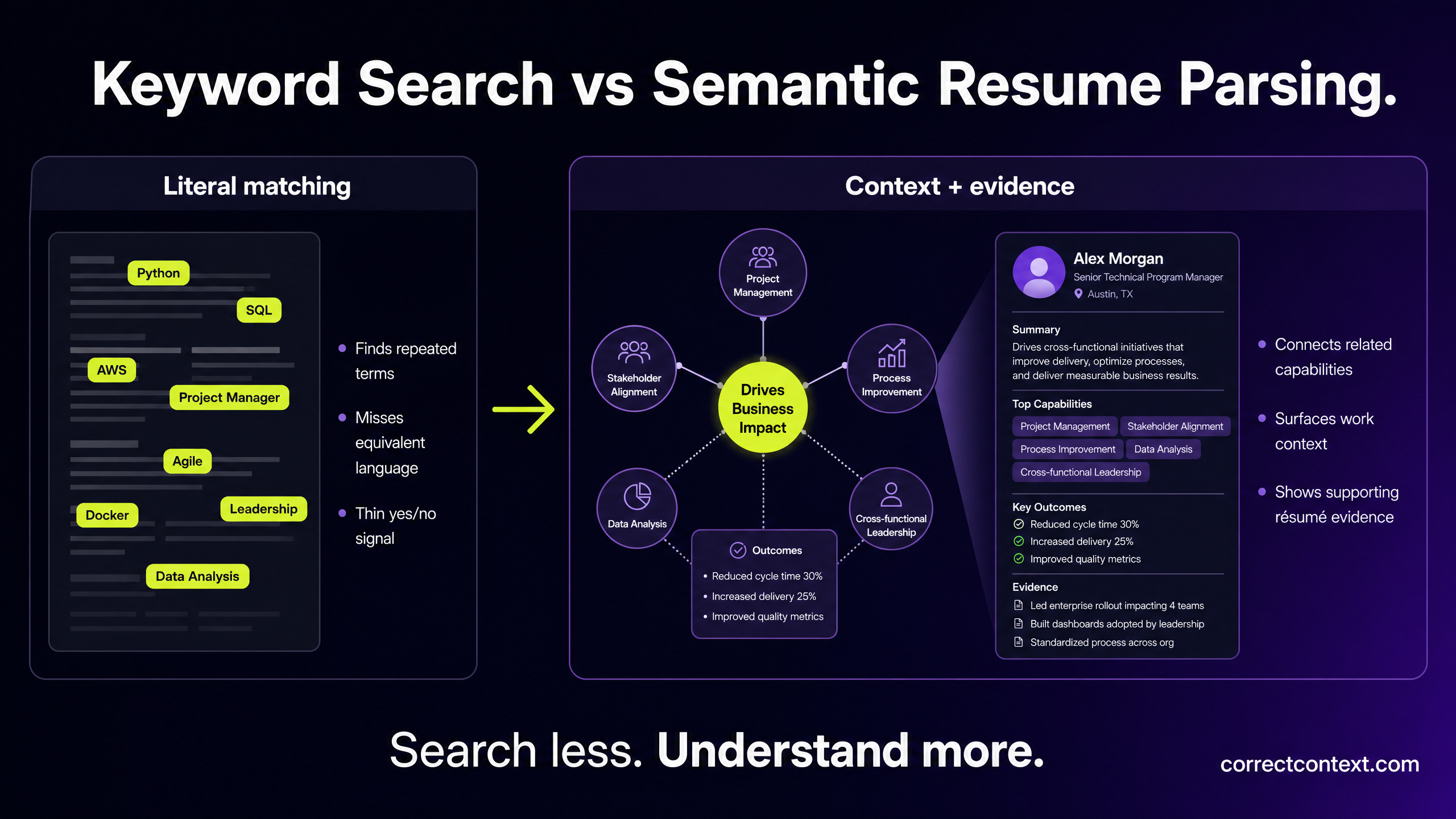
The problem compounds in technical recruiting. Skills are often expressed indirectly through outcomes, internal titles, or adjacent tools. A candidate who writes “built a self-serve deployment platform for 30 engineers” may be highly relevant to a platform-engineering role even if they do not repeat the exact phrase in the job description. Keyword matching can retrieve terms; it cannot reliably explain whether the evidence demonstrates the capability the role needs.
What semantic resume parsing adds to AI CV scanning
Semantic resume parsing converts unstructured CV content into a comparable candidate record while preserving the evidence behind it. It recognizes the relationships among skills, roles, seniority, scope, outcomes, and time – not just the frequency of a keyword. In practical terms, it can identify that “reduced deployment time from two hours to 15 minutes” is evidence of delivery and automation experience, then link that evidence to the role requirements.
| Manual résumé review | Keyword-only screening | Semantic resume parsing |
|---|---|---|
| Relies on each reviewer to find and interpret relevant evidence. | Searches for literal matches, which can overlook equivalent phrasing. | Extracts structured facts and connects related skills, experiences, and outcomes. |
| Notes are often inconsistent and difficult to compare. | Produces a thin yes/no signal based on term presence. | Produces an evidence-backed profile for human review. |
| Is slowest when the applicant volume or CV length rises. | Is fast, but can be brittle when titles and terminology vary. | Accelerates the first pass while preserving source evidence and review context. |
An AI ATS with this capability should create a profile that answers the recruiter’s immediate questions: What has this person done? At what level? In which environment? What job criteria does the résumé support? Where is the missing or contradictory information? Most importantly, every summary item should trace back to the text that supports it.
The seven-second workflow: from document to recruiter-ready profile
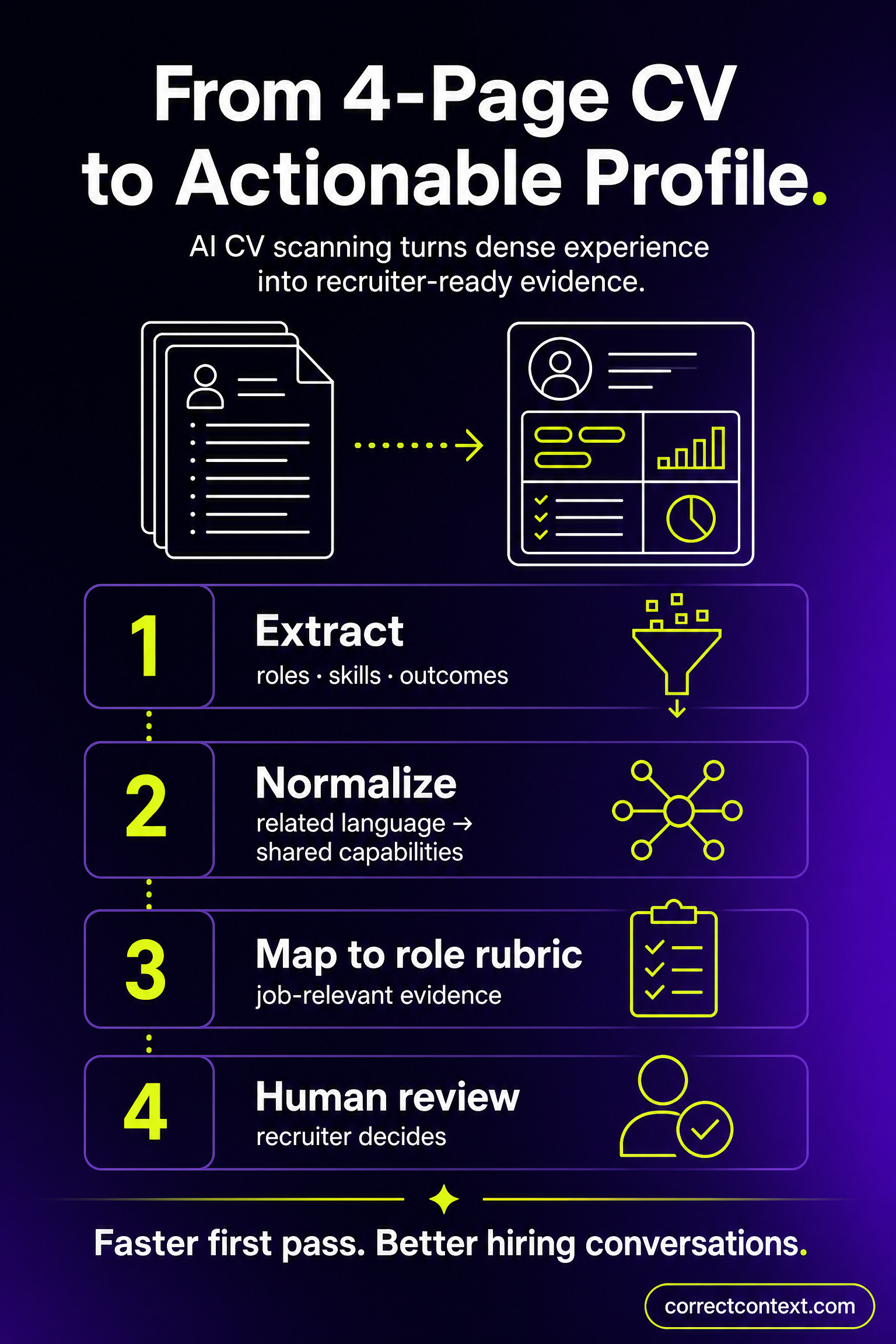
The useful unit of work is not a résumé score alone. It is an actionable profile that can move a candidate into the right next step or surface a reason to pause. A strong AI CV scanning workflow follows four steps.
First, the system ingests the CV and extracts fundamental facts such as roles, employers, dates, education, tools, certifications, projects, and measurable outcomes. It should handle common variations, including non-linear chronology and skills embedded in project descriptions.
Second, it normalizes the information. This is where “Python automation,” “internal tooling in Python,” and “built scripts for data quality” can be represented as related evidence rather than three unrelated strings. Normalization gives startup teams a shared language for comparing applicants without forcing candidates into a rigid template.
Third, the tool maps the evidence to a role-specific rubric. For a founding backend engineer, the rubric may value production ownership, system design, APIs, cloud operations, and an ability to work in ambiguity. For a first sales hire, it may weight pipeline ownership, target-segment experience, deal complexity, and evidence of building a motion from scratch. The rubric must be created by the hiring team, not inferred from historical hires.
Fourth, the recruiter reviews the output and source excerpts, then decides whether to advance, reject, request clarification, or route the candidate elsewhere. The speed comes from avoiding repetitive extraction; the judgment remains with the people accountable for hiring.
| Profile component | What the AI should provide | What the recruiter should decide |
|---|---|---|
| Career snapshot | Roles, tenure, seniority signals, industries, and trajectory. | Whether the path fits the company’s present-stage need. |
| Skills evidence | Related tools, capabilities, and the résumé lines that support them. | Whether the evidence is sufficient for the role’s must-haves. |
| Impact and scope | Projects, ownership, measurable outcomes, and team or customer scale. | Whether the scope is comparable to the problem the startup needs solved. |
| Fit signals | Transparent alignment against an agreed job rubric. | Whether to advance, ask targeted questions, or consider another role. |
| Data-quality flags | Missing dates, conflicting claims, unclear chronology, or unsupported assertions. | Whether a clarification is needed and how much weight the issue deserves. |
Why “score” should never mean “reject automatically”
Automated applicant screening becomes risky when a score is presented as a verdict. A numeric ranking can be useful as a sorting aid, but it should not conceal the factors that produced it or substitute for a human decision. The U.S. Equal Employment Opportunity Commission has specifically noted that résumé-scoring software may use algorithms or AI and warned that such tools can unlawfully discriminate against people with disabilities if safeguards are absent.
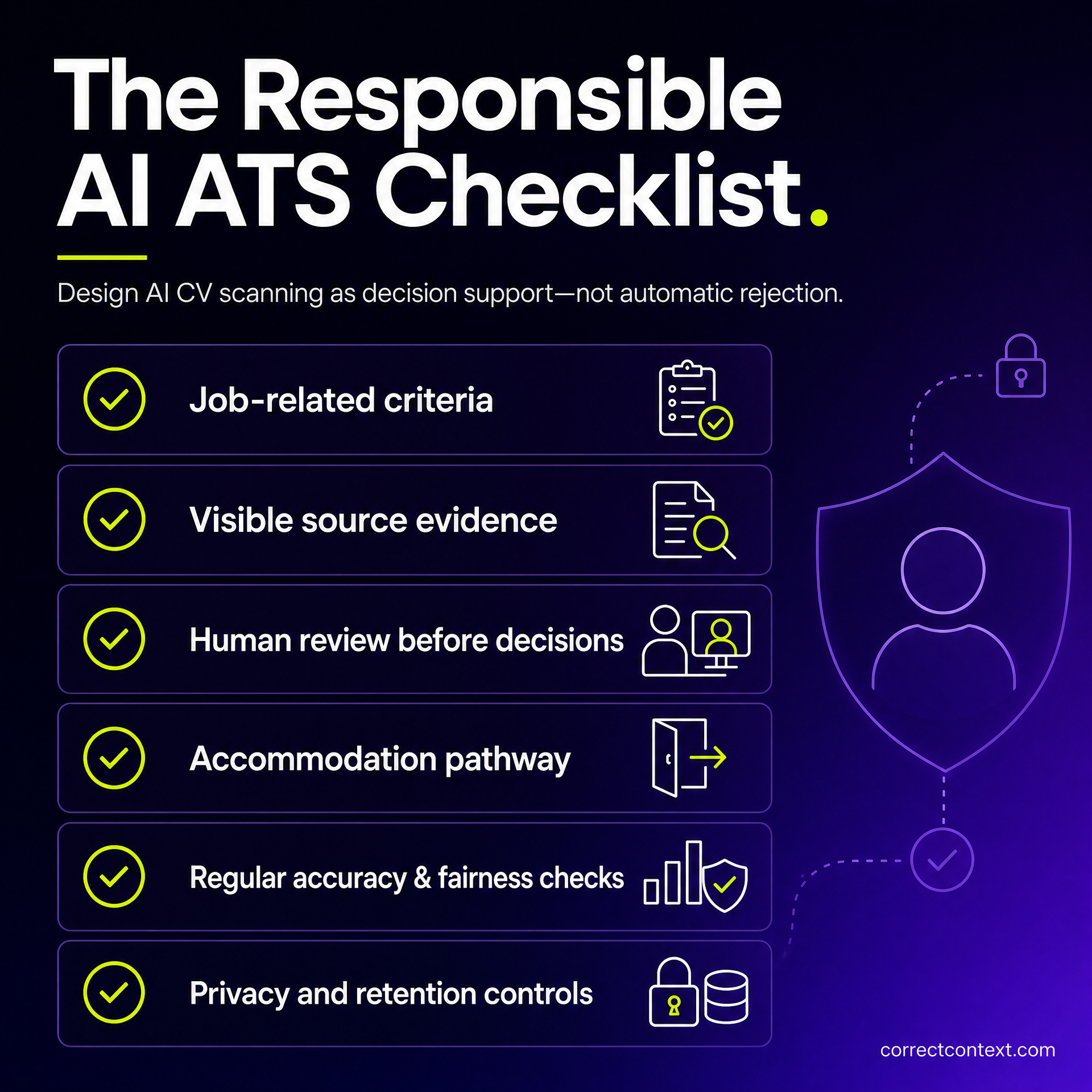
This does not make the technology unusable. It makes the implementation important. The EEOC’s guidance highlights the need for a process to provide reasonable accommodations and warns that algorithmic tools can screen out qualified people with disabilities, including people who could do the job with or without accommodation. A startup should therefore define the AI system as decision support, keep a qualified human reviewer in the loop, and ensure that candidates have a clear accommodation path.
Use an AI ATS to make the first pass explainable
The best test of an AI-powered ATS is simple: when a recruiter asks, “Why is this candidate a match?” the platform should point to evidence, not a black-box conclusion. For each match or flag, the reviewer should be able to see the relevant CV excerpt and the criterion that was applied.
This approach also makes hiring debriefs better. Instead of arguing from vague impressions, interviewers can discuss the evidence: production scale, domain knowledge, leadership scope, a career transition, or a skill that is adjacent rather than identical. It is easier to spot a weak rubric when the system shows its work.
NIST’s AI Risk Management Framework describes voluntary guidance for incorporating trustworthiness considerations into the design, development, use, and evaluation of AI systems. Applied to recruiting, that means treating CV scanning as an operating process: define the purpose, document the role criteria, test the outputs, monitor outcomes, and revise the workflow when evidence shows it is not serving the intended goal.
A practical adoption checklist for startup teams
Start with one role family and one narrowly defined problem, such as reducing the manual review burden for inbound engineering applicants. Resist the temptation to activate every automated decision feature at once. The initial goal is to make the recruiter faster and better informed while collecting feedback on extraction accuracy and relevance.
| Before launch | During implementation | After launch |
|---|---|---|
| Define job-related, observable criteria with the hiring manager. | Configure the tool to show evidence and uncertainty, not only a composite score. | Sample decisions regularly and compare profiles with the original CVs. |
| Identify what the tool must not infer or use in screening. | Preserve a human review step before consequential decisions. | Track errors, overrides, and candidate feedback to improve the rubric. |
| Confirm privacy, retention, security, and regional legal requirements with appropriate internal or external advisers. | Provide a documented accommodation and escalation path. | Revalidate when the role, candidate market, or model changes. |
| Set baseline measures: time to first review, reviewer agreement, and qualified-candidate conversion. | Train recruiters on what each signal means and does not mean. | Audit whether the workflow creates unintended exclusion or inconsistent handling. |
These controls are not administrative overhead. They are how a startup avoids turning speed into noise. A strong implementation should make it easier to identify candidates whose experience is described differently, not harder for them to be seen.
Questions to ask before choosing an AI CV-scanning platform
When evaluating vendors, focus less on headline automation claims and more on operational fit. Ask whether the platform can explain each screening signal, show the underlying résumé evidence, and let your team change the rubric by role. Ask how it handles PDFs with unusual layouts, multi-language applications, candidates with non-traditional career paths, and information the hiring team does not want to use.
You should also ask how the platform supports oversight. Can reviewers override a recommendation and record why? Can you review distributions or outcomes across stages? Does the vendor provide clear information about data handling, model updates, access controls, and retention? Does the workflow give candidates an accessible way to request an accommodation or alternative process where applicable? These questions turn “AI-powered” from a feature label into a capability you can govern.
The bottom line: reclaim review time without lowering the bar
AI CV scanning is most valuable when it transforms a dense technical résumé into a transparent, evidence-backed starting point for a real recruiter. It can help startups spend less time reformatting career histories and more time evaluating the work, potential, and motivation that matter for the role.
Choose semantic resume parsing when you need more than a keyword filter. Choose an AI ATS when it gives you configurable, job-related criteria; visible evidence; meaningful human control; and a process for monitoring risk. If a four-page CV can become an actionable profile in seconds, the reward should be better conversations with more of the right people – not a faster way to close the door on them.
Frequently asked questions
What is AI CV scanning?
AI CV scanning is the use of artificial intelligence to read CVs or résumés and organize the information into a structured candidate profile. A responsible system helps recruiters surface roles, skills, achievements, and evidence relevant to a defined job rubric; it does not replace the recruiter’s decision.
How is semantic resume parsing different from keyword matching?
Keyword matching checks whether specific words appear in a CV. Semantic resume parsing interprets related language and context, helping the system recognize that different terms or project descriptions may demonstrate a similar capability. The recruiter should still verify the source evidence and decide whether it meets the role requirement.
Can an AI ATS automatically reject applicants?
It can be configured to automate workflow actions, but that is not the safest or most useful default for consequential hiring decisions. Employers remain responsible for ensuring their processes comply with applicable obligations. In the United States, the EEOC warns that AI and algorithmic employment tools can create disability-discrimination risks without appropriate safeguards. Seek qualified legal and HR advice for your organization and jurisdiction.
What should startups measure after adopting automated applicant screening?
Measure practical outcomes: time from application to first qualified review, recruiter override rate, quality of extracted information, reviewer agreement, interview conversion, and feedback from candidates and hiring managers. Pair operational measures with periodic checks that the tool is being used as intended and is not creating avoidable exclusion.
References
AI CV Scan — From PDF to profile in 7 seconds | Ceevee
AI Risk Management Framework | NIST
Table of content
- The startup hiring bottleneck is not a lack of résumés
- What semantic resume parsing adds to AI CV scanning
- The seven-second workflow: from document to recruiter-ready profile
- Why “score” should never mean “reject automatically”
- Use an AI ATS to make the first pass explainable
- A practical adoption checklist for startup teams
- Questions to ask before choosing an AI CV-scanning platform
- The bottom line: reclaim review time without lowering the bar
- Frequently asked questions
- References
Related articles



About the Author: Marta