
An internal candidate database should be a sourcing advantage. Yet many teams treat it like a maze: they try one Boolean string, scan a page of results, add or remove a synonym, and hope the next query uncovers the person who should have appeared first. The problem is not that recruiters are poor searchers. The problem is that careers are described in human language, while conventional recruiter database search often relies on literal text overlap.
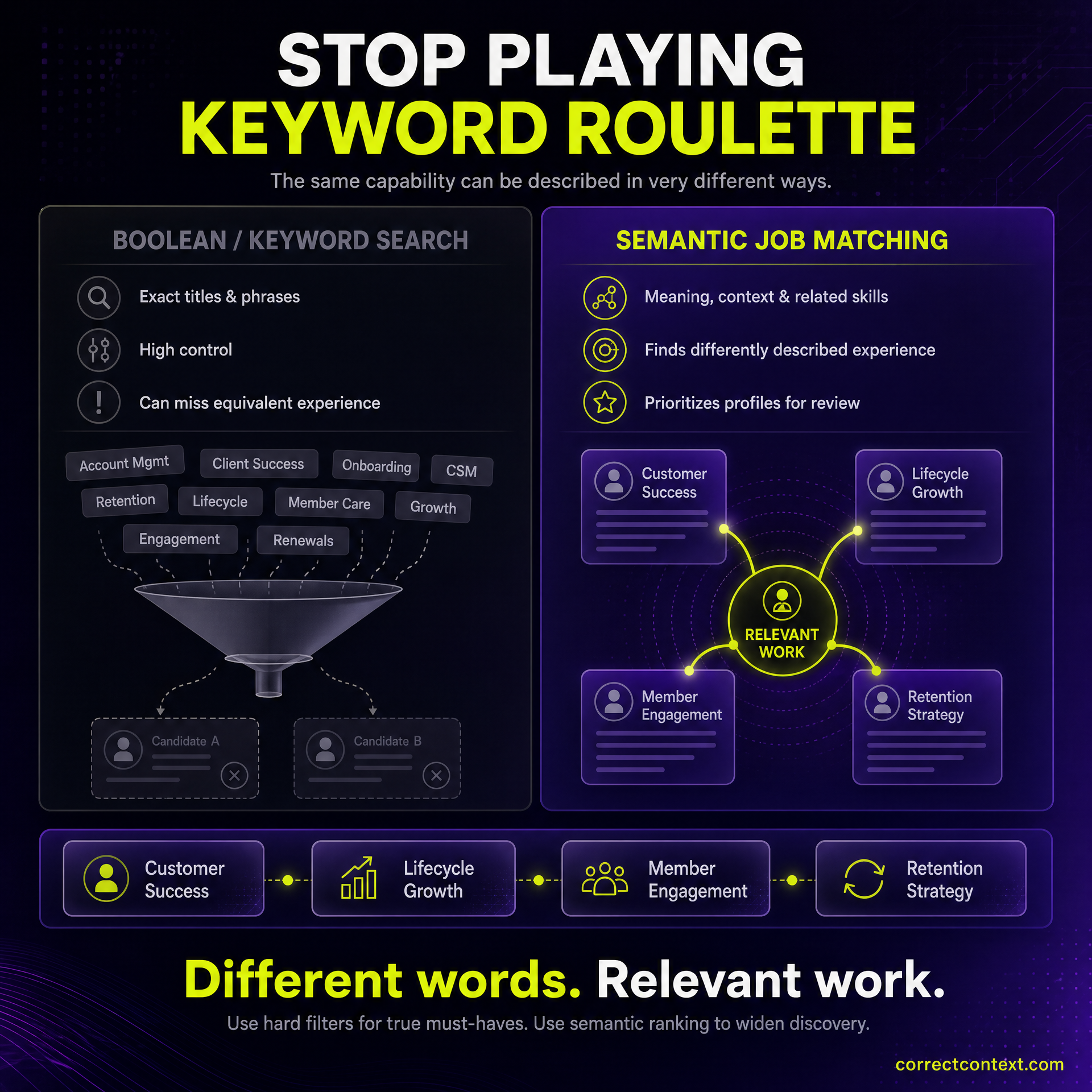
A strong candidate for a “customer retention manager” role may call their work “lifecycle growth,” “member engagement,” or “subscription marketing.” A Boolean query can catch some of those variations when an expert anticipates them, but it remains fragile. The recruiter has to predict every viable title, tool, acronym, spelling variation, and way of describing relevant work before the search begins. That creates a costly form of keyword roulette: the right person may already be in the database but remain invisible because their résumé uses different language.
Semantic job matching changes the starting point. Instead of treating a job description and a candidate profile as bags of matching words, it interprets the relationship among roles, skills, scope, industry context, and evidence of experience. Semantic search is designed to find concepts and meanings rather than merely matching text strings; in recruiting, this can surface people who describe similar roles and skills differently.[2]
Semantic job matching is an AI-assisted retrieval and ranking approach that compares the meaning of a job’s requirements with the evidence in candidate profiles, then gives recruiters an explainable, reviewable shortlist.
This is not an argument for eliminating Boolean search. Exact search remains valuable when a requisition calls for a specific license, location, employer, clearance, language, or technology. The better model is beyond Boolean search, not against it: use precise filters to protect true requirements, then use semantic retrieval to broaden discovery and AI candidate ranking to help a human prioritize review.
| Search approach | What it does well | Where it falls short | Best role in a sourcing workflow |
|---|---|---|---|
| Exact keyword search | Finds known names, credentials, tools, and phrases quickly | Misses equivalent language and can be overly dependent on query construction | Verifying non-negotiable terms and running narrow, targeted queries |
| Boolean search | Gives skilled sourcers detailed control over inclusion and exclusion logic | Becomes difficult to maintain as title, skill, and industry vocabularies multiply | Applying hard constraints and investigating a defined talent niche |
| Semantic job matching | Recognizes related concepts, contextual skills, and different descriptions of comparable work | Requires quality role inputs, transparent ranking logic, and recruiter review | Expanding the candidate pool and prioritizing likely relevance |
Why Boolean searches miss strong candidates
Boolean syntax is a powerful language for saying exactly what you already know. A query such as (“Customer Success” OR “Account Management”) AND (SaaS OR software) AND renewal can be useful. But it asks the recruiter to define the language of success in advance. It may omit a candidate who led “retention strategy” in a subscription business, increased “net revenue retention,” and built post-sale processes without ever using the phrase “customer success.”
The issue is more than titles. Candidate profiles distribute evidence across several fields: job titles, employer descriptions, project bullets, skills, certifications, recruiter notes, and prior applications. A person may use a broad title but show precise, relevant experience in the details. An effective match process should connect that evidence to the job rather than discard it because a single title or keyword does not line up.
Semantic search engines are intended to recognize different expressions of a concept and evaluate terms in context, which can make candidate discovery more relevant while reducing dependence on specialized Boolean expertise.[2] For the sourcing team, the practical value is straightforward: the internal database becomes a broader set of candidate stories to evaluate, not simply a set of strings to match.
What AI candidate ranking should actually rank
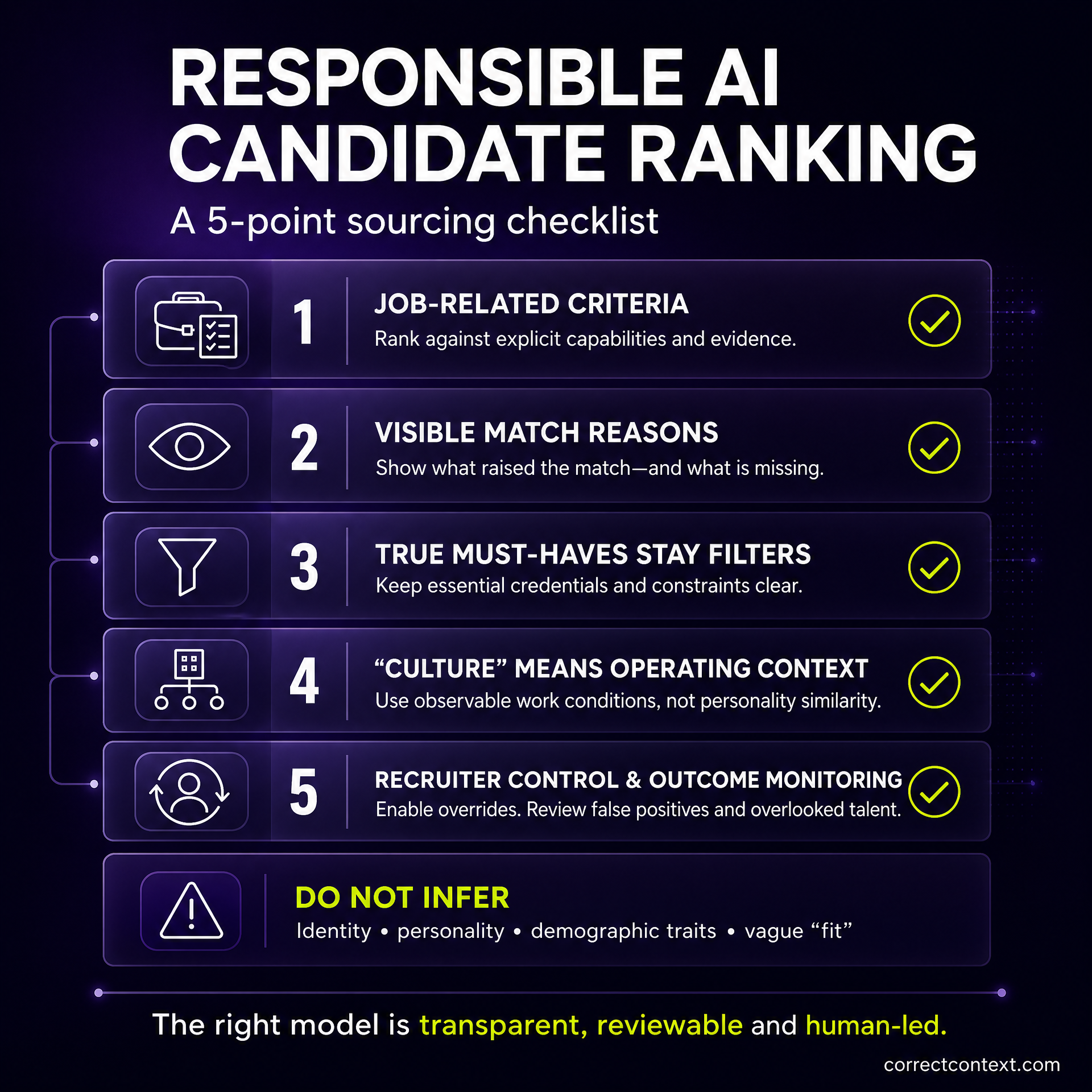
The word “ranking” can imply a black box that decides who is worthy. That is the wrong operating model. A useful Job Match AI should produce a structured recommendation, not a final employment decision. It should make its reasoning visible enough for recruiters to validate, adjust, and override.
Start by converting the requisition into a small number of explicit criteria. Separate must-haves from preferences, and distinguish demonstrated experience from assumptions. Then weight the factors according to the role. A senior implementation leader may need deep evidence of enterprise delivery and change management. An early-career revenue operations hire may call for foundational analytical skills, learning agility demonstrated through projects, and relevant operating exposure. The ranking logic should change with the work, rather than reuse a generic notion of “best candidate.”
| Ranking dimension | What the system evaluates | Example of recruiter-facing evidence | Safeguard |
|---|---|---|---|
| Core capability | Whether the candidate has performed work connected to the role’s essential responsibilities | “Built onboarding program for multi-site customers” linked to implementation leadership | Keep the required capabilities explicit and job-related |
| Transferable experience | Similarity of scope, environment, outcomes, and complexity—not just identical job titles | “Managed renewal portfolio” connected to retention ownership | Show the connection and allow recruiters to reject it |
| Skills and tools | Direct skills, related tools, and adjacent technical concepts | SQL, dashboarding, and analytics workflow evidence for an operations role | Preserve hard requirements when they are genuinely necessary |
| Practical constraints | Location, work authorization, language, availability, clearance, or compensation range where lawful and appropriate | “Based in Chicago; hybrid eligible” | Treat as filters or disclosed factors, not hidden penalties |
| Operating-context preferences | Documented, job-relevant preferences such as team size, client-facing work, travel, or pace | “Led a lean, cross-functional team in a rapid-release environment” | Do not infer personality, identity, or vague ‘culture fit’ |
The final dimension deserves special care. “Culture” should not mean whether a candidate resembles the existing team or shares social preferences. That is neither a reliable nor defensible criterion for talent selection. If culture is relevant, translate it into observable, work-related conditions: comfort with a distributed team, willingness to travel, experience in regulated environments, preference for a high-autonomy operating model, or evidence of stakeholder-facing work. Then make the factor visible, secondary to core qualifications, and easy to challenge.
How semantic job matching works in an internal database
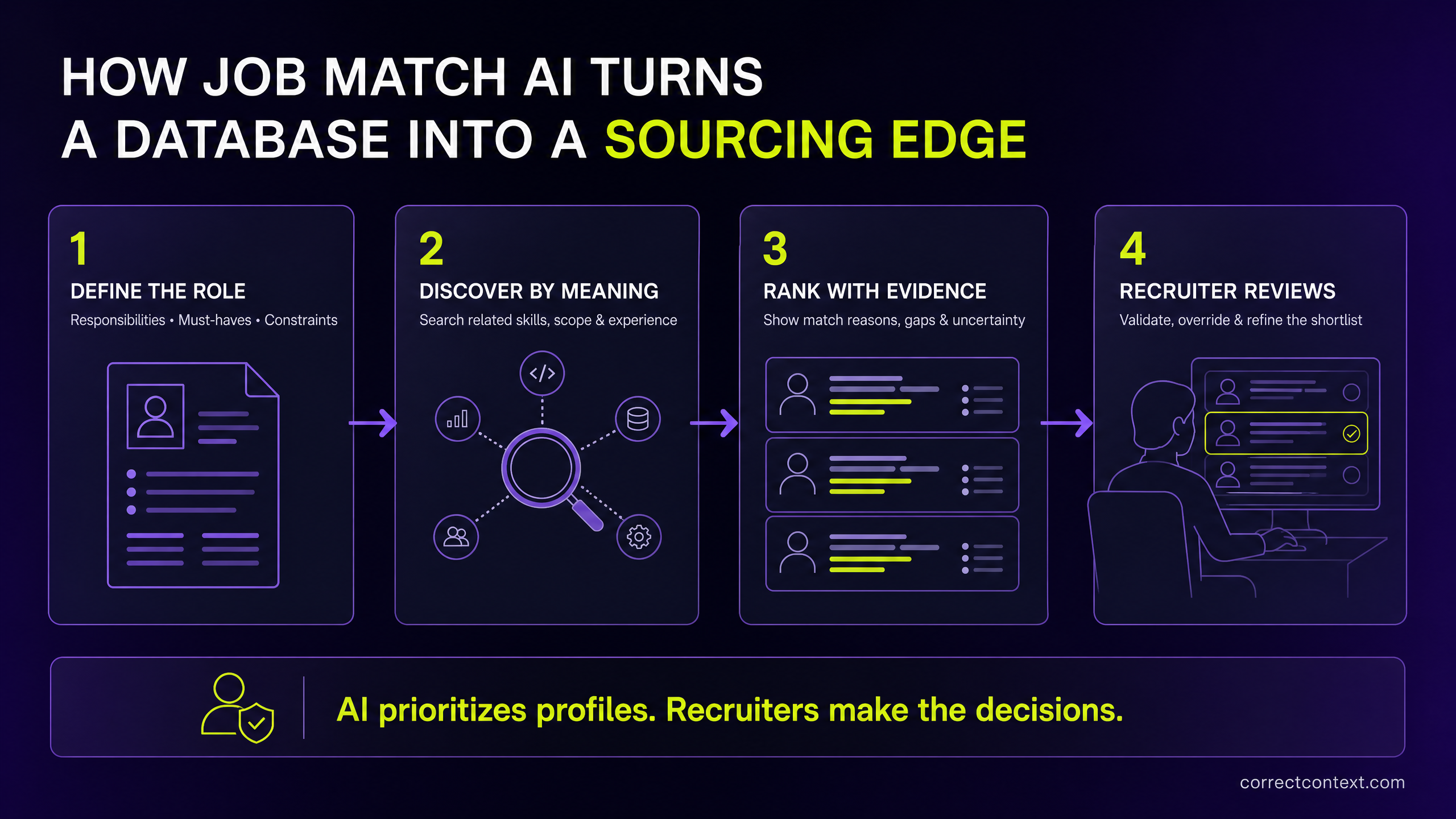
A Job Match AI does not need to replace an ATS or CRM to be useful. Its immediate role is to improve recall and prioritization inside the records the team already owns. The process can be understood as a four-layer workflow.
First, the system turns a job brief into a structured requirement profile. The sourcer or hiring team identifies the work to be done, must-have capabilities, preferred evidence, practical constraints, and disqualifiers. This step is where hiring quality begins. A vague brief produces a vague ranking, no matter how sophisticated the model is.
Second, semantic retrieval looks across candidate profiles for related experience and skills. Instead of only returning profiles that contain the same word, it can retrieve candidates whose profile language indicates similar work. This produces a wider discovery pool—one that should still respect any hard filters the team set.
Third, AI candidate ranking orders the retrieved group against the structured job profile. The system should show a match summary, supporting profile evidence, and any uncertainty. A good interface does not merely label a candidate “92% match.” It explains that the candidate is highly ranked because they have led renewal programs, managed a comparable book of business, and worked in a similar go-to-market motion, while lacking a requested industry credential. Recruiters can then decide whether that gap is disqualifying.
Finally, the recruiter reviews the list and gives feedback. This is the point at which expertise matters most. The recruiter can elevate an unconventional but promising background, remove a superficial match, and refine the weighting or requirements for the next search. The goal is not to automate judgment away; it is to focus judgment on the most relevant evidence sooner.
| Workflow stage | Team action | System contribution | Useful output |
|---|---|---|---|
| Define the role | Clarify responsibilities, must-haves, preferences, and constraints | Normalizes the brief into comparable criteria | A searchable, auditable job profile |
| Discover candidates | Select the internal database, talent pool, or prior applicants to search | Retrieves profiles connected by meaning and context | A broader, relevant candidate set |
| Prioritize review | Set role-specific weights and inspect reasons for a match | Ranks candidates and highlights evidence and gaps | A transparent, recruiter-ready shortlist |
| Validate and learn | Review profiles, contact candidates, and record outcomes | Captures feedback for process improvement | Better queries, better criteria, and better governance |
A practical example: from “exact title” to relevant work
Imagine a company hiring a customer expansion manager for a B2B software product. The role needs experience owning renewals, partnering with sales, interpreting account health signals, and working with mid-market customers. A traditional query might prioritize titles containing “customer success manager” and words such as “renewals” or “upsell.” It will find some excellent candidates, but it can also leave valuable records untouched.
A semantic job matching workflow can surface an account manager who references “retention,” “contract extensions,” “usage adoption,” and “expansion pipeline”; a client services lead who owned customer health reviews; or a subscription growth manager whose résumé describes lowering churn and improving account engagement. None should be hired because the system found them. Each should be reviewed because their evidence may connect meaningfully to the job.
The recruiter retains control over essential differences. A candidate who worked only with consumers rather than B2B buyers, or only in a very small portfolio when the role demands enterprise complexity, may rank lower after review. The advantage is that the team makes that decision based on relevant evidence rather than failing to see the candidate at all.
How to implement Job Match AI without creating a new black box
The safest and most useful launch is a focused pilot, not an organization-wide switch. Choose one or two roles that have enough historical candidate records, repeat often enough to test the workflow, and involve recruiters who know the talent market well. Establish a baseline using the existing recruiter database search process. Then compare results with semantic retrieval and AI candidate ranking.
Success should be measured at the workflow level. Look at whether the semantic process surfaces qualified candidates absent from the initial Boolean shortlist, whether recruiters can explain why they reviewed the top recommendations, and whether candidate-recruiter interactions improve. Do not rely only on a headline match score or on speed. A fast shortlist that overlooks critical experience or embeds a flawed proxy is not a sourcing improvement.
Because these systems influence employment-related work, governance belongs in the design, not after launch. NIST’s AI Risk Management Framework is a voluntary resource for incorporating trustworthiness considerations into the design, development, use, and evaluation of AI systems.[1] In practice, sourcing teams can apply that principle by documenting intended use, limiting the data and signals used for ranking, keeping a recruiter responsible for decisions, monitoring outcomes, and providing a clear escalation path when results appear questionable.
| Pilot question | What a strong answer looks like | Warning sign |
|---|---|---|
| Can recruiters see why a person ranked highly? | The interface points to job-relevant evidence and identifies gaps or uncertainty | A single unexplained score or generic “strong match” label |
| Are hard requirements handled consistently? | The team can define which requirements are filters, ranking inputs, or review prompts | Non-negotiables are silently ignored or inconsistently weighted |
| Can recruiters override the result? | Overrides are easy, documented, and used as feedback | Users feel compelled to follow the order without judgment |
| Is ‘culture’ defined appropriately? | It is limited to observable, job-relevant operating context | The system infers personality, demographic traits, or likeness to incumbents |
| Are outcomes monitored? | The team reviews quality, false positives, overlooked profiles, and stakeholder feedback | The pilot relies on vendor claims or time saved alone |
The right hiring model treats search as decision support
Choosing the right hiring model is not simply a choice between human recruiting and AI. It is a choice between a rigid retrieval process and a disciplined system that helps recruiters see more relevant evidence. For sourcing teams working through years of internal applications, silver-medalist pools, alumni records, and CRM notes, that distinction matters.
Semantic job matching gives teams a practical way to move beyond Boolean search while preserving the precision that Boolean filters provide. It can reduce the dependence on a recruiter’s ability to anticipate every synonym, make existing databases more useful, and turn candidate ranking into an auditable prioritization workflow. But it only earns that value when the system is built around clear job criteria, visible reasons, human review, and ongoing measurement.
The next time a critical requisition lands, do not ask only, “What keywords should we search?” Ask, “What evidence would demonstrate the ability to do this work—and how can our database help us find it?” That question is the beginning of a better shortlist.
Frequently asked questions
What is semantic job matching?
Semantic job matching is a method of comparing a role’s requirements with candidate profiles based on meaning, related skills, and contextual evidence rather than exact keyword overlap alone. It is particularly useful when capable candidates describe comparable work through different job titles, tools, or business language.[2]
Does semantic job matching replace Boolean search?
No. Boolean search is still effective for strict criteria such as a required certification, geography, employer, or named technology. Semantic matching is most effective when it complements those filters by expanding discovery and prioritizing profiles whose experience is relevant but phrased differently.
What should AI candidate ranking consider?
A responsible ranking model should focus on explicit, job-related criteria: essential capabilities, transferable experience, relevant skills, practical constraints, and clearly defined operating-context preferences. Recruiters should be able to inspect the evidence behind the ranking and override it when needed.
Can an AI system assess culture fit?
It should not infer vague “culture fit” or personal similarity. If operating context matters, define it in observable, job-related terms—for example, travel expectations, distributed collaboration, regulated-industry exposure, or client-facing work—and keep it transparent and reviewable.
References
[1] AI Risk Management Framework | NIST
[2] The Benefits of a Semantic Search Engine in Recruitment Tech
Table of content
- Why Boolean searches miss strong candidates
- What AI candidate ranking should actually rank
- How semantic job matching works in an internal database
- A practical example: from “exact title” to relevant work
- How to implement Job Match AI without creating a new black box
- The right hiring model treats search as decision support
- Frequently asked questions
- References
Related articles



About the Author: Marta