
An empty senior engineering seat is not merely a hiring issue. It is a daily operating expense. Founders may treat an open requisition as a future salary cost. In a product-led company, it misses the urgent number: the value, decisions, and work delayed while the role is vacant.
This is the cost of unfilled IT jobs. It is not a single invoice from Finance. It is a compound drain across delivery, leadership attention, customer commitments, and team capacity. For lean startups and enterprise data units, this drain can be more consequential than a difference in agency fees.
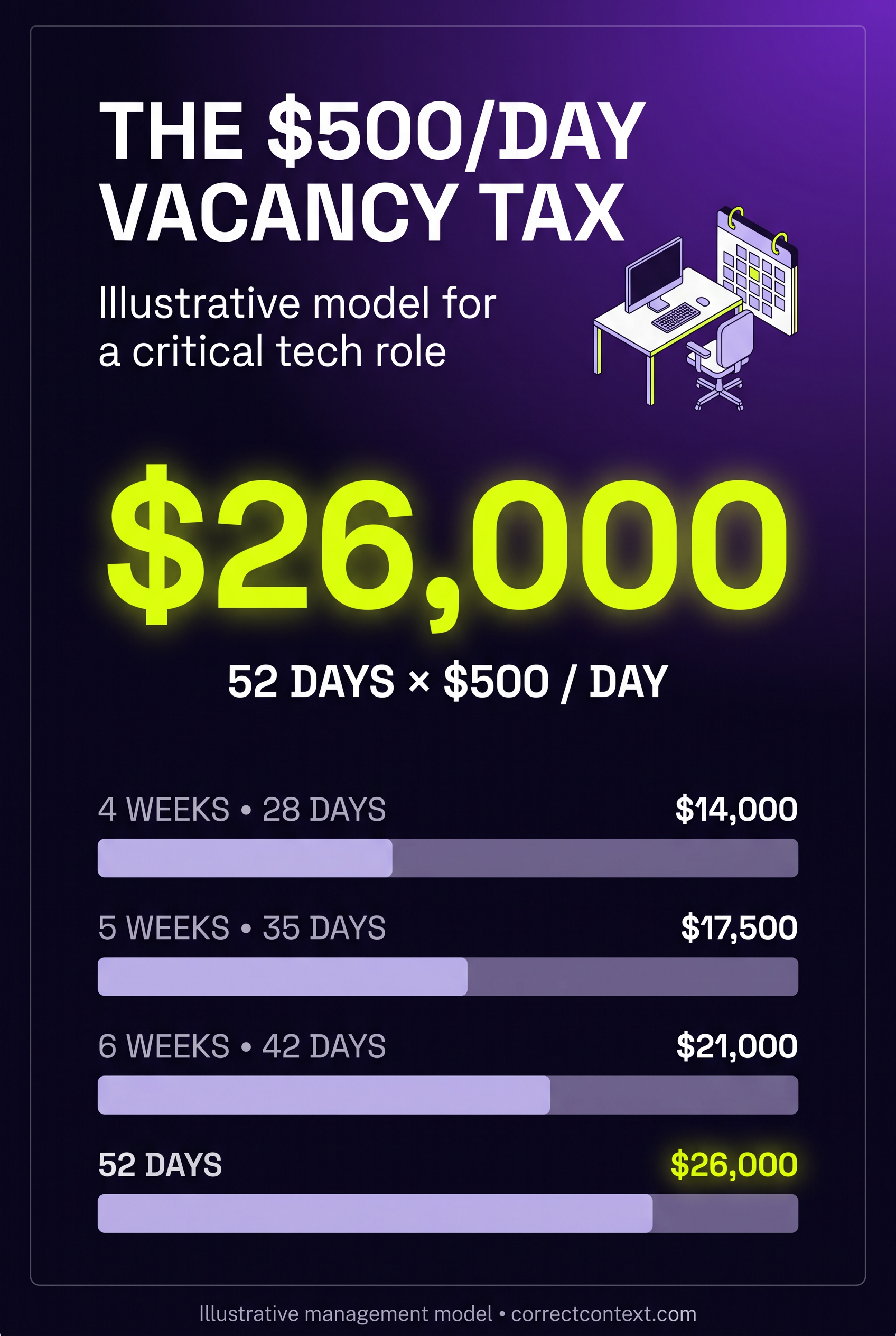
A useful way to make the issue visible is to assign a daily threshold to the role. At $500 per day, a 52-day hiring cycle creates a $26,000 vacancy tax before the new employee’s first day. That is not a universal market benchmark; it is an illustrative operating model. Its purpose is to force an executive conversation about the economics hidden behind the phrase, “We are still interviewing.”
Vacancy tax is the estimated daily economic loss created when a mission-critical role remains unfilled. It includes forgone or delayed output, the cost of coverage, execution risk, and the incremental expense of keeping the search open.
The hiring market makes this more than a theoretical concern. SHRM defines time-to-fill as the period from requisition to offer acceptance and reported a 2025 median of roughly a month and a half for executive and nonexecutive roles alike.[1] For specialized technology roles, a 52-day cycle is therefore not an absurd scenario. It is only about one week beyond that broad benchmark—and broad benchmarks rarely capture the additional friction of scarce cloud, data, platform, or AI capabilities.
Why salary is the wrong starting point
A role’s salary tells you what the company will pay after hiring. It does not tell you what the company loses while the work has no owner. That distinction matters because senior technical roles often unblock other people’s work.
Consider a staff engineer who must establish platform standards before three product squads can ship. Or a data engineering lead needed to make a customer analytics commitment credible. Or an ML engineer who has to validate a high-value automation before sales can confidently take it to market. These are not interchangeable units of labor. Each role sits in a dependency chain.
For context, the U.S. Bureau of Labor Statistics reports a May 2024 median annual wage of $133,080 for software developers and projects 15% growth for developers, QA analysts, and testers from 2024 to 2034.[2] Salary does not establish vacancy cost; an unfilled role can preserve cash in one ledger while destroying value in several others.
European data points in the same direction. Eurostat reported that 62.8% of EU enterprises recruiting or trying to recruit ICT specialists in 2021 had difficulty filling vacancies; cited barriers included applications, qualifications, experience, and salary expectations.[3] Treat the search as a commercial process with a quantified delay cost.
The vacancy cost calculation: a practical model
Start with a simple formula. Use calendar days if the vacancy delays customer commitments, launches, or revenue recognition. Use working days if the impact is almost entirely internal. State the basis and use it consistently.
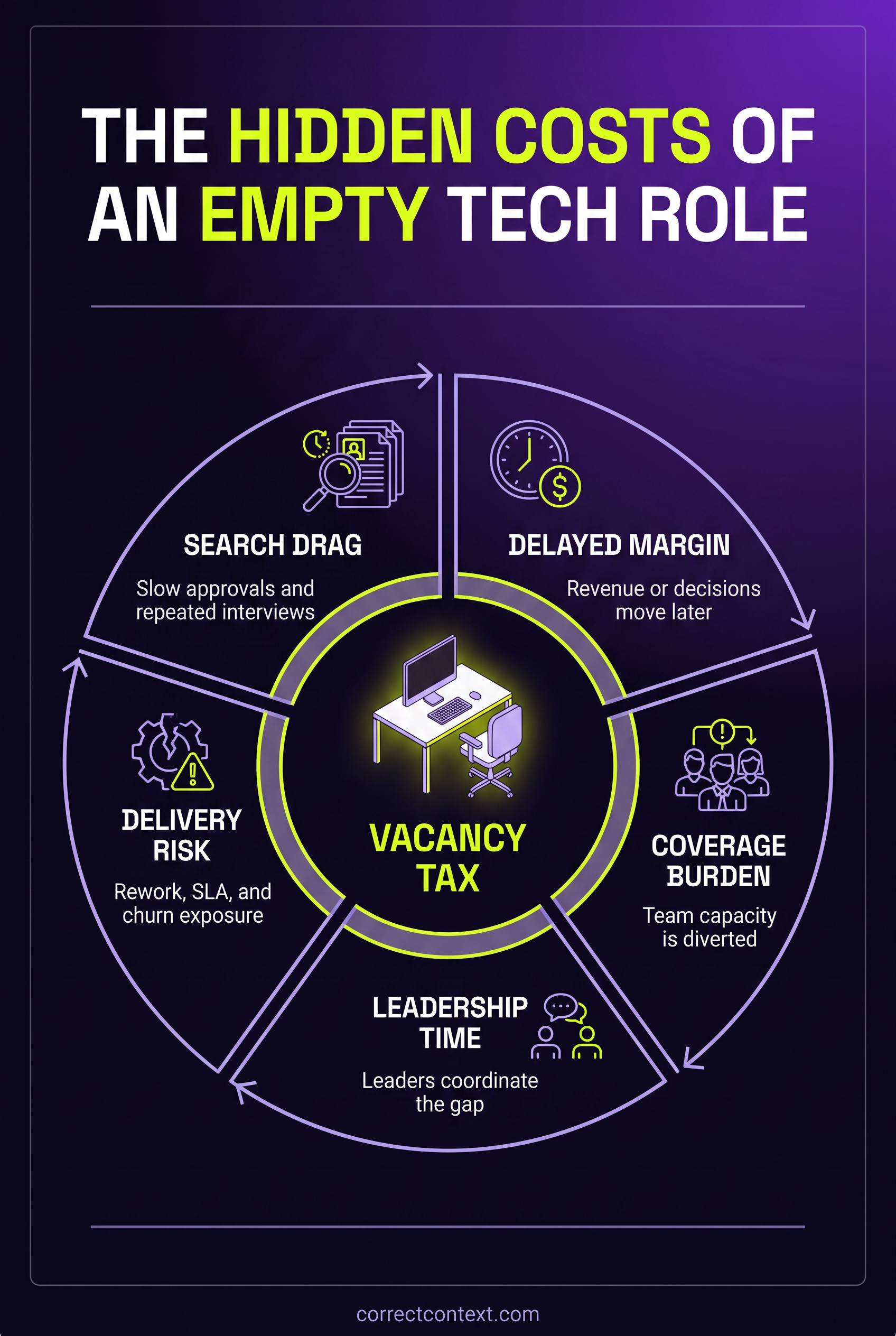
Daily vacancy cost = delayed contribution margin + temporary coverage cost + leadership and coordination cost + risk reserve + incremental search spend.
| Component | What to measure | Illustrative daily amount | Evidence to collect internally |
|---|---|---|---|
| Delayed contribution margin | Margin deferred because a release, migration, or customer commitment moves | $200 | Product roadmap, sales forecast, deal desk notes |
| Coverage burden | Overtime, contractors, or lost capacity from colleagues covering the work | $125 | Capacity plan, contractor invoices, sprint allocation |
| Leadership and coordination | CTO, product, HR, and interview time required to manage the gap | $75 | Calendar samples, interview load, decision-log time |
| Delivery and quality risk | Expected cost of defects, rework, missed SLA commitments, or avoidable churn | $50 | Incident history, rework data, account risk register |
| Incremental search cost | Paid sourcing, repeated interviews, job-board spend, or retained-search extension | $50 | Recruitment spend, ATS data, vendor invoices |
| Modeled daily vacancy tax | Sum of the above components | $500 | Review monthly with Finance and hiring leaders |
The numbers in the table are deliberately transparent. A company may decide its actual daily cost is $200, $500, or $2,000. The value comes from replacing an unexamined assumption with a shared model that Finance, Product, and Talent can challenge together.
What 52 days really costs
A 52-day cycle at $500 per calendar day creates a $26,000 vacancy cost calculation.
| Hiring outcome | Calendar days open | Daily vacancy tax | Modeled vacancy cost | Savings versus 52 days |
|---|---|---|---|---|
| Current operating scenario | 52 | $500 | $26,000 | — |
| Specialist-led target: 6 weeks | 42 | $500 | $21,000 | $5,000 |
| Specialist-led target: 5 weeks | 35 | $500 | $17,500 | $8,500 |
| Specialist-led target: 4 weeks | 28 | $500 | $14,000 | $12,000 |
This does not mean a specialist partner can promise a 28-day placement for every role. Seniority, compensation, notice periods, security requirements, and candidate fit still govern the outcome. It shows why a disciplined 4–6 week time-to-hire operating target can be worth funding when the vacancy is critical.
The opportunity is particularly clear for founders trying to reduce burn. An apparent $10,000 saving on a search partner can be a false economy if the decision adds 20 days to a role with a $500 daily cost. The incremental delay alone is $10,000—before any revenue, morale, or customer impact compounds. The decision should be based on the likely all-in cost of reaching an accepted offer, not the visible price of a sourcing channel.
The five hidden costs that turn a vacancy into a bottleneck
1. Delayed product and revenue milestones
The most material cost is frequently delayed contribution margin. If a missing engineer holds up an integration required to activate a contracted customer, the lost value is not their salary. It is the margin on the delayed customer outcome. If the role postpones an experiment, the cost may be the decision that cannot be made until the experiment runs.
The correct question is not, “What would this engineer earn?” It is, “Which economic event is waiting for this engineer’s work?” Put a named milestone, forecasted date, and owner next to every business-critical requisition.
2. Capacity leakage in the existing team
When a team does not lower its commitment after a vacancy opens, the work does not disappear. It is absorbed by staff engineers, managers, or contractors. That can create a quiet double loss: high-value people spend time on lower-leverage coverage work while their own strategic responsibilities slow down.
Measure this explicitly. Ask each affected squad to identify the number of hours diverted, the role performing the coverage, and the roadmap item displaced. This turns a vague feeling of overload into a cost line that can be compared with the speed and quality of different hiring approaches.
3. Decision latency at the leadership level
The longer a role remains vacant, the more senior leaders revisit priorities, attend extra interviews, re-explain the role, and arbitrate trade-offs. Those actions may be necessary, but they are not free. A CTO who spends four additional hours per week shepherding a search for two months is not spending those hours on architecture, customers, security, or investor communication.
This category is modest in isolation but powerful as a signal. If the same executive must repeatedly intervene to move a search forward, the hiring system—not the candidate market alone—is probably the constraint.
4. Quality, resilience, and customer risk
Vacancies can be covered only up to a point. As context is spread across too few people, code-review quality drops, incident response becomes more fragile, and documentation stalls. A platform or DevOps vacancy can also concentrate operational knowledge in one person at precisely the time the organization needs redundancy.
Where data is weak, use a modest risk reserve based on historic rework, escalations, SLA credits, or churn exposure. The aim is not a precise prediction; it is to avoid treating the risk as zero.
5. Recruitment process drag
Hidden costs of recruitment accumulate when roles are re-scoped, panels respond slowly, feedback is inconsistent, or compensation approval begins too late. These are controllable time-to-hire delays that also damage candidate experience. Track requisition approval, shortlist, interviews, offer approval, and offer acceptance separately: each bottleneck needs a different remedy.
When a specialized recruitment center changes the equation
A specialized recruitment center is not simply an external recruiter. At its best, it is a focused operating layer around the search: calibrated sourcing, a validated technical network, fast candidate communication, compensation intelligence, interview orchestration, and a clear path to employment or employer-of-record support when building in a new country.
That can be particularly valuable when extending an engineering team into Poland or wider CEE. The objective is access to qualified nearshore developers in Europe with less local recruitment, payroll, HR, and employment-administration friction—not “offshore for the lowest rate.”
A partner should be evaluated against the vacancy-tax model, not against a vague promise of “faster hiring.” Ask for the expected time from calibrated brief to first qualified shortlist, the interview-service-level agreement, role-specific candidate evidence, a clear definition of fees, and the process for cross-border employment compliance. For a critical data engineering team, cloud engineering hire, or AI development team, insist on evidence that the partner understands the technical environment—not just generic IT titles.
A four-to-six-week target is reasonable only when the company does its part: approves the brief and compensation range quickly, commits interview capacity, returns feedback within 24–48 hours, and makes decisive offers. A partner can accelerate the market-facing part of hiring; it cannot repair internal indecision alone.
A decision rule for founders and technology leaders
Before choosing between a retained search, a specialized recruitment center, internal recruiting, or a temporary contractor, calculate three numbers:
| Question | Decision use |
|---|---|
| What is the role’s daily vacancy tax? | Sets the economic urgency of the role |
| How many days is each route likely to save or add? | Converts speed into a dollar comparison |
| What quality, compliance, and retention risks does each route change? | Prevents a fast but fragile decision |
If the modeled daily cost is $500 and one route credibly removes 17 days, the route has created $8,500 of modeled value before considering quality. If it costs more than that, it may still be correct—but the burden of proof is now visible. If it costs less, the organization should ask why it is accepting the longer delay.
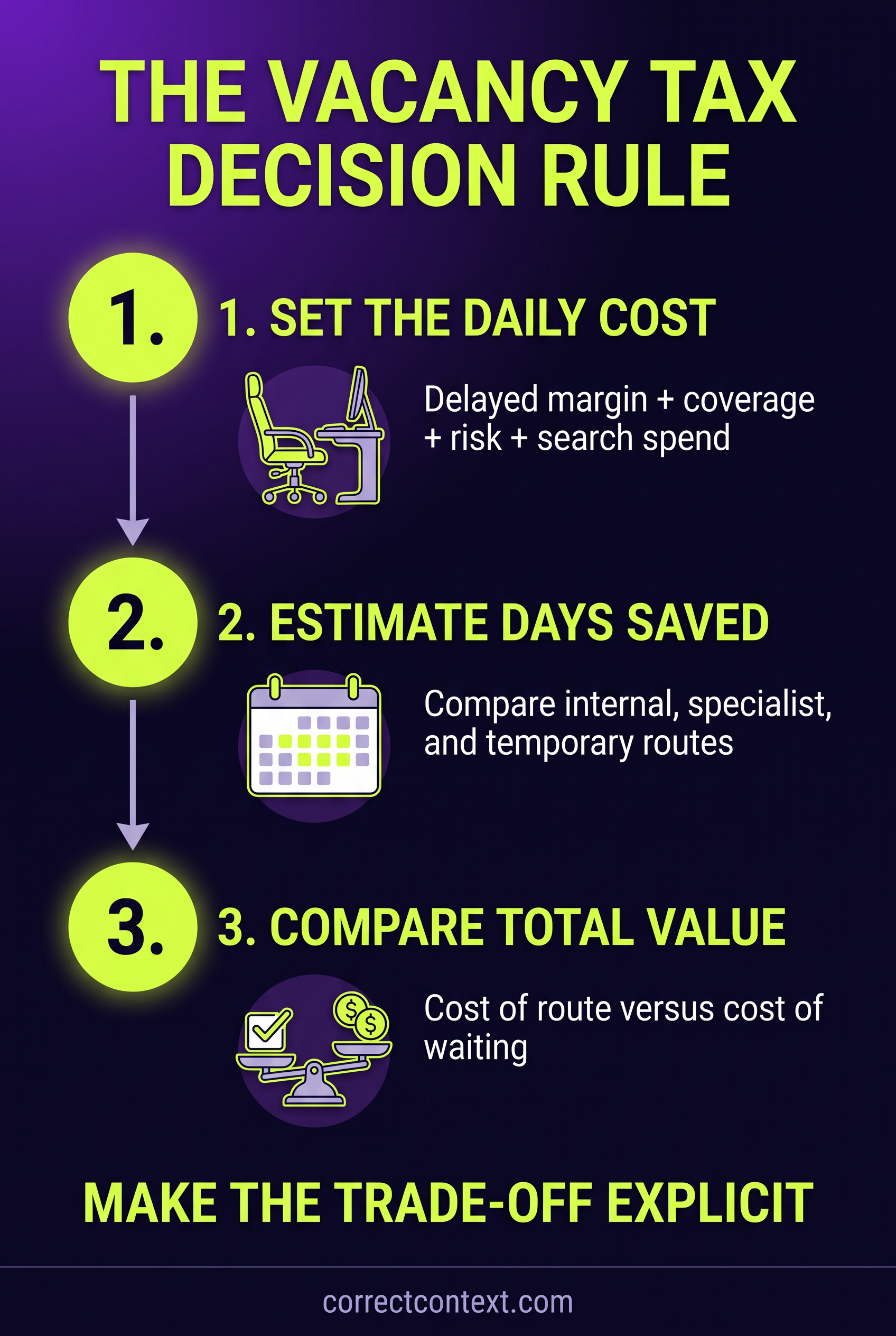
The aim is not to reduce hiring to a spreadsheet; it is to make the trade-off explicit. A role blocking customer value should not be governed by intuition alone.
The bottom line
The cost of unfilled IT jobs begins the day a critical requisition opens—not the day the offer is accepted. A 52-day cycle at $500 per day produces a $26,000 vacancy tax, and the true impact may be materially higher when the role is a delivery bottleneck. Track the number, identify the source of delay, and decide deliberately whether specialized recruiting capacity can reduce it.
For founders protecting runway and enterprise leaders protecting transformation timelines, the most expensive hiring strategy is often not the one with the highest visible fee. It is the one that leaves a critical technical seat empty while momentum quietly expires.
References
[3] Eurostat, EU companies face difficulties in hiring ICT experts (12 July 2023).
Table of content
- Why salary is the wrong starting point
- The vacancy cost calculation: a practical model
- What 52 days really costs
- The five hidden costs that turn a vacancy into a bottleneck
- When a specialized recruitment center changes the equation
- A decision rule for founders and technology leaders
- The bottom line
- References
Related articles



About the Author: Marta