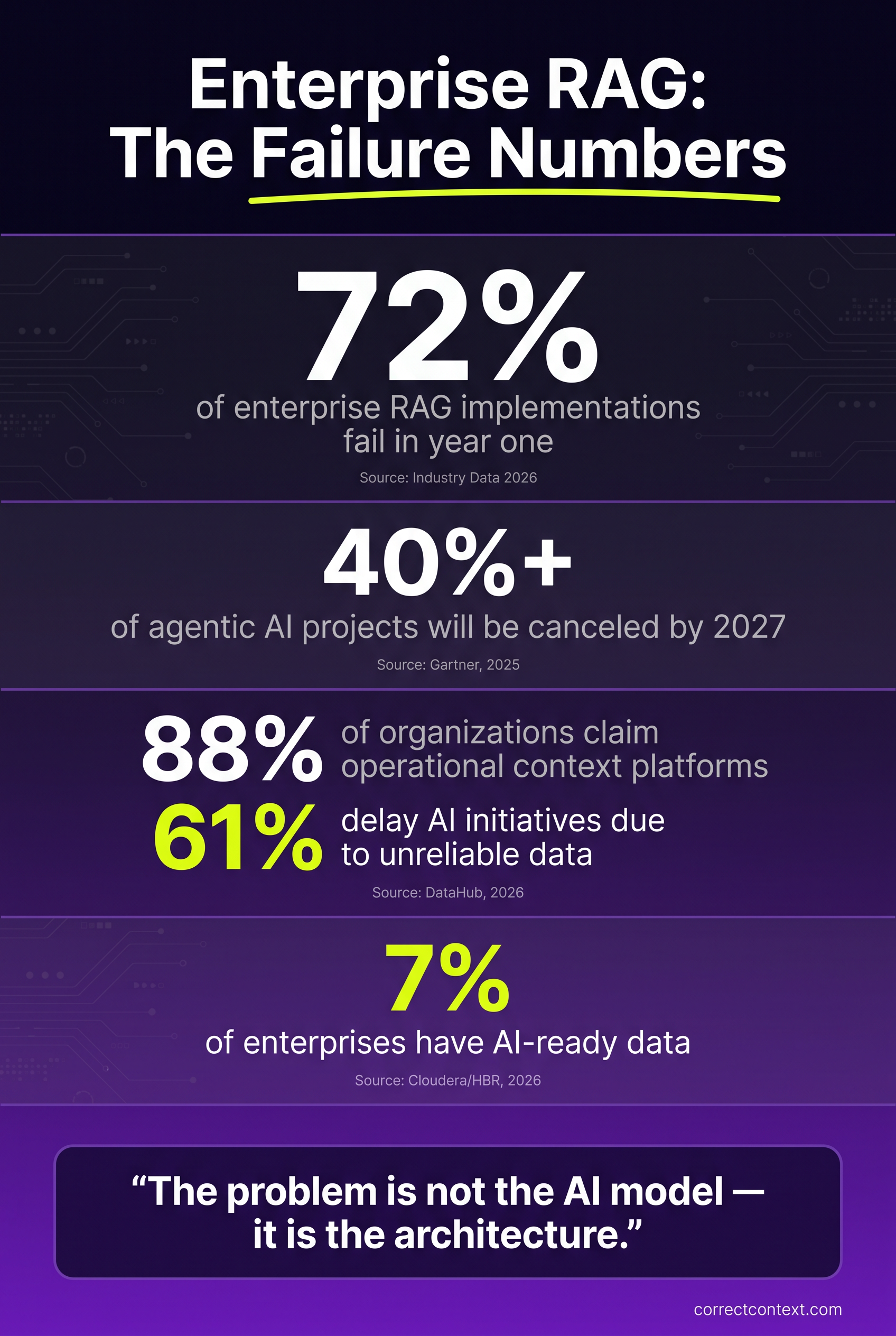
In 2026, enterprise AI is facing a reckoning. The initial promise of Retrieval-Augmented Generation (RAG) was straightforward: connect a large language model to your internal documents, and watch productivity soar. Yet, the reality has been starkly different. According to recent industry data, 72% of enterprise RAG implementations fail in their first year [1]. Furthermore, Gartner predicts that over 40% of agentic AI projects will be canceled by 2027 due to escalating costs, unclear business value, or inadequate risk controls [2].
For enterprise innovation and data units, as well as Series A+ startups scaling globally, the core problem is clear: system degradation and a low signal-to-noise ratio in basic RAG setups. When an AI agent accesses fragmented enterprise data without understanding the underlying business logic, it guesses. That guessing leads to hallucinations, compliance risks, and ultimately, abandoned projects.
The solution emerging as the new standard is the Context Layer Architecture, powered by context graphs AI. This approach shifts the focus from simply retrieving text chunks to providing AI agents with structured, governed, and relational business meaning. This article explores why traditional RAG is failing at the enterprise level and how context graphs are becoming the essential infrastructure for reliable AI.
The Limitations of Traditional Enterprise RAG
Basic RAG systems treat enterprise knowledge as a monolithic pile of text. When a user asks a question, the system uses vector search to find the most semantically similar text chunks and feeds them to the LLM. While this works for simple Q&A on static documents, it breaks down when applied to complex enterprise workflows.
The Missing Meaning Problem. LLMs are pattern-matching engines; they do not inherently understand how a specific business operates. They do not know that a refund request touches finance, support, and compliance simultaneously, or that a customer in one region follows different rules than a customer in another [3]. When a traditional RAG system pulls data from a CRM, a billing system, and a support wiki, it lacks the relational context to understand how those pieces connect. More data without meaning is simply noise.
The Signal-to-Noise Ratio. In a monolithic vector database, searching across disparate content types simultaneously creates semantic interference. A query about “user engagement” might return results mixing customer support metrics, product feature usage, and marketing campaign data [1]. This dilution of relevant context leads to inaccurate or operationally useless answers — a problem that compounds as the enterprise data estate grows.
The Governance and Compliance Gap. Eighty-three percent of IT and data leaders agree that agentic AI cannot reach production value without a proper context platform [4]. When AI agents make decisions at enterprise scale, every action must be explainable and auditable. Traditional RAG systems often lack the policy enforcement to restrict what data an agent can see or use based on user permissions, creating significant security and privacy risks that are increasingly scrutinized under frameworks like the EU AI Act.
Enter the Context Layer Architecture
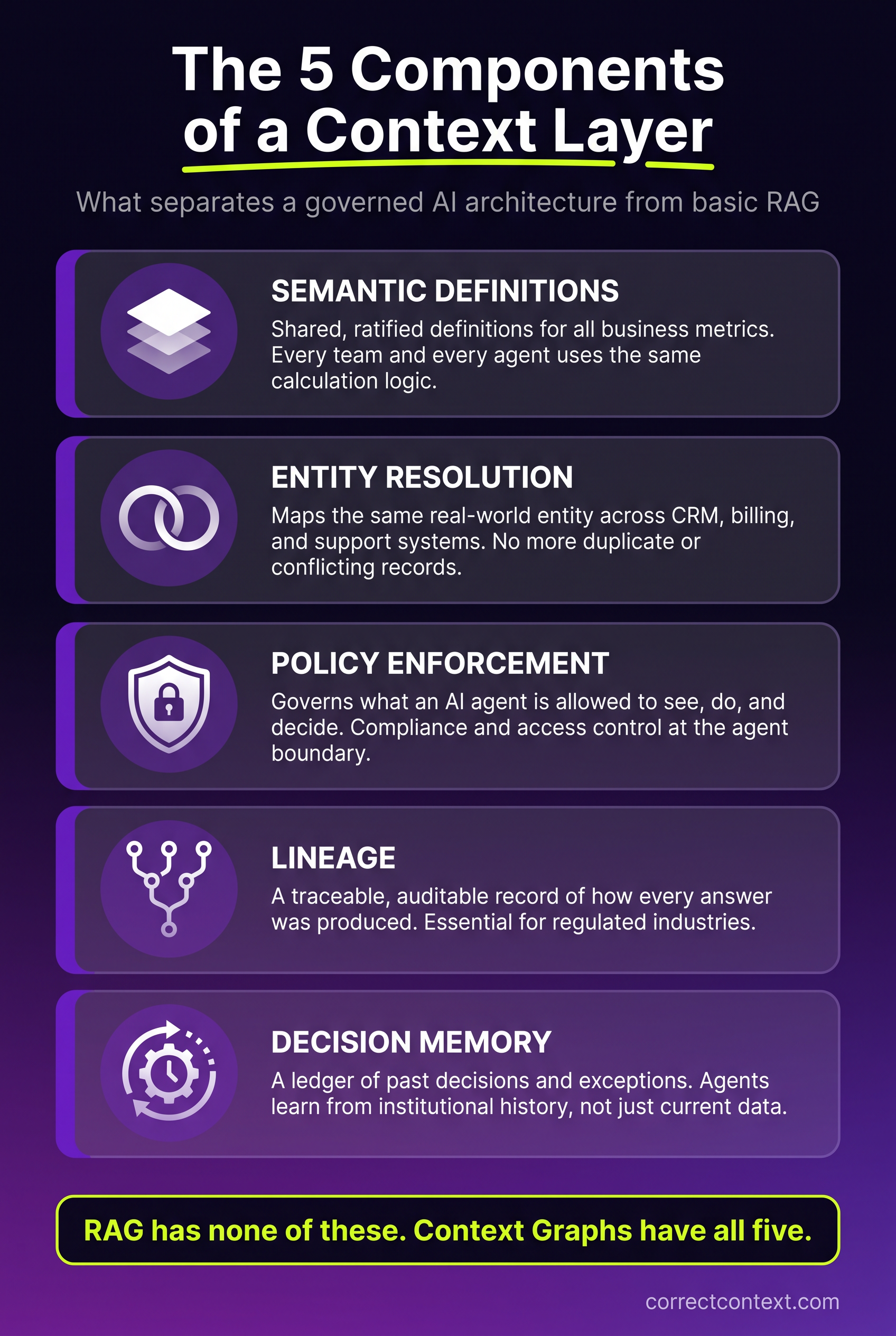
A context layer architecture is the infrastructure that sits between an organization’s raw data estate and its AI agents. It translates fragmented data into governed business meaning that the agent can act on reliably [4]. This is not a semantic layer rebrand — it is a superset that adds four critical capabilities on top of metric definitions: entity resolution across systems, policy enforcement, governance at the agent boundary, and memory of past decisions.
The consensus architecture, as documented by Snowflake, Databricks, and major research firms, combines the following components:
| Component | Function in Context Layer | Why Traditional RAG Lacks It |
|---|---|---|
| Semantic Definitions | Provides shared, ratified definitions for business metrics (e.g., how “active customer” is calculated). | RAG retrieves text, not standardized calculation logic. |
| Entity Resolution | Maps entities across systems (e.g., linking a CRM customer ID to a billing ID). | RAG treats each system’s data as isolated text chunks. |
| Policy Enforcement | Dictates what an agent is allowed to do or see based on governance rules. | RAG lacks built-in access controls and compliance routing. |
| Lineage | Provides a traceable, auditable record of how an answer was produced. | RAG often struggles to provide exact, verifiable citations. |
| Decision Memory | A ledger of past decisions and exceptions to inform future reasoning. | RAG treats every query as a new, isolated event. |
Only 7% of enterprises report that their data is fully ready for AI, according to a Cloudera/HBR study from March 2026 [5]. The DataHub State of Context Management 2026 report found that 88% of organizations claim to have operational context platforms, yet 61% of those same organizations delay AI initiatives due to a lack of trusted and reliable data [4]. This structural contradiction is precisely the gap that a proper context layer is designed to close.
How Context Graphs AI Powers the Layer
At the heart of an effective context layer is the context graph — often implemented as GraphRAG. A knowledge graph models the entities in a business, the relationships between them, the rules, and the unwritten constraints that govern operations [3].
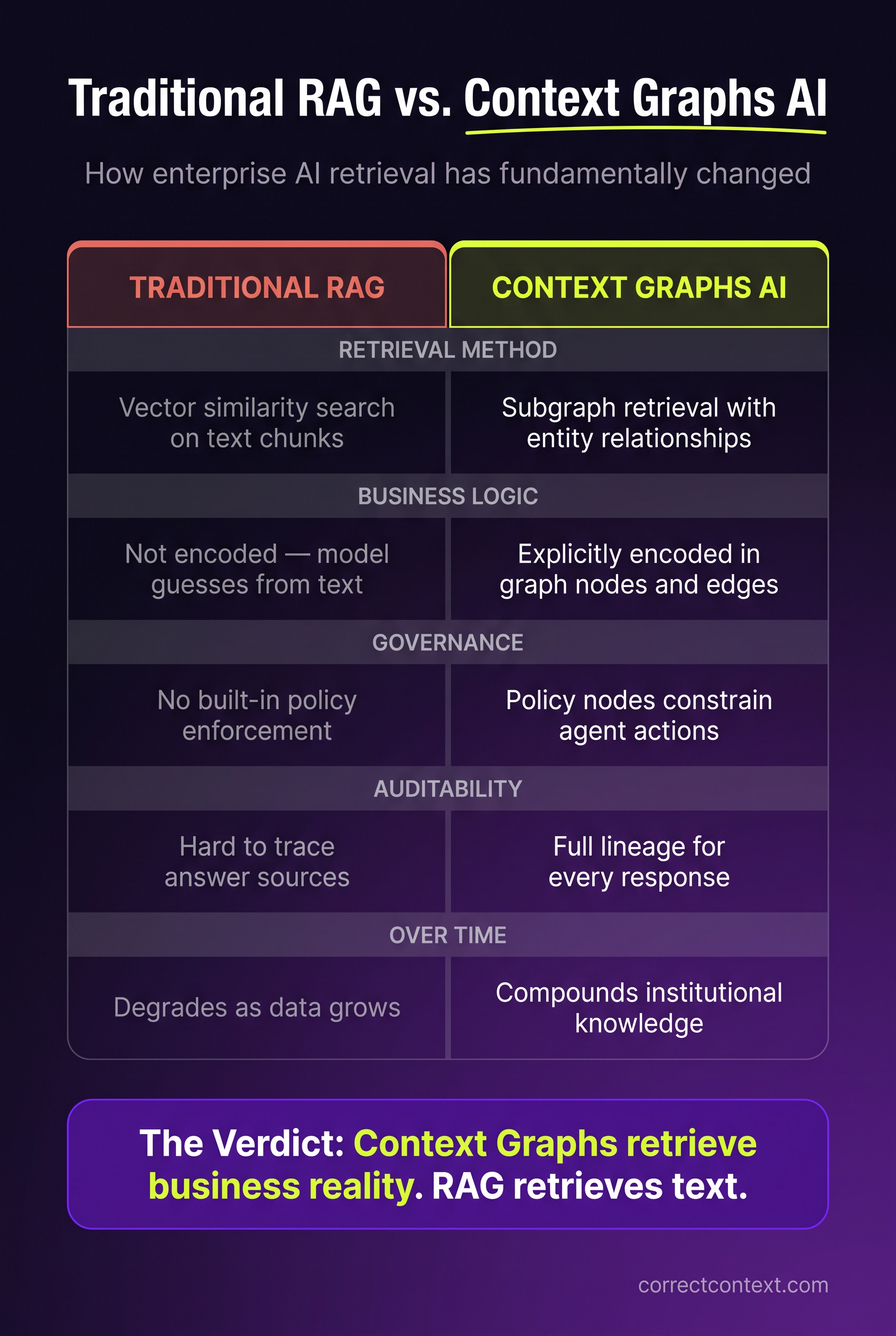
Instead of using purely embedding similarity to pull isolated paragraphs, context graphs AI retrieves a subgraph that reflects the entities, relationships, and policies relevant to the current question. Consider a practical enterprise example: an AI agent is asked whether to extend payment terms for a specific customer by 30 days.
A traditional RAG system would search for any occurrence of the customer’s name and “payment terms” across policies and emails, then attempt to stitch an answer together from semantically similar text chunks.
A context graph system would instead:
- Resolve the customer to the correct entity in the graph.
- Retrieve connected contracts, invoices, risk scores, and regional segment data.
- Pull policy nodes that apply to that specific region and segment.
- Surface prior exceptions and their outcomes as historical context.
- Present this structured, constrained slice of business reality to the LLM for reasoning [3].
The model is no longer guessing; it is reasoning inside a defined space that reflects real-world business rules. This is why enterprise RAG alternatives are rapidly moving toward graph-based architectures. Forrester’s June 2026 report, “Combine Semantics, Ontology, And Knowledge Graphs For AI-Ready Data,” confirms that AI-ready data depends on more than schemas — it requires the relational, governed structure that context graphs provide.
Building the Context Layer: The Talent Imperative
For enterprise architects and CTOs, the transition from basic RAG to a robust context layer architecture is not a simple software upgrade. It requires building complex AI data pipelines, integrating semantic models, and encoding implicit business knowledge into a graph structure. This architectural shift demands cross-functional expertise that most enterprises do not have sitting idle.
Building a centralized Context Layer requires specialized talent across several domains:
- Data Engineering: To create the event-based architecture that continuously syncs metadata from across the data estate, ensuring the context layer reflects operational reality rather than stale documentation [4].
- Platform Engineering: To build the intelligence gateways, multi-model routing infrastructure, and API layers that serve AI agents at machine speed [1].
- AI/ML Engineering: To optimize GraphRAG retrieval strategies, fine-tune embedding models, and implement the policy enforcement layers.
- Backend Development: To integrate the context layer with existing enterprise systems — CRM, ERP, billing, and support platforms.
Many organizations find that their internal teams are already stretched thin maintaining existing infrastructure. This is where scaling dedicated software teams becomes a critical strategic decision. Enterprises looking to build advanced enterprise AI tools and AI data pipelines are increasingly establishing engineering hubs in Europe — particularly in Poland and the broader CEE region — to access top-tier talent in big data development, cloud engineering (AWS, Azure, GCP), and AI/ML.
Utilizing an employer of record in Poland or EoR CEE allows enterprises to quickly assemble a remote development team or nearshore development team without the overhead of establishing a local legal entity, managing local HR, or navigating complex employment compliance in Europe. Whether the need is a data analytics team to structure the semantic layer, a backend development team to build the API integrations, or a machine learning engineers team to implement GraphRAG, an offshore development team or nearshore developers in Europe can provide the specialized skills needed to build a reliable context layer at the speed the market demands.
The Strategic Decision: Context Layer or Technical Debt?
The 72% failure rate of enterprise RAG implementations is not an indictment of AI — it is a failure of architecture. Adding more documents, using larger context windows, or connecting more systems through MCP protocols will not fix the fundamental issue of missing business meaning. As Gartner’s Andres Garcia-Rodeja noted at the 2026 Data and Analytics Summit, 60% of agentic analytics projects relying solely on MCP will fail by 2028 without a semantic layer underneath [5].
The enterprises that succeed with AI in 2026 and beyond will be those that invest in context layer architecture as foundational infrastructure — not as a feature to be bolted on later. By utilizing context graphs AI to encode implicit knowledge and enforce governance, organizations can build AI agents that are accurate, reliable, and secure enough to deploy in regulated workflows.
For enterprise architects deciding where to invest next quarter, the question is not whether to build a context layer. The question is whether to build it with the right cross-functional team — one that combines data engineering, platform engineering, and AI/ML expertise — or to continue accumulating the technical debt of basic RAG systems that degrade over time.
The choice is clear: structured context now, or expensive failure later.
References
[1] Why 72% of Enterprise RAG Implementations Fail in the First Year—and How to Avoid the Same Fate
[2] Gartner Predicts Over 40% of Agentic AI Projects Will Be Canceled by End of 2027
[3] The Real AI Bottleneck of 2026: Your Company’s Implicit Knowledge
[4] The Context Layer for AI: What Enterprises Get Wrong | DataHub
[5] What Is a Context Layer for AI Agents? The 2026 Definitive Guide | Tellius