The Recruiting Bottleneck That’s Burning Out Your Best HR People
For HR teams at fast-growing scale-ups and enterprise innovation units, inbound applications are both a blessing and a curse. A surge in applicants signals strong employer brand appeal, but the operational reality of processing that volume is a logistical nightmare. The core problem is straightforward and well-documented: recruiters are burning out and wasting hours on preliminary screening calls — work that is repetitive, low-leverage, and increasingly difficult to justify in a world where AI can do it better.
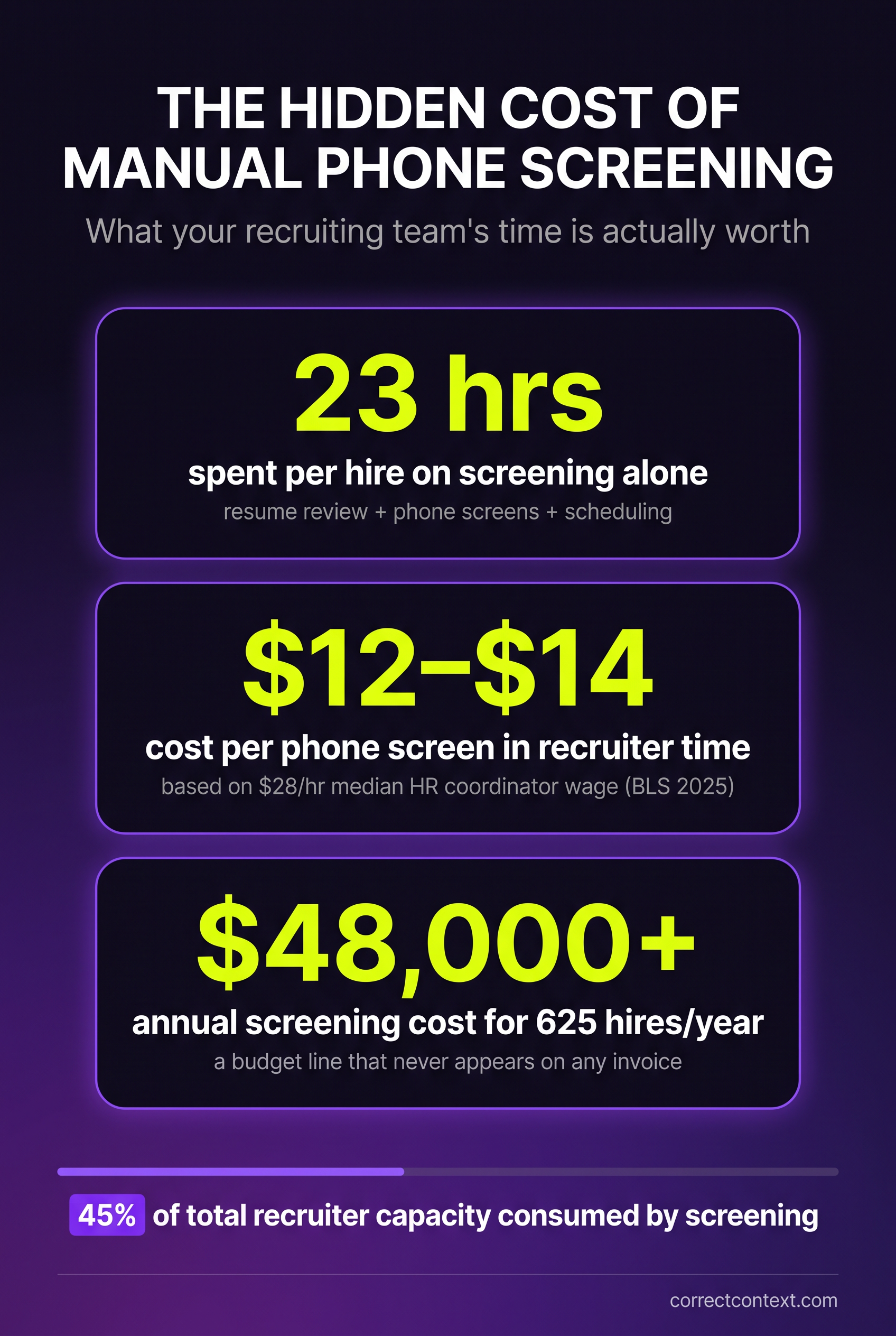
According to a 2026 analysis of recruiter time allocation, the average hiring professional spends approximately 23 hours per hire just on the screening process — covering resume review, phone screens, and the endless email back-and-forth of scheduling [1]. For a typical mid-volume role receiving 150 to 300 applications, a recruiter might conduct 40 phone screens. At 25 minutes each, that alone consumes 16 to 17 hours of repetitive conversation that often yields thin, surface-level information: current role, reason for looking, salary expectations, and availability [1]. The recruiter knew within the first five minutes whether the candidate was viable — but continued for another 20 because cutting a call short feels unprofessional.
The financial impact compounds the human cost. A single phone screen costs an estimated $12 to $14 in recruiter time, based on the national median HR coordinator wage of $28 per hour and a realistic 25 to 30 minutes per screen including scheduling overhead [2]. For a company making 625 hires a year, the annual cost of phone screening alone can exceed $48,000 in recruiter time — a budget line that never appears on any invoice because it is absorbed into the general noise of the workweek [2]. For a five-person recruiting team handling 100 hires annually, the math is even starker: approximately 2,300 hours per year — nearly 45% of total recruiter capacity — consumed by screening activities that a well-configured AI can execute in minutes [1].
This is the problem that AI calling for recruiters is designed to solve.
What AI Calling Actually Means for Recruiting Teams
AI calling for recruiters refers to the use of conversational AI agents — powered by large language models and voice synthesis technology — to autonomously conduct initial screening interviews over the phone or via digital audio. Rather than a human recruiter dialing candidates one by one, an AI recruitment agent initiates outbound calls or accepts inbound ones, walks each candidate through a structured set of qualifying questions, evaluates responses in real time, and delivers a scored transcript to the recruiter’s dashboard before the next morning.
The distinction from older automated screening tools is significant. Earlier systems relied on rigid IVR (interactive voice response) menus or keyword-matching resume parsers. Modern AI calling for recruiters uses natural language understanding to interpret nuanced answers, follow up on ambiguous responses, and assess both content and communication quality. The candidate experience is conversational, not robotic — and increasingly indistinguishable from a human interaction for the purposes of a first-round screen.
For HR teams at fast-growing scale-ups overwhelmed by inbound applications, this capability is transformative. A single AI agent can run parallel calls simultaneously, meaning that a batch of 100 candidates submitted on a Monday evening can be fully screened, scored, and ranked by Tuesday morning. The recruiter arrives at work with a shortlist — not a queue.
The Business Case: Numbers That Justify the Investment
The economic argument for automated phone screening is compelling at every level of the organization. Gartner’s 2025 research on talent acquisition trends identifies high-volume recruiting as the leading use case for an AI-first approach, noting that these roles have “the highest potential for cost savings” and that “the stable, repetitive work is a good fit for AI capabilities” [3]. The analyst firm further predicts that by 2027, 75% of hiring processes will include certifications and tests for workplace AI proficiency, reflecting the deep and accelerating integration of AI into the talent lifecycle [3].
Forrester’s economic impact analysis of AI-powered recruitment platforms found that organizations automating and centralizing their recruitment workflows can reduce the average time to hire from 87 days to 43 days — a 49% reduction that directly translates to lower vacancy costs and faster team ramp-up [4]. For a Series A+ startup building a dedicated development team or scaling its engineering team Poland / CEE, every day a critical role remains open is a day of lost productivity.
McKinsey’s 2025 workplace AI report sizes the long-term productivity opportunity from AI at $4.4 trillion in added value across corporate use cases, with talent and HR functions among the highest-impact areas [5]. The report also notes that employees are already using AI far more extensively than their leaders realize — a dynamic that applies equally to candidates, who increasingly expect modern, frictionless hiring experiences.
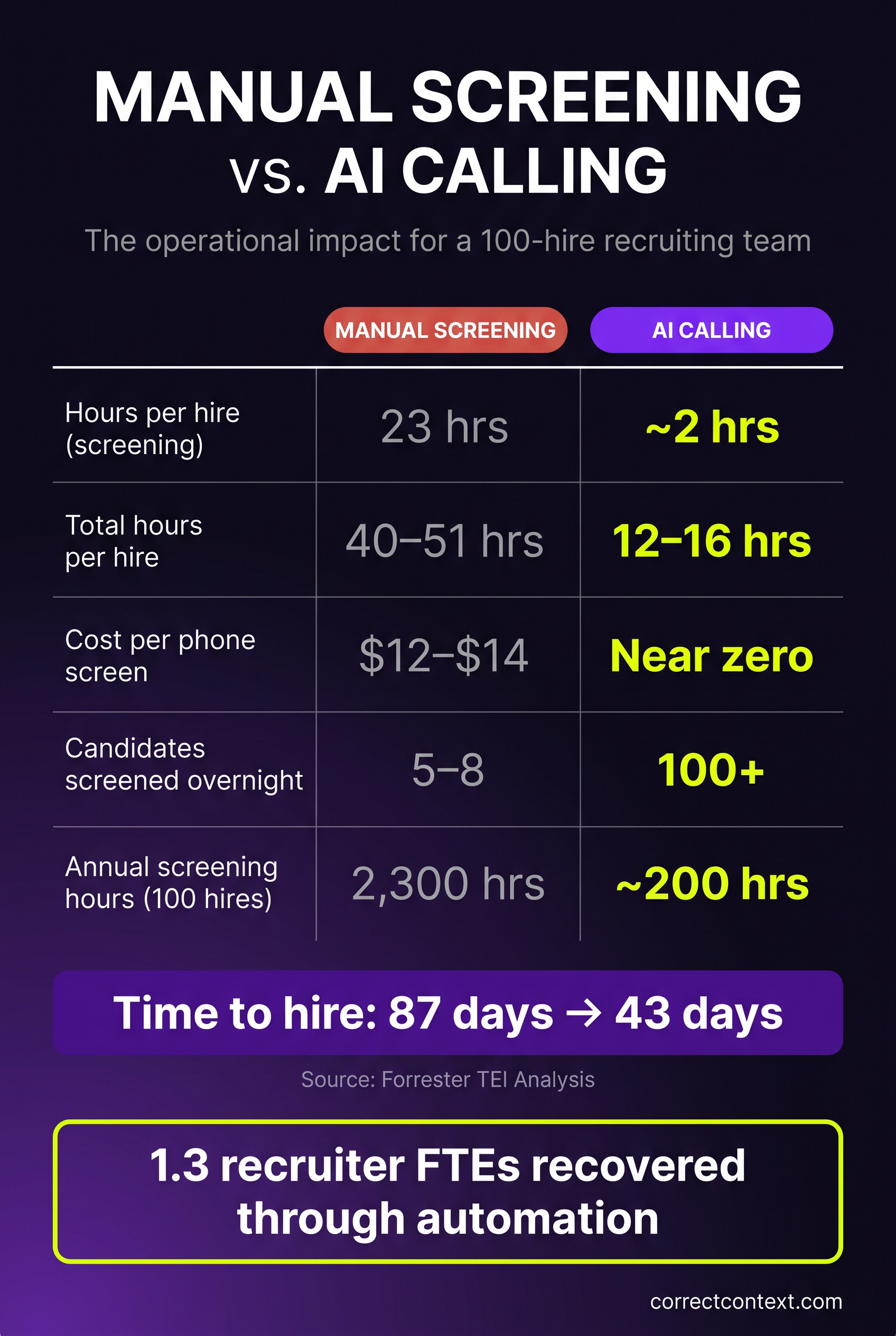
The table below summarizes the operational impact of introducing AI calling into a typical recruiting workflow:
| Metric | Manual Screening | With AI Calling | Change |
|---|---|---|---|
| Hours per hire (screening only) | 23 hours | ~2 hours (review shortlist) | -91% |
| Total hours per hire | 40–51 hours | 12–16 hours | -65–70% |
| Cost per phone screen | $12–$14 | Near zero (AI cost) | -90%+ |
| Candidates screened overnight | 5–8 (one recruiter) | 100+ (AI agent) | 12–20x |
| Annual screening hours (100 hires) | 2,300 hours | ~200 hours | -2,100 hours |
| Equivalent recruiter FTEs recovered | — | 1.3 FTEs | — |
How Automated Phone Screening Works in Practice
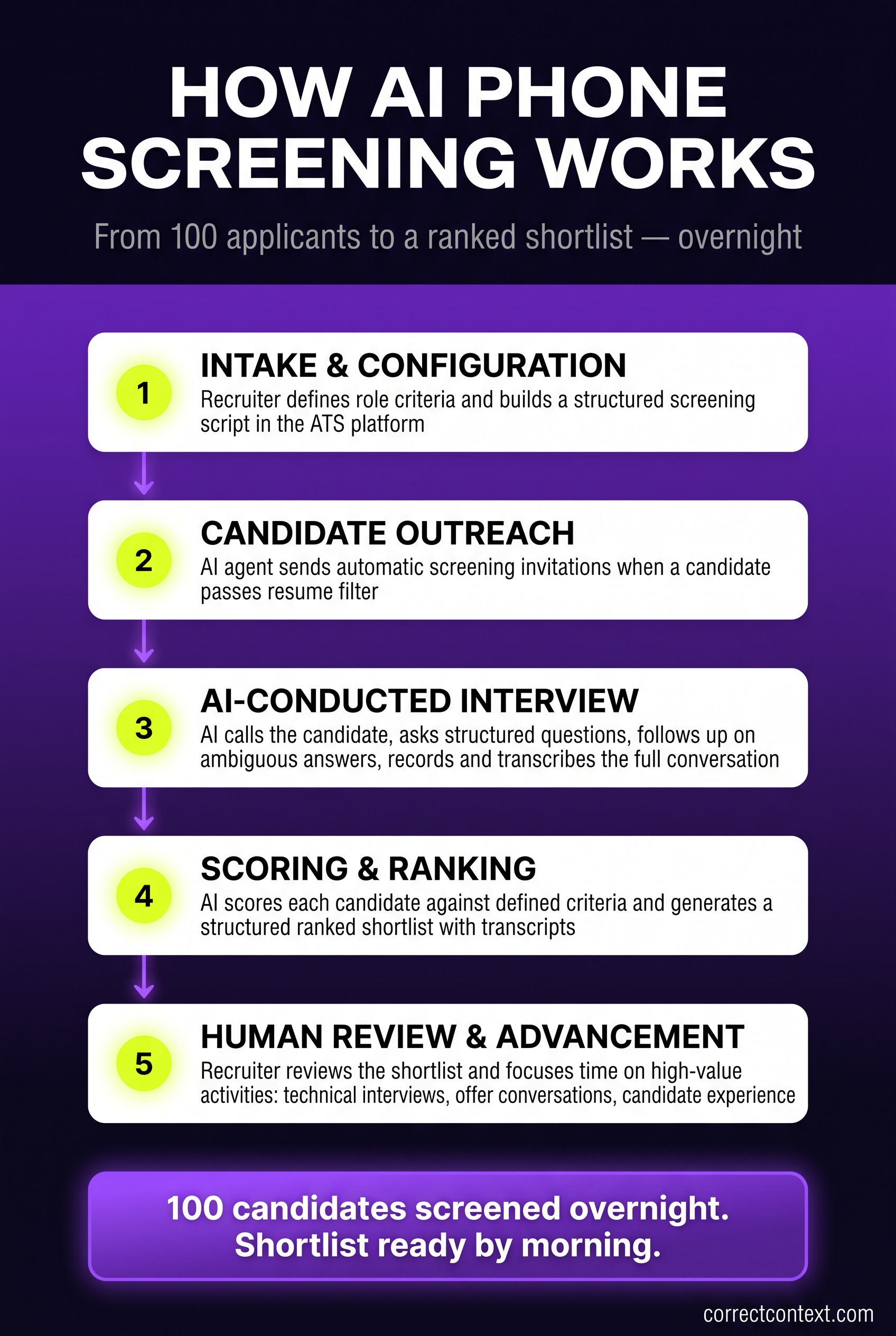
The workflow of a modern automated phone screening system follows a clear, repeatable pattern that integrates with existing ATS infrastructure.
Step 1 — Intake and Configuration. The recruiter defines the role requirements and builds a screening script inside the platform. This typically includes five to ten structured questions covering qualifications, motivation, availability, compensation expectations, and one or two role-specific competency probes. The Ceevee ATS features and similar platforms allow these scripts to be saved as templates and reused across similar roles.
Step 2 — Candidate Outreach. When a candidate applies and passes an initial resume filter, the AI agent automatically sends an invitation to complete a phone screening at their convenience. Candidates can call in at any hour — evenings, weekends, between shifts — removing the scheduling friction that consumes 3 to 4 hours of recruiter time per hire [1].
Step 3 — AI-Conducted Interview. The AI agent conducts the call using natural language. It asks the scripted questions, listens to the candidate’s responses, and can follow up on incomplete or ambiguous answers. The entire interaction is recorded and transcribed.
Step 4 — Scoring and Ranking. Upon completion, the AI scores the candidate against the defined criteria and generates a structured summary. Recruiters receive a ranked shortlist with transcripts and scores, enabling rapid, data-driven decisions without listening to a single recording.
Step 5 — Human Review and Advancement. The recruiter reviews the shortlist, selects candidates for the next stage, and invests their time in the high-value activities that genuinely require human judgment: the hiring manager debrief, the technical interview, the offer conversation, and the candidate experience that converts an offer into an acceptance.
Why This Matters Specifically for Startups and Scale-Ups
Startups and fast-scaling technology companies face a unique set of hiring pressures. They are competing for talent against larger organizations with bigger brand recognition and deeper compensation budgets. They cannot afford to move slowly. And their recruiting teams are typically lean — often one or two people managing dozens of open roles simultaneously.
For a startup development team or a company looking to hire developers for startup, the ability to screen 100 candidates overnight is not a marginal efficiency gain — it is a fundamental competitive advantage. It means that a great candidate who applies on a Friday evening receives a screening call within hours, not days. It means that the recruiter’s Monday morning is spent advancing qualified candidates, not clearing a backlog of calls.
The same logic applies to enterprise teams building out offshore development teams or nearshore development teams in regions like Poland and CEE. When candidates are distributed across time zones — as is inherently the case when you hire developers Poland or build an engineering hub Europe — AI calling eliminates the scheduling complexity entirely. The AI operates around the clock, across time zones, without fatigue.
Addressing the Candidate Experience Concern
A common objection to AI calling for recruiters is the concern that candidates will find the experience impersonal or off-putting. The data does not fully support this concern. Gartner’s research notes that candidates expect transparency about AI use in hiring and, where possible, the choice to opt out — but that transparency itself builds trust [3]. Organizations that clearly communicate their use of AI screening, frame it as a candidate-friendly convenience (available 24/7, no scheduling required), and ensure a human follows up promptly with shortlisted candidates consistently report positive candidate feedback.
The key is design. A well-built AI recruitment agent does not feel like a phone tree. It feels like a structured conversation. And for candidates who are genuinely qualified, the speed of the process — receiving a callback or advancement within 24 hours rather than waiting two weeks — is a significant positive signal about the company’s operational maturity.
Building the Right Infrastructure: ATS Integration and Data Governance
Deploying AI calling for recruiters effectively requires more than purchasing a tool. It requires integrating the AI layer into your existing ATS and establishing clear data governance protocols. Key considerations include:
- ATS Compatibility: Ensure the AI calling platform integrates natively with your existing applicant tracking system to avoid manual data transfer and maintain a single source of truth for candidate records.
- Bias Auditing: Regularly audit the AI’s scoring outputs for demographic disparities. Gartner recommends reframing the risk of bias by focusing on how an AI-augmented process is measurably less biased than a human-only system — but this requires active monitoring [3].
- Data Retention and GDPR Compliance: For companies hiring in Europe — particularly those building EoR Europe or employer of record CEE structures — ensure that call recordings and transcripts are handled in compliance with GDPR and local data protection regulations.
- Candidate Disclosure: Clearly disclose the use of AI in the screening process in the job application flow. This is both an ethical best practice and, in several jurisdictions, a legal requirement.
The Strategic Shift: From Reactive Processor to Talent Advisor
The deepest value of AI calling for recruiters is not the hours saved or the cost reduced, as significant as those are. It is the strategic repositioning of the recruiter role itself.
When a recruiter is no longer buried in 40 screening calls per week, they become something entirely different: a talent advisor. They have time to proactively source passive candidates — the engineers who are not applying but might be perfect for the dedicated software team you are building. They have time to build relationships with hiring managers, understand the real requirements behind a job description, and provide market intelligence on compensation and availability. They have time to create the candidate experience that converts an offer into an acceptance.
Gartner’s 2025 research is explicit on this point: as AI and automation take on low-complexity work, “recruiters’ ability to deliver on high-complexity hiring becomes more critical” [3]. The recruiter of 2026 is not a phone screener. They are a strategic partner — and automated phone screening is what makes that evolution possible.
For HR teams at fast-growing scale-ups and enterprise innovation units looking to scale engineering teams or build a remote development team, the question is no longer whether to adopt AI calling. The question is how quickly you can implement it before your competitors do.
References
[1] You’re Spending 23 Hours Per Hire on Screening — Here’s the Math | Tukadi
[2] The Hidden Cost of the Phone Screen: What Your Recruiting Team’s Time Is Actually Worth
[4] The Total Economic Impact™ Of Cornerstone Galaxy
[5] AI in the workplace: A report for 2025 | McKinsey
Table of content
- The Recruiting Bottleneck That’s Burning Out Your Best HR People
- What AI Calling Actually Means for Recruiting Teams
- The Business Case: Numbers That Justify the Investment
- How Automated Phone Screening Works in Practice
- Why This Matters Specifically for Startups and Scale-Ups
- Addressing the Candidate Experience Concern
- Building the Right Infrastructure: ATS Integration and Data Governance
- The Strategic Shift: From Reactive Processor to Talent Advisor
Related articles


About the Author: Marta