
The European tech landscape has long relied on flexible, cross-border talent acquisition to fuel innovation and scale operations. For enterprise innovation units and globally scaling startups, tapping into the engineering talent pool in Poland and the broader Central and Eastern European (CEE) region has been a strategic imperative. Historically, this has often been achieved through business-to-business (B2B) contractor agreements. However, as regulatory scrutiny intensifies across the continent, companies relying on loose B2B contractor agreements in Europe are exposing themselves to significant misclassification risks, financial penalties, and intellectual property issues.
This article explores the evolving regulatory environment surrounding contractor misclassification Europe, the financial and legal risks of maintaining the status quo, and how transitioning to an Employer of Record (EoR) model can safeguard your enterprise. If you are a legal or HR leader auditing your current European contractor setup and afraid of compliance penalties, understanding the dynamic between B2B vs EoR Europe is critical for deciding whether it is time for transitioning contractors to employees.
The Era of the B2B Contractor in European Tech
The appeal of the B2B contractor model is clear. It offers unparalleled flexibility, allowing companies to quickly scale their dedicated development team or remote software engineers team without the overhead of establishing local legal entities. For highly skilled professionals, such as a machine learning engineers team or cloud engineering team, B2B arrangements have often meant favorable tax conditions and greater autonomy.
In markets like Poland, the B2B model has been the bedrock of the IT sector. Companies seeking to hire developers Poland or build an engineering hub Europe have utilized these contracts to secure top-tier talent efficiently. The arrangement is simple on paper: the company engages an independent business entity (the contractor) to provide specific services, avoiding the complexities of local labor laws, payroll taxes, and social security contributions.
However, the reality of these arrangements often blurs the line between independent contracting and de facto employment. When a startup development team member works exclusively for one client, uses company-provided equipment, and adheres to core business hours, the legal foundation of the B2B contract begins to crack.
The Crackdown: Contractor Misclassification in Europe
European regulators are increasingly recognizing that many B2B contracts are merely “sham” or “bogus” self-employment—arrangements designed to circumvent labor protections and tax obligations. The legal distinction between an independent contractor and an employee is determined by substance, not form.
Key Indicators of Employment Status
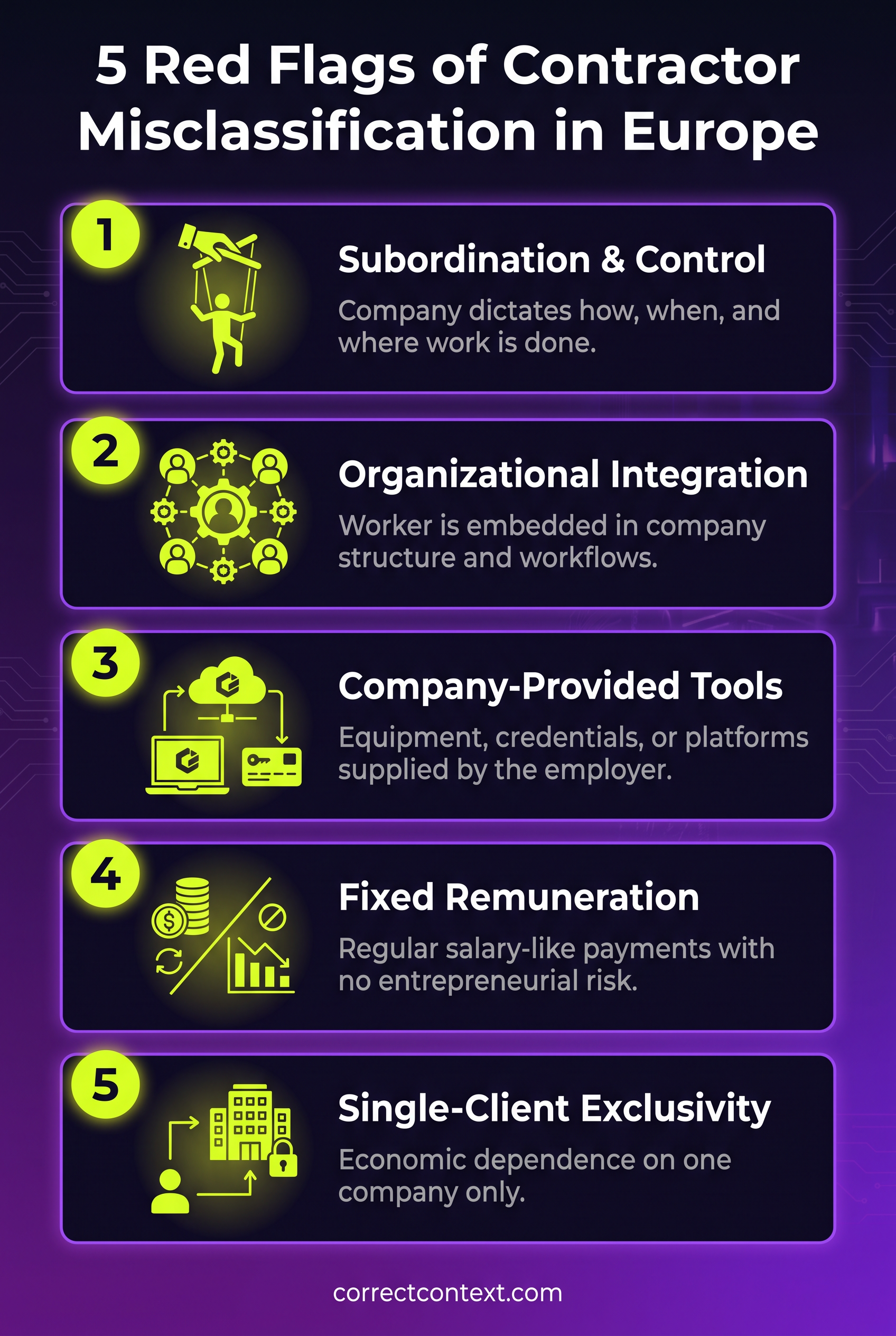
Across European jurisdictions, courts and labor inspectorates apply holistic tests to determine employment status. The core elements typically include [1]:
- Subordination and Control: Does the hiring company dictate how, when, and where the work is performed?
- Organizational Integration: Is the worker integrated into the company’s business structure and operational framework?
- Provision of Tools: Does the company provide the necessary equipment, digital platforms, or credentials?
- Economic Risk: Does the worker bear true entrepreneurial risk, or are they guaranteed regular, fixed remuneration resembling a salary?
- Exclusivity: Does the contractor provide services to multiple clients, or are they economically dependent on a single entity?
If these factors point toward subordination rather than independence, the worker is legally considered an employee, regardless of the contractual label.
The Legislative Shift: Poland’s New Enforcement Powers
The regulatory tightening is perhaps most evident in Poland, a primary destination for companies looking to hire developers for startup or establish an offshore development team. A landmark reform to the National Labor Inspectorate (PIP), scheduled to take effect in July 2026, fundamentally alters the enforcement landscape [2].
Previously, only labor courts could reclassify a B2B contract as an employment relationship—a prolonged judicial process. Under the new legislation, the PIP gains the authority to administratively determine the existence of an employment relationship directly during an inspection [2]. This means inspectors can immediately convert improperly concluded civil law contracts into employment contracts based on factual working conditions.
This shift significantly narrows the margin for error. A B2B audit is no longer just a best practice; it is a critical compliance necessity for any company utilizing an extended engineering team in Poland [2].
The True Cost of Misclassification
The risks associated with contractor misclassification Europe extend far beyond administrative headaches. They represent substantial financial, legal, and operational threats to the enterprise.
Financial Penalties and Back Taxes
When a contractor is reclassified as an employee, the hiring company becomes retroactively liable for obligations it failed to meet. This includes:
- Unpaid Social Security Contributions: The company must cover both the employer and employee portions of social security contributions that should have been paid during the misclassified period.
- Income Tax Deductions: Liability for income tax that should have been withheld from the individual’s pay.
- Fines and Interest: Significant financial penalties and accumulated interest on unpaid amounts. In some jurisdictions, fines can range from thousands to tens of thousands of euros per misclassified worker.
For an enterprise employing a large data analytics team or DevOps team for hire under non-compliant B2B contracts, the cumulative financial exposure can be devastating.
Intellectual Property Vulnerabilities
For tech-first enterprises, intellectual property (IP) is the most valuable asset. The legal framework governing IP ownership differs significantly between employees and independent contractors.
Generally, IP created by an employee in the course of their duties automatically vests in the employer. However, IP created by an independent contractor typically remains with the contractor unless explicitly and comprehensively assigned to the hiring company through the contract [3].
If a B2B contract is poorly drafted or subsequently reclassified, the company may find itself without clear legal ownership of the code, algorithms, or platforms developed by its AI development team or backend development team. This ambiguity can derail investment rounds, complicate M&A activities, and expose the company to IP infringement claims.
The EU Platform Work Directive
The regulatory direction is further underscored by the EU Platform Work Directive (Directive (EU) 2024/2831), which came into force in December 2024 [4]. While primarily targeting digital labor platforms, the Directive introduces a crucial concept: the legal presumption of employment.
If facts indicate direction and control by the platform, the worker is presumed to be an employee, shifting the burden of proof to the company to demonstrate otherwise [4]. This legislative trend reflects a broader European mandate to ensure worker protections and combat false self-employment, signaling that the era of unchecked contractor models is drawing to a close.
Navigating Compliance: The Employer of Record (EoR) Solution
Faced with mounting regulatory pressure and the severe consequences of misclassification, enterprise leaders must evaluate sustainable alternatives. For companies seeking to maintain their European talent base without the burden of establishing local entities, the Employer of Record (EoR) model offers a robust solution.
What is an Employer of Record?
An employer of record Europe is a third-party organization that serves as the legal employer for your international workforce. The EoR assumes responsibility for all formal employment tasks, including:
- Local labor law compliance
- Payroll processing and tax withholding
- Social security contributions
- Benefits administration
- Employment contract management
While the EoR handles the legal and administrative complexities, the hiring company retains day-to-day operational control over the employees, directing their work and managing their output.
B2B vs EoR Europe: A Strategic Comparison
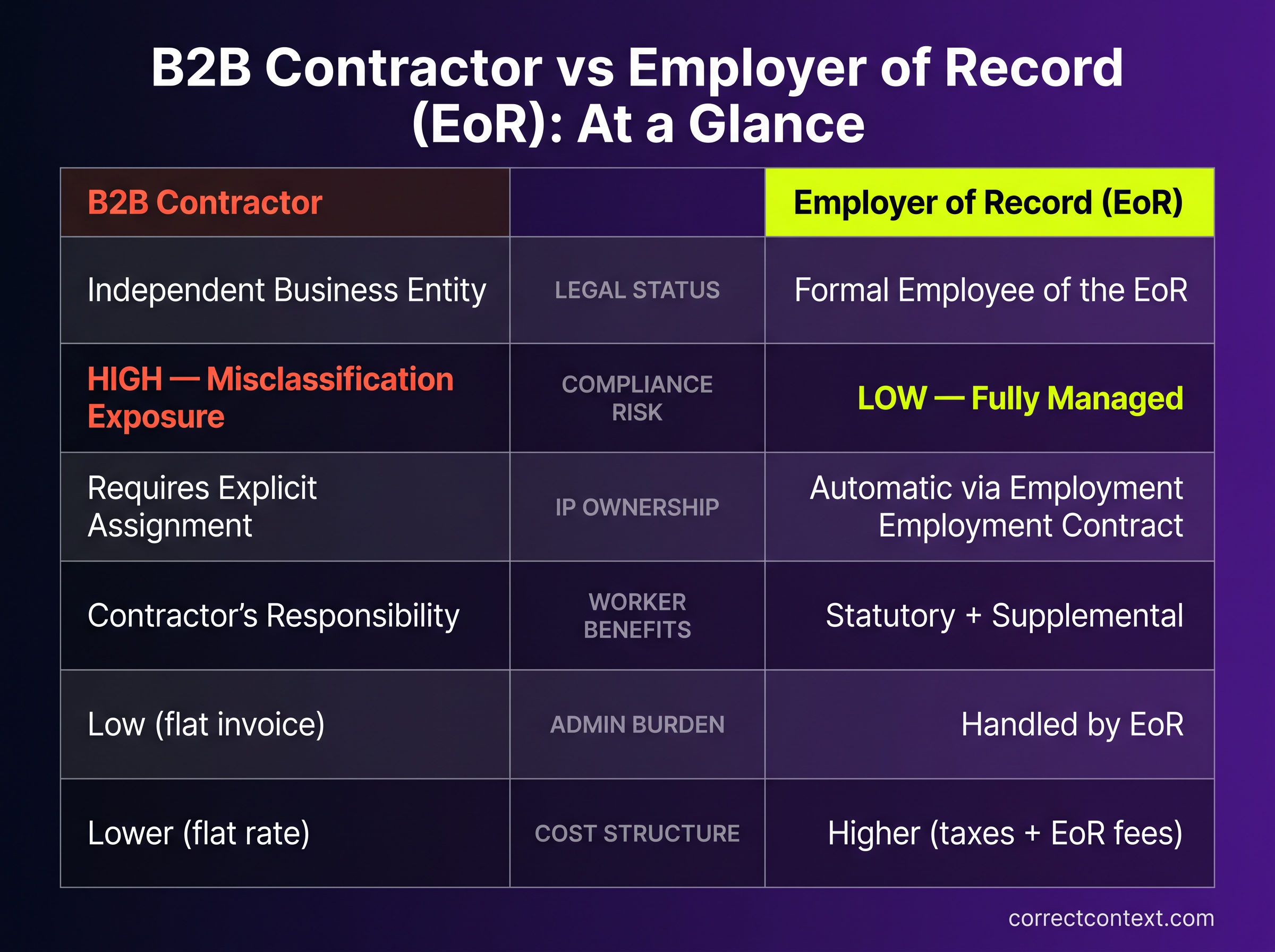
When evaluating B2B vs EoR Europe, the decision hinges on balancing flexibility with compliance.
| Feature | B2B Contractor Model | Employer of Record (EoR) Model |
|---|---|---|
| Legal Status | Independent business entity | Formal employee of the EoR |
| Compliance Risk | High (risk of misclassification) | Low (EoR ensures local compliance) |
| Administrative Burden | Low for the hiring company | Handled by the EoR |
| IP Ownership | Requires strict contractual assignment | Standard employment IP transfer |
| Worker Benefits | Handled by the contractor | Provided via the EoR (statutory & supplemental) |
| Cost Structure | Typically lower (flat rate) | Higher (includes employer taxes & EoR fees) |
The Benefits of Transitioning Contractors to Employees
Transitioning your remote development team from B2B contracts to an EoR CEE arrangement provides immediate strategic advantages:
- Elimination of Misclassification Risk: By formalizing the employment relationship through an EoR, you neutralize the threat of reclassification audits, back taxes, and penalties.
- Secure IP Ownership: Employment contracts managed by the EoR ensure that all intellectual property generated by your big data development team or enterprise ai tools specialists securely belongs to your company.
- Enhanced Talent Retention: Offering formal employment status provides workers with statutory benefits, paid leave, and job security. In a competitive market, this stability is crucial for retaining top-tier talent.
- Scalable Expansion: An European employer of record allows you to seamlessly scale engineering teams across multiple jurisdictions without navigating the bureaucratic hurdles of entity establishment.
The Transition Process: Moving from B2B to EoR
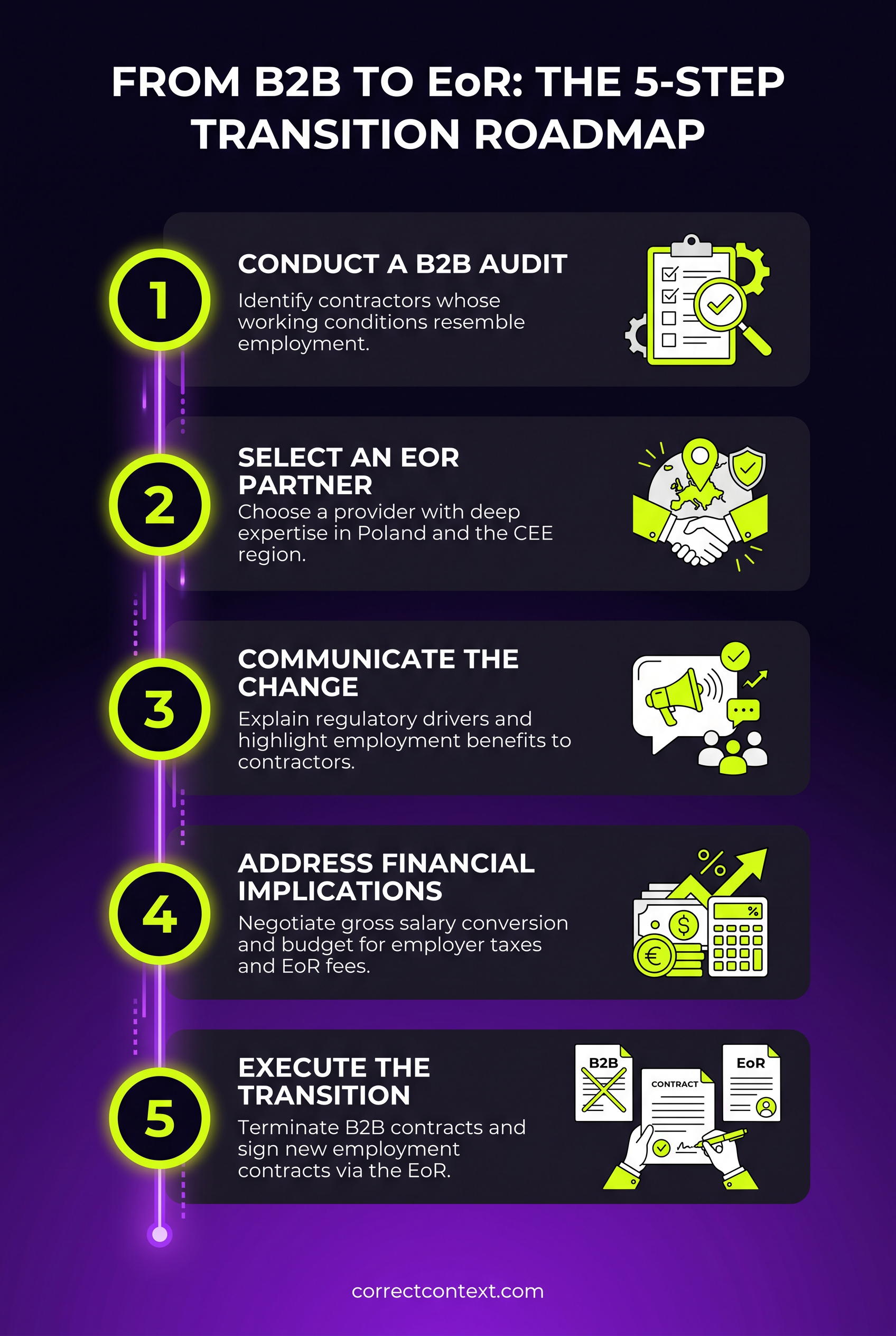
Transitioning contractors to employees requires careful planning and clear communication. It is not merely an administrative switch but a fundamental change in the working relationship.
- Conduct a B2B Audit: Assess your current contractor arrangements against local labor laws. Identify individuals whose working conditions resemble employment (e.g., fixed hours, sole client, use of company equipment).
- Select an EoR Partner: Partner with a reputable EoR provider with deep expertise in the specific jurisdictions where your talent resides, such as an employer of record Poland. Ensure they offer robust compliance frameworks and transparent pricing. Note: When selecting a partner, prioritize established platforms with proven track records in the region.
- Communicate the Change: Engage in transparent discussions with your contractors. Explain the regulatory drivers behind the change and highlight the benefits of formal employment, such as paid time off and social security protections.
- Address Financial Implications: Understand that the total cost of employment will be higher than the B2B flat rate due to employer social security contributions and EoR fees [5]. You must negotiate how the contractor’s remuneration will be converted to a gross salary to ensure fairness while managing the company’s budget.
- Execute the Transition: Terminate the existing B2B contracts and facilitate the signing of new employment contracts through your EoR partner.
Conclusion
The European regulatory environment is decisively shifting towards stricter enforcement of employment laws. For enterprises and scaling startups relying on affordable senior developers or specialized AI development teams in Europe, the traditional B2B contractor model is becoming a significant liability.
By proactively auditing your workforce and embracing the Employer of Record model, you can mitigate misclassification risks, secure your intellectual property, and build a compliant, sustainable foundation for your global operations. The choice between B2B vs EoR Europe is no longer just about cost efficiency; it is about safeguarding the future of your enterprise.
References
[1] Global guide: Independent contractors, potential misclassification issues, and labor implications
[2] B2B Contracts Audit in Poland | Dudkowiak & Putyra
[3] How to capture IP created by employees and contractors
[4] New EU Directive Impacting Digital Platforms and Individuals Working for Them | Crowell & Moring LLP
[5] How to transfer a B2B contractor in Poland to employment? | Article | Chambers and Partners