
When a startup secures its Series A funding, the pressure to scale rapidly becomes immense. Founders and technical leaders face a critical decision: should they hire fast-moving freelancers to build the product immediately, or should they invest the time and resources into building a stable, long-term engineering team? This debate over freelancers vs full time engineers is not just about cost; it is fundamentally about the trajectory of the product and the survival of the company.
The gig economy has expanded significantly, with projections suggesting that half of the United States workforce will freelance by 2027 [1]. For startups, the appeal of hiring freelancers is obvious. Freelancers offer immediate availability, specialized skills for specific tasks, and the avoidance of long-term payroll commitments and benefits. However, as companies transition from early-stage development to mid-stage scaling, the freelance developers risks begin to outweigh the short-term benefits. Stability, continuity, and product ownership become the defining factors of success.
This article explores the true cost of the freelancer model, the hidden risks of team instability, and why long term engineering teams are the proven path for globally scaling tech companies in FinTech, Software, and Media.
The Allure and the Trap of the Freelance Model
At first glance, the freelance model seems tailor-made for startups operating under tight constraints. If a company needs a specific feature built — perhaps a complex machine learning algorithm or a niche cloud integration — finding a specialist on a contract basis appears efficient. Freelancers are essentially independent business owners, which means they are often highly motivated to complete a project quickly to secure payment and move on to the next client [2].
However, the core problem with freelance setups is precisely the vulnerability inherent in their nature: the lack of continuity and accountability. When a startup relies on temporary contractors, they are essentially renting code rather than building a foundational asset. The freelance developers risks manifest in several critical areas that can stall or even derail product progress.
The True Cost of Turnover and Knowledge Loss
The most significant risk in relying on freelancers is turnover. When a contractor finishes a project and departs, they take with them the intimate understanding of the codebase, the architectural decisions, and the unwritten “tribal knowledge” that makes a system function efficiently. This knowledge loss is not just an inconvenience; it is a massive financial drain.
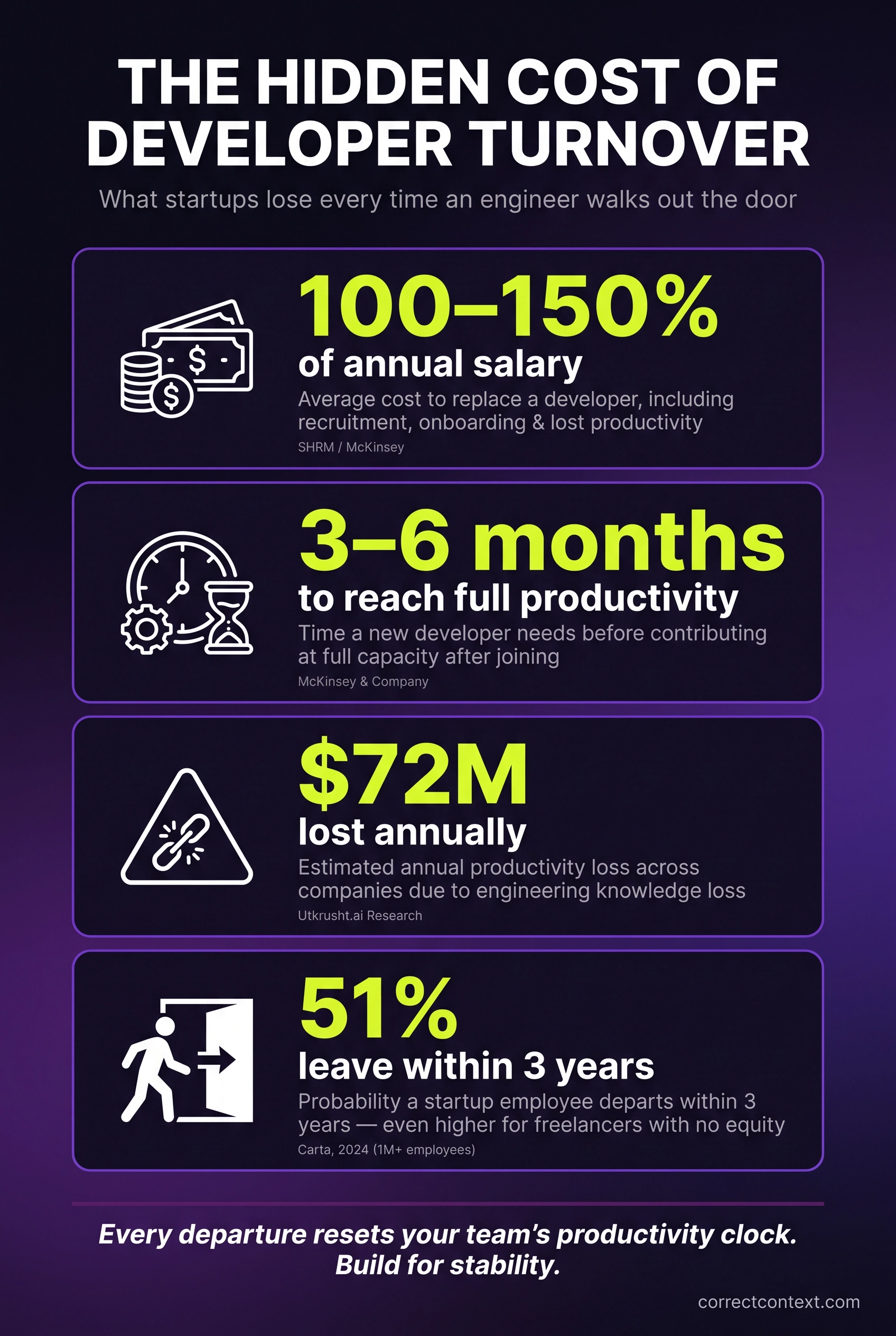
Industry data reveals that the cost of replacing a developer can exceed 100% to 150% of their annual salary when factoring in recruitment, onboarding, and lost productivity [3]. For senior developers, total turnover costs can reach $150,000 to $200,000 per departure. Furthermore, companies lose an estimated $72 million annually in productivity due to knowledge loss, and losing a single developer can cost up to 213% of their salary [4].
For a startup development team, where product velocity means life or death, losing a key engineer midway through a critical sprint can delay a launch by months. Freelancers, by definition, have divided loyalties. They juggle multiple clients simultaneously, and if a higher-paying or more interesting project arises, they may deprioritize or abandon the current task. Research shows that approximately 90% of freelance developers struggle to maintain profitable, sustainable practices, leading to elevated project abandonment and disengagement rates [5].
According to Carta data covering more than 1 million startup employees, there is a 51% chance a startup employee will leave within three years, with median job tenure at startups sitting at just 2.2 years — compared to 4.1 years across all industries [6]. For a freelancer without equity or cultural ties to the company, that number skews even shorter.
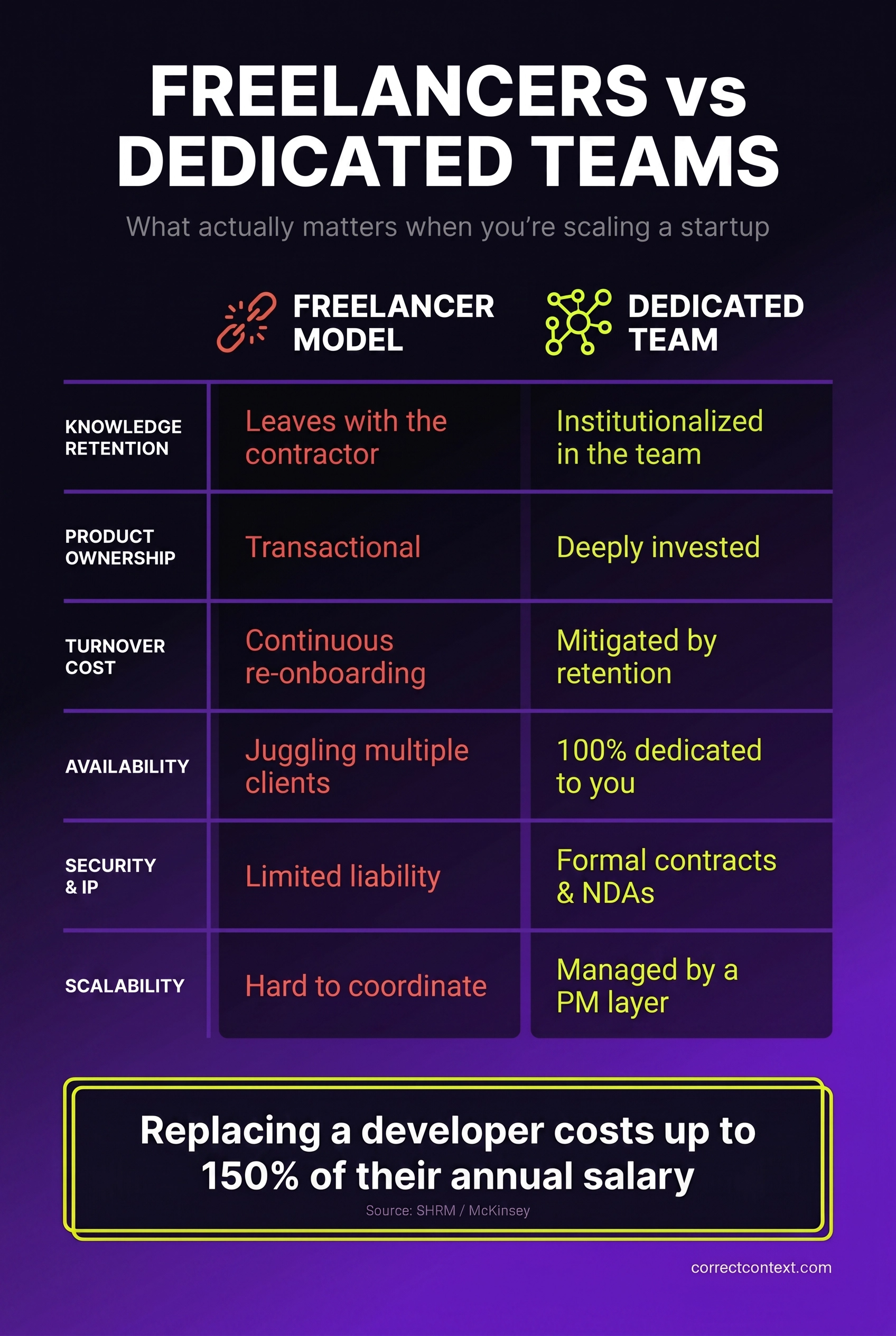
| Metric | Freelance Model | Dedicated Long-Term Team |
|---|---|---|
| Knowledge Retention | Low — departs with the contractor | High — institutionalized in the team |
| Product Ownership | Transactional | Deeply invested |
| Turnover Cost | Continuous, recurring onboarding costs | Mitigated through retention strategies |
| Availability | Variable — juggling multiple clients | 100% dedicated to your product |
| Security & Accountability | Limited contractual liability | Formal contracts, legal accountability |
| Scalability | Difficult to coordinate at scale | Seamlessly managed by a PM layer |
Why Long-Term Engineering Teams Drive Product Velocity
Product velocity is not merely about writing lines of code quickly; it is about consistently delivering value in a fast, focused, and sustainable way. High product velocity requires a team that understands the product vision, the user base, and the long-term business goals. This is where long term engineering teams vastly outperform ad-hoc freelance groups.
Deep Product Ownership and Accountability
A dedicated software team operates with a mindset of ownership. When engineers know they will be maintaining the code they write today for years to come, they prioritize clean architecture, thorough documentation, and scalable solutions. They are not just completing a Jira ticket; they are building the foundation of the company.
In contrast, freelancers are incentivized to deliver the immediate requirement and move on. This often leads to technical debt — quick fixes and workarounds that the next developer will have to untangle. For enterprise innovation units and Series A+ startups, technical debt is a silent killer of growth. McKinsey research shows it takes 3 to 6 months for a new developer to achieve full productivity [3], meaning every contractor departure resets the clock on your team’s output.
Seamless Collaboration and Cultural Alignment
Building a successful tech product requires intense collaboration. A remote development team that works together full-time develops a rhythm. They understand each other’s strengths, communication styles, and problem-solving approaches. This cohesion reduces friction and accelerates the development cycle. A dedicated team typically includes not just developers but also project managers, QA engineers, and business analysts — all aligned to a single client’s goals.
Moreover, long-term employees align with the company’s culture and mission. They care about the success of the business because their success is tied to it. This alignment is nearly impossible to replicate with a rotating cast of temporary workers.
Security and Intellectual Property Protection
One of the most underappreciated freelance developers risks is data security. A freelancer may work on multiple competing projects simultaneously, and there is limited recourse if proprietary code or business logic is mishandled. A dedicated development team operates under formal, binding contracts with clear IP ownership clauses, non-disclosure agreements, and legal accountability — critical for any company building proprietary technology.
Scaling Smart: The Dedicated Nearshore Engineering Model
For startups and enterprise units based in the US East Coast, UK, DACH, and Nordics, the challenge often lies in the local talent shortage and prohibitive costs. The median annual wage for a software developer in the US is over $133,000 [7], and the competition for top-tier talent is fierce. Hiring locally at scale is simply not viable for most Series A companies.
This reality has led many companies to explore the extended engineering team model, specifically by choosing to hire developers Poland and the broader Central and Eastern European (CEE) region. The CEE region has emerged as a premier destination for building a dedicated development team that combines world-class technical talent with cost efficiency and cultural proximity.
The Advantages of an Engineering Hub in Poland / CEE
Establishing an engineering team Poland / CEE offers the perfect balance between the cost-efficiency often sought in freelancing and the stability of an in-house team. This model allows companies to scale engineering teams rapidly without sacrificing quality or continuity.
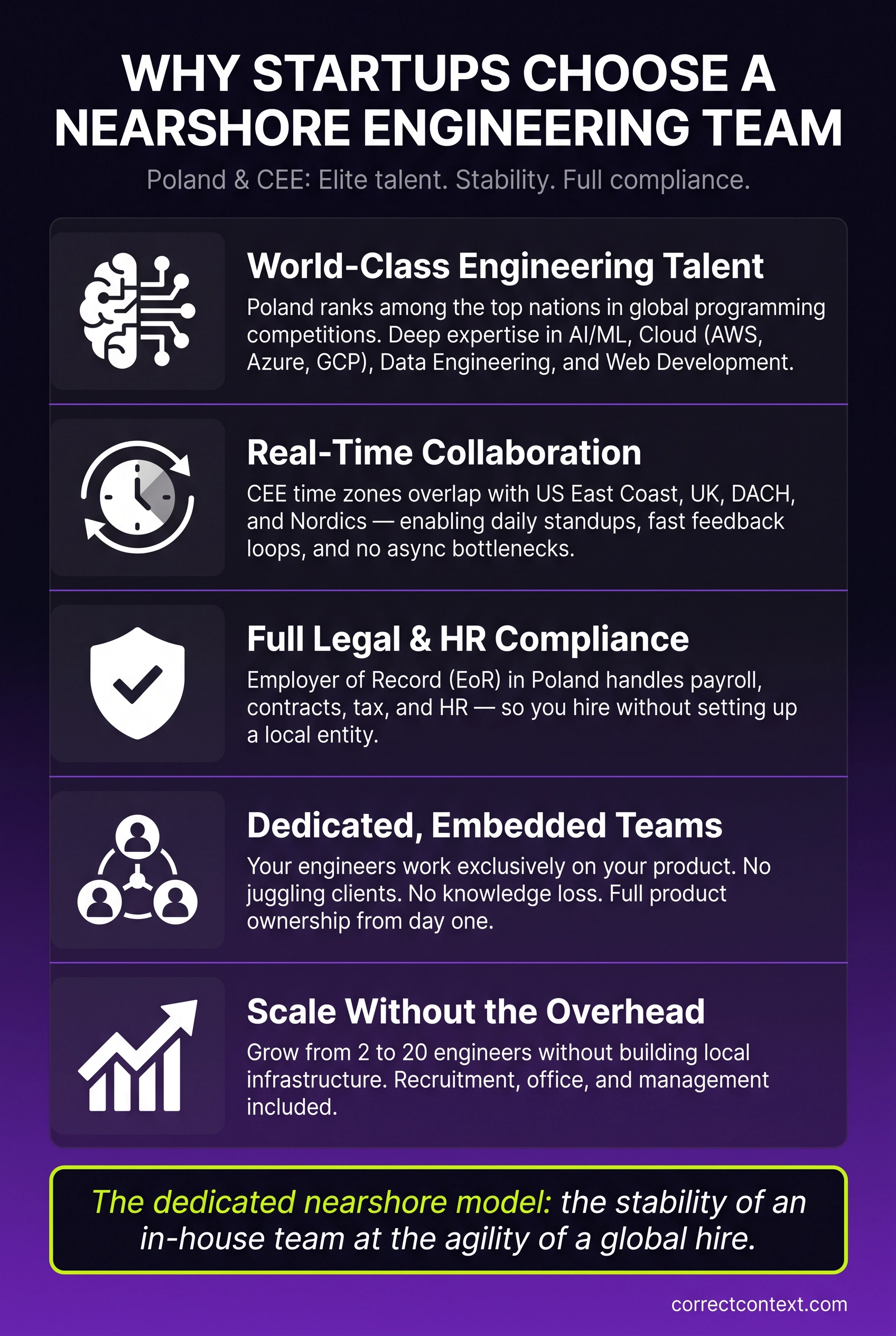
Access to Elite Talent. The region is renowned for producing world-class engineers, particularly in high-demand areas such as AI development team building, cloud engineering team deployment (AWS, Azure, GCP), data engineering team formation, and platform engineering team management. Poland alone graduates tens of thousands of STEM professionals annually, consistently ranking among the top nations in international programming competitions.
Cultural and Time Zone Compatibility. Unlike traditional offshore destinations, the CEE region shares significant cultural alignment and overlapping working hours with Western Europe and the US East Coast, facilitating real-time collaboration and reducing the communication overhead that plagues many offshore development team arrangements.
Regulatory Compliance via EoR. Setting up a legal entity in a foreign country is complex, time-consuming, and expensive. Utilizing an employer of record Poland or EoR Europe solution allows companies to hire in Europe without company establishment. The EoR handles payroll services, HR, accounting, and employment compliance — enabling the startup to focus entirely on product development while remaining fully compliant with local labor law.
The Verdict: Speed Today vs. Stability Tomorrow
When evaluating freelancers vs full time engineers, startup founders must ask themselves a fundamental question: is the perceived speed of hiring a freelancer today worth the instability and technical debt of tomorrow?
For a globally scaling startup, the answer is clear. The startup hiring models that succeed are those that prioritize stability, continuity, and deep product ownership. While freelancers have their place for isolated, non-core tasks — a one-off design sprint, a specialized security audit, a short-term API integration — the core intellectual property of a tech company must be built by a dedicated development team with skin in the game.
By partnering with an established provider to build a remote software engineers team in a highly skilled region like Poland, startups can achieve the best of both worlds: the agility to scale rapidly and the stability required to build a lasting, market-leading product. The math is straightforward: the cost of rebuilding a team after freelancer churn far exceeds the investment in a stable, embedded engineering team from day one.
References
[1] SQ Magazine.Freelance Economy Statistics 2026: Powerful Trends. Freelance Economy Statistics 2026: Powerful Trends • SQ Magazine
[2] Arc.dev. Freelance vs In-House Developers: Pros & Cons of Hiring or Contracting
[3] BetterWay Devs. How to Calculate Turnover Cost for Tech Teams
[4] Utkrusht.ai. 7 methods to avoid knowledge loss when developer/engineer leaves – Utkrusht
[5] Medium / Coders Stop. Why 90% of Freelancers Fail at Coding Projects (Avoid These Mistakes) | by Coders Stop | Medium
[6] Carta. Employee Attrition: Types, Causes & Trends for Startups
[7] Bureau of Labor Statistics. Software Developers, Quality Assurance Analysts, and Testers