
How to align external core teams with internal company culture and scale engineering without friction.
When Enterprise innovation units and scaling Tech-first startups decide to scale engineering teams, they often face a common dilemma: how to integrate an extended engineering team without creating silos. The “Us vs Them” trap is a well-known pitfall where nearshore/offshore teams feel disconnected from the main company, leading to poor communication, lower quality output, and ultimately, project failure.
For a VP of Engineering or CTO looking to build a tech hub in Poland or CEE, the goal is not just to hire affordable senior developers but to seamlessly integrate them so they function as a true extension of the core team. This article explores the data-backed strategies for aligning an offshore development team with your internal company culture, ensuring that your dedicated software team drives innovation rather than friction.
The Cultural Cost of Disconnected Teams
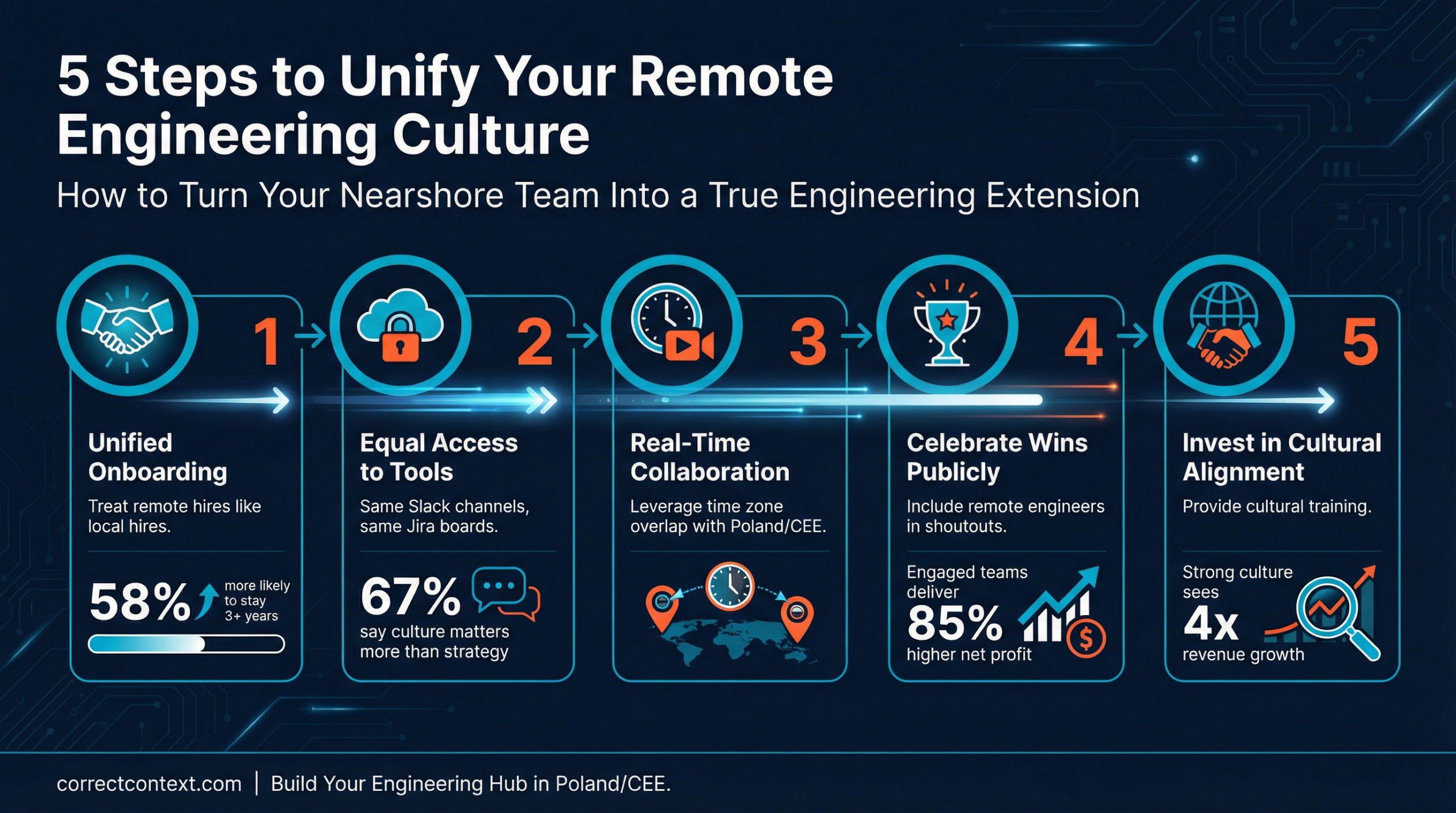
A PwC Global Culture Survey found that 67% of employees and leaders believe culture is more important to business success than strategy and operations [1]. Furthermore, Harvard Business Review found that companies with a strong corporate culture see a 4x increase in revenue growth compared to companies with a weak culture [1]. When an engineering team in Poland / CEE is treated merely as an outsourced vendor rather than a core partner, the resulting cultural disconnect can be devastating.
The Standish Group’s CHAOS report, which analyzed over 50,000 technology projects, discovered that the primary reason for failure was miscommunication due to cultural differences and poor relationship management [2]. When your remote software engineers team lacks context, they cannot make the intuitive product decisions that an aligned team makes daily.
The Myth of the “Bad Offshore Dev”
It is a common misconception that offshore team for startup or enterprise projects fail because of a lack of technical skills. In reality, the failure often stems from the environment they are placed in. If an AI development team or cloud engineering team is kept in the dark about business goals, isolated from company all-hands meetings, and treated as second-class citizens, their output will reflect that exclusion.
As research from Gallup indicates, engaged employees produce better business outcomes than disengaged employees, and engaged teams have a measurable impact on organizational performance [3]. To maximize the ROI of a dedicated development team, leaders must focus on cultural integration as intensely as technical onboarding.
Infographic: The Culture Integration Playbook
Why Nearshore Teams Can Strengthen Company Culture
The belief that building internal teams is good and hiring nearshore developers Europe is bad is an outdated assumption. In fact, a thoughtfully integrated nearshore development team can actually enhance your company culture.
- 1. Diversity of Thought: An engineering hub Europe brings seasoned experts with diverse experiences, enriching problem-solving and innovation.
- 2. Time Zone Alignment: For companies in the Eastcoast US, UK, DACH, and Nordics, a nearshore development team in Poland offers significant workday overlap, facilitating real-time collaboration and a “one team” mentality [1].
- 3. High English Proficiency: Countries like Poland consistently rank high on the English Proficiency Index, ensuring clear communication and cultural alignment [4].
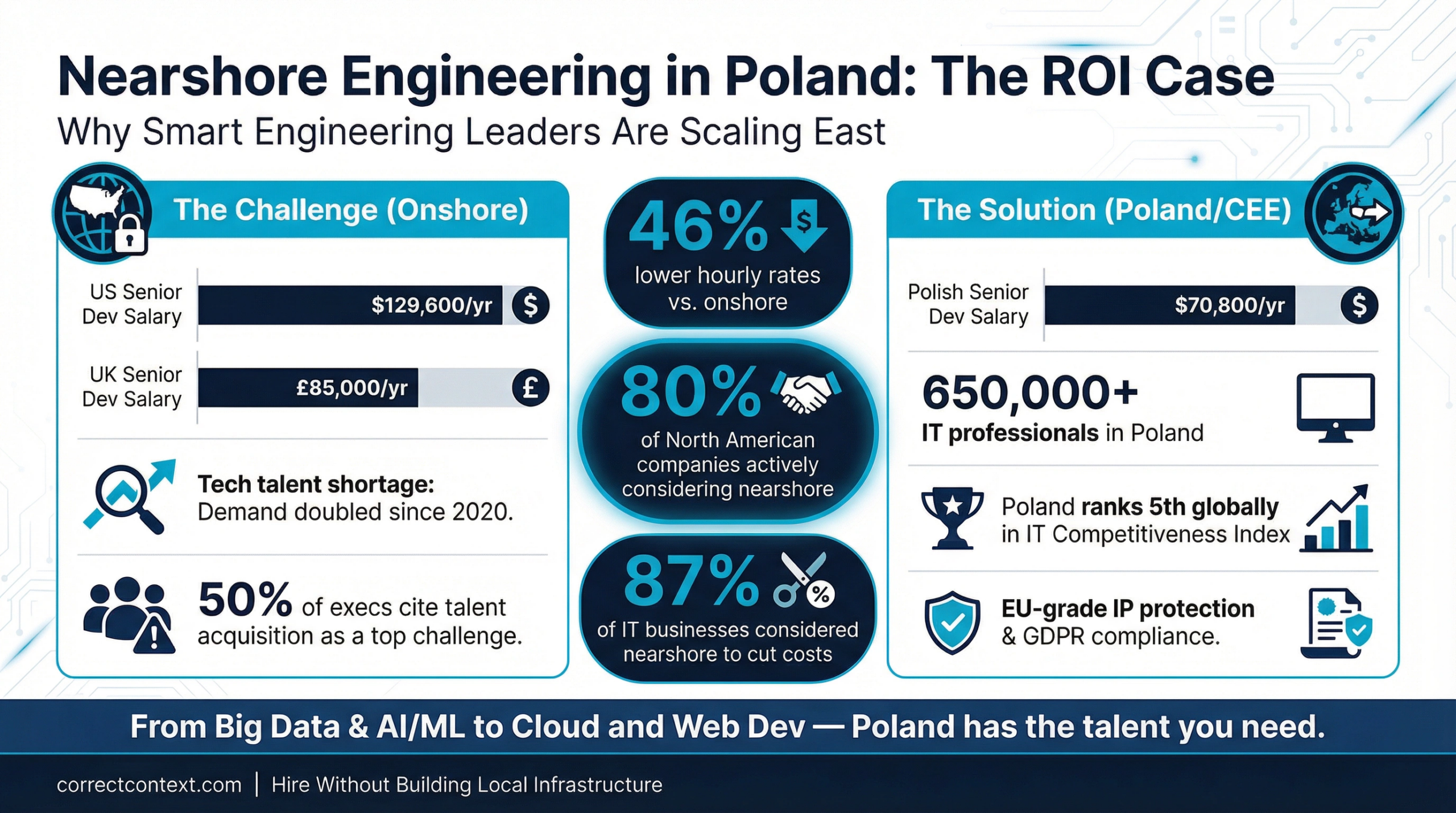
According to a Deloitte survey, 59% of companies choose nearshore software development as a cost-cutting tool, but the most successful ones leverage it for strategic growth [4]. Nearshore rates are typically 46% lower than onshore rates, allowing companies to scale software development efficiently [4].
Strategies for Integrating a Remote Core Team
To avoid the “Us vs Them” trap, engineering leaders must adopt specific practices to align their backend development team, data engineering team, or platform engineering team with the core company culture.
1. Unified Onboarding and Context Sharing
A remote development team needs the same onboarding experience as a local hire. This means sharing the company vision, product roadmap, and customer personas. When you hire developers Poland, they should understand why they are building a feature, not just what to build.
2. Equal Access to Tools and Information
Ensure your AWS / Azure / GCP engineers team has access to the same Slack channels, Jira boards, and documentation as the internal team. Transparency builds trust. If you are using an employer of record Poland (EoR) to hire in Europe without company entity, the administrative separation should be invisible to the engineers themselves.
3. Fostering Real-Time Collaboration
Leverage the time zone overlap to schedule joint sprint planning, daily stand-ups, and retrospective meetings. A startup development team thrives on agile communication.
4. Recognizing and Rewarding Contributions
Celebrate the wins of your big data development team or data analytics team publicly. Inclusion in company-wide shoutouts reinforces that they are a valued part of the organization.
The Poland / CEE Advantage for Enterprise and Startups
For Fortune 5000 enterprises and Series A+ startups in FinTech, Software, and Media, Poland has emerged as the premier destination to scale engineering teams. With over 650,000 IT professionals and a €30.4 billion software market, Poland offers EU-grade IP protection and deep technical expertise [5].
When you need to hire AI engineers, hire AI programmers, or hire AI coders to implement enterprise AI tools and capitalize on AI trends enterprise, the Polish talent pool is unmatched. Furthermore, utilizing payroll services Poland or an EoR Europe / employer of record CEE allows companies to achieve employment compliance Europe seamlessly.
Infographic: Poland/CEE vs. Onshore — The Numbers That Matter
Table 1: Comparing Onshore vs. Nearshore (Poland/CEE) Teams
| Metric | Onshore Team (US/UK) | Nearshore Team (Poland/CEE) | Impact on Business |
| Cost | High ($120k+ average salary) | Moderate ($50k – $70k average salary) | Up to 46% cost savings [4] |
| Time Zone Overlap | Full | High (4-6 hours with US East Coast, full with UK/EU) | Enables real-time agile collaboration |
| IP Protection | High | High (EU GDPR and IP laws) | Secure environment for proprietary code |
| Talent Availability | Highly competitive, scarce | Abundant (650,000+ IT professionals) [5] | Faster scaling and access to niche skills |
| Cultural Alignment | Native | High (Western work culture, high English proficiency) | Seamless integration and communication |
Partnering for Success: The Correct Context Approach
Building a successful extended engineering team requires more than just finding talent; it requires a holistic approach to integration. This is where specialized partners come in. By leveraging services that handle recruitment, payrolls, HR, accounting, law, and office management, companies can focus on what matters: building great products.
When you use an European employer of record to hire employees without entity, you remove the administrative burden while maintaining direct control over your engineering culture. Whether you are looking to integrate corporate AI use or use AI tools inside corporation, a dedicated partner ensures that your remote team operates with the same context and commitment as your internal staff.
Conclusion
The “Us vs Them” trap is not an inevitable consequence of distributed teams; it is a symptom of poor integration. By treating your dedicated development team as a true extension of your company, providing them with context, and fostering a unified culture, you can unlock the full potential of global talent. For enterprises and startups looking to scale, a nearshore team in Poland or CEE offers the perfect balance of skill, cultural alignment, and cost efficiency.
References
[1] Dualboot Partners. How Nearshore Teams Can Strengthen Company Culture.
[2] The Standish Group. The CHAOS Report.
[3] Gallup. State of the Global Workplace Report
[4] HatchWorks. 25 Nearshore Software Development Statistics to Know in 2025.
[5] Correct Context. 10 Essential Best Practices for IT Nearshoring and Offshoring Success