In the relentless gold rush to integrate artificial intelligence, enterprises are scrambling to assemble their dream teams. The pressure is immense, with executives seeing AI as the definitive frontier for competitive advantage. Yet, a staggering number of these ambitious initiatives are quietly failing. The RAND Corporation reports that over 80% of enterprise AI projects never make it to production, a failure rate double that of standard IT projects [1]. A 2025 MIT study delivered an even harsher verdict for the latest wave of technology, finding that 95% of generative AI pilots fail to deliver a return on investment [2].
The primary culprit isn’t the technology—it’s the team. In a rush to innovate, companies are making critical and costly hiring mistakes. They are grappling with role confusion, overhiring for roles they don’t need, and under-hiring for roles that are essential. For a CTO or an enterprise innovation leader, the fear of getting this wrong is palpable. The cost of a bad hire, which the U.S. Department of Labor estimates can reach 30% of an employee’s first-year salary, is magnified in the high-stakes, high-salary world of AI [3]. For a senior AI engineer commanding a $200,000+ salary, a mis-hire can easily cost a company over $60,000 in direct losses, not to mention the crippling loss of momentum.
This article provides a clear, stage-by-stage guide for building a successful AI development team. We’ll cut through the hype to define the roles you actually need at each phase of your AI journey, from initial MVP to enterprise-wide scaling. We will also highlight the roles you can afford to ignore for now, saving you from expensive missteps. And we’ll explore a smarter way to scale your capabilities by leveraging a dedicated development team in global tech hubs like Poland and Central Eastern Europe (CEE), giving you access to top-tier talent without the crippling overhead.
The High Cost of Getting It Wrong: Role Confusion and Overhiring
The most common pitfall in building an AI team is a fundamental misunderstanding of the roles themselves. The titles “Data Scientist” and “Machine Learning Engineer” are often used interchangeably, yet they represent vastly different skill sets. A Data Scientist is an explorer and a researcher, skilled in statistical analysis and hypothesis testing. A Machine Learning Engineer is a builder, a software engineer who specializes in taking a theoretical model and making it work in a real-world, production environment. Hiring a team of Data Scientists when you need to build a scalable product is like hiring a team of physicists to build a bridge—you’ll get a lot of brilliant theory but very little functional infrastructure.
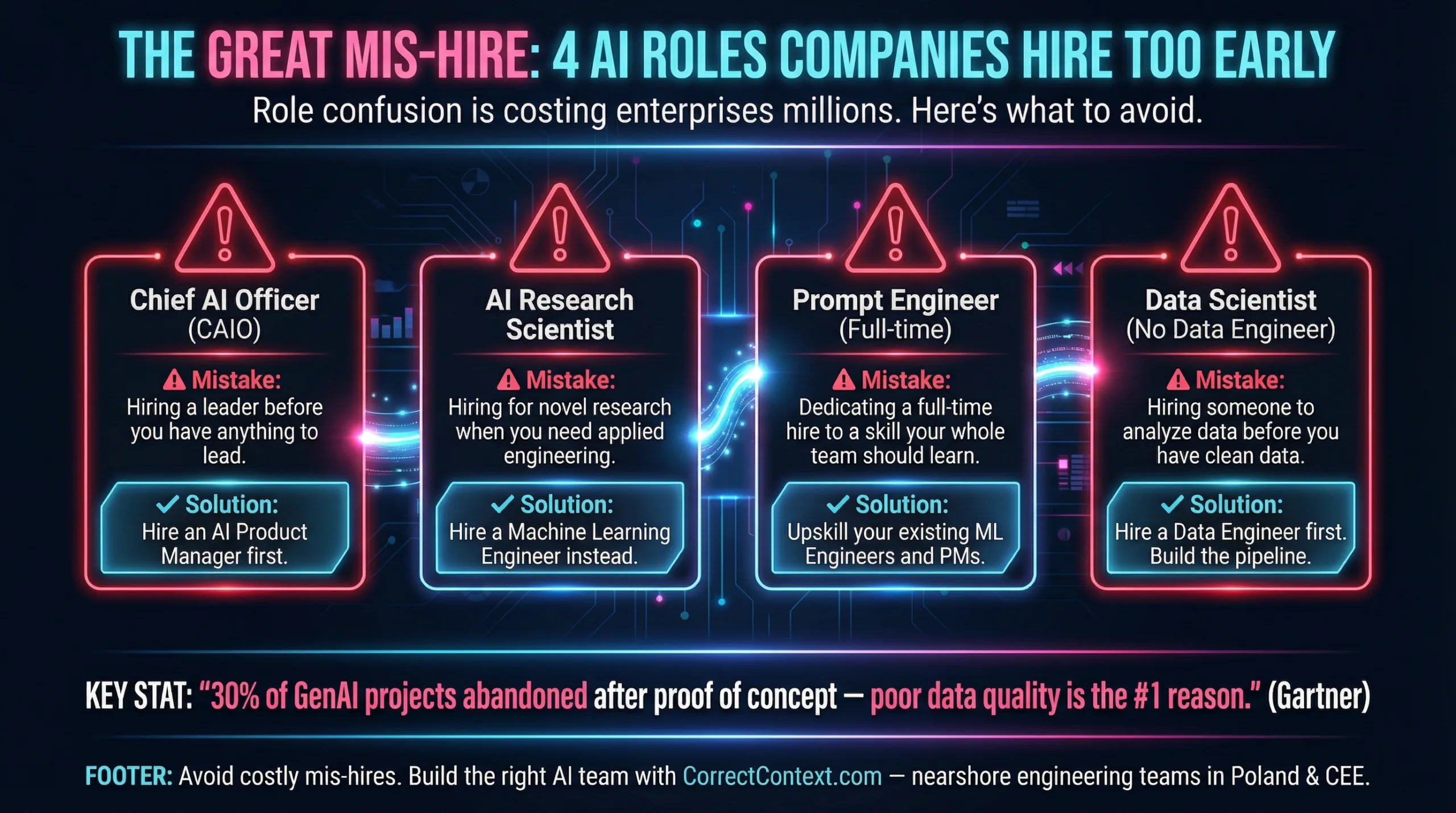
4 AI roles companies hire too early
This role confusion leads to overhiring in the wrong areas. Many organizations, eager to appear “AI-first,” rush to hire a Chief AI Officer or a team of AI Research Scientists before they have a single clean data pipeline. The result is a team of highly paid experts with nothing to work on, leading to frustration, project delays, and wasted resources. According to Gartner, 30% of generative AI projects are abandoned after the proof-of-concept stage, often due to a mismatch between the team’s skills and the project’s foundational needs, like data quality and risk management [4].
| Common Pitfall | Consequence | Why It Happens |
|---|---|---|
| Hiring Data Scientists First | Models never leave the lab | Confusing research with production engineering. |
| No MLOps Engineer | AI models fail in production | Underestimating the complexity of maintaining live models. |
| Hiring a Chief AI Officer Prematurely | Strategy without execution | A desire for top-down leadership before a bottom-up foundation exists. |
| Ignoring Data Engineering | “Garbage in, garbage out” | The unglamorous work of data pipelines is less exciting but more critical. |
The Foundational AI Team: Your First Essential Hires
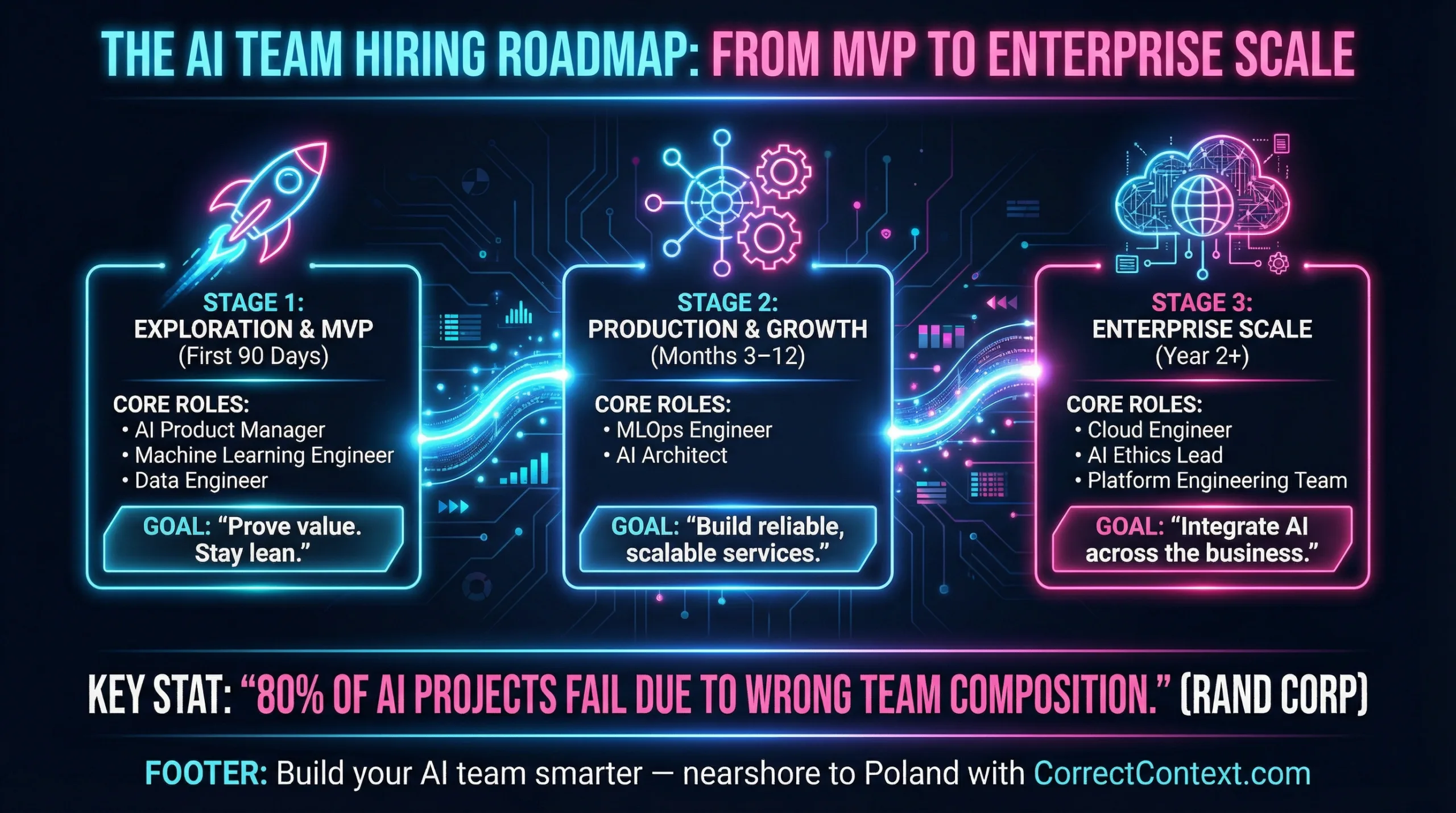
The AI team hiring roadmap
For organizations early in their AI journey, the goal is to prove value quickly with a Minimum Viable Product (MVP). This doesn’t require a sprawling team of specialists. It requires a lean, focused unit capable of moving from idea to a functional prototype. This is your foundational AI development team.
- The AI Product Manager (The Strategist): This is your translator. This individual understands the business needs and can translate them into a technical roadmap for the AI team. They define what success looks like and ensure the project stays aligned with business goals. Without this role, even the most brilliant technical team can build a product that solves no real-world problem.
- The Machine Learning Engineer (The Builder): This is your most critical technical hire. An MLE is a software engineer first and a machine learning expert second. They can take a model, write production-grade code, integrate it with existing systems, and deploy it. When you need to hire AI engineers, focus on this hybrid skillset. This is the role that turns AI from a science experiment into a business tool.
- The Data Engineer (The Plumber): AI is fueled by data, and the Data Engineer builds the pipelines that deliver it. This role is responsible for creating and maintaining the data infrastructure, ensuring that the ML Engineers have access to clean, reliable, and timely data. Hiring a Data Scientist or ML Engineer without a Data Engineer is like buying a race car with no gas station in sight.
This core trio forms the nucleus of a successful startup development team for AI. They have the strategic direction, the building capacity, and the fuel to get the job done. All other roles, at this early stage, are a distraction.
Scaling Your AI Initiative: Roles for Growth and Production
Once your initial AI projects have demonstrated value and you’re ready to scale, your team’s needs will evolve. This is the stage where you move from building individual models to creating a robust, enterprise-grade AI platform. This requires a new set of roles to manage complexity, ensure reliability, and govern your AI systems.
- MLOps Engineer: As soon as your models are in production, you need an MLOps Engineer. This role is the DevOps of AI, responsible for automating the deployment, monitoring, and retraining of your models. They ensure your AI systems are reliable, performant, and don’t degrade over time. Without MLOps, your production models are a ticking time bomb.
- AI Architect: As you build more AI services, you need someone to design the overarching system. The AI Architect ensures that your various models, data pipelines, and applications work together cohesively. They make critical decisions about technology stacks, scalability, and security, preventing you from building a collection of disconnected and unmanageable AI silos.
- Cloud Engineers (AWS/Azure/GCP): Modern AI runs on the cloud. As you scale, you’ll need dedicated cloud engineering team members who are experts in your chosen platform, whether it’s AWS, Azure, or GCP. They manage the underlying infrastructure, optimize costs, and ensure your AI platform is secure and scalable.
The Smart Alternative: Building Your AI Team with a Nearshore Partner
The challenge with hiring for these roles is immense. The demand for AI talent far outstrips the supply. A 2026 survey by ManpowerGroup found that 72% of employers report difficulty filling key roles, with AI and machine learning skills being among the most sought-after [5]. This talent shortage has driven salaries to astronomical levels, particularly in the US and Western Europe, making it prohibitively expensive for many companies to build a comprehensive in-house team.
This is where a nearshore development team in a tech hub like Poland offers a powerful strategic advantage. Poland has emerged as a global leader in technology, with a deep pool of highly skilled and experienced software engineers, including those specializing in AI and data science. By partnering with a company like Correct Context, you can hire developers in Poland and build a world-class engineering team Poland / CEE at a fraction of the cost of hiring in the US or UK.
The cost savings are significant. An experienced AI engineer in the US can command an hourly rate of $150 or more. In Poland, a developer with a comparable skillset can be hired for around $60-$90 per hour. This isn’t about sacrificing quality for cost; it’s about accessing a market of affordable senior developers who have been educated in top-tier technical universities and have experience working on complex projects for global companies.
Furthermore, an employer of record (EoR) in Poland like Correct Context handles all the operational complexities. We manage recruitment, payroll, HR, legal compliance, and office infrastructure, allowing you to focus on building your product. You get a fully integrated extended engineering team without the headache and expense of setting up a foreign entity. Whether you need a full remote development team or a hybrid model, this approach provides the flexibility to scale your AI development team on demand.
Conclusion: Build Smart, Not Fast
The journey to AI maturity is a marathon, not a sprint. The companies that succeed will be those that build their teams deliberately, focusing on the right roles at the right time. Start with a lean, foundational team of a Product Manager, an ML Engineer, and a Data Engineer. As you prove value and are ready to scale, introduce MLOps, AI Architects, and Cloud Engineers.
Most importantly, recognize that you don’t have to go it alone. In a market defined by a severe talent shortage and soaring costs, a nearshore development team in Poland or the CEE region offers a strategic and cost-effective path to building a world-class AI team. By leveraging a partner who can provide an employer of record in Europe, you can access the talent you need to win the AI race without breaking your budget.
References
[1] RAND Corporation, The Root Causes of Failure for Artificial Intelligence Projects and How They Can Succeed: Avoiding the Anti-Patterns of AI
[2] MIT, “Generative AI in the Enterprise,” August 2025.
[3] U.S. Department of Labor, “The Cost of a Bad Hire.”
[4] Gartner, “Gartner Predicts 30% of Generative AI Projects Will Be Abandoned,” July 2024.
[5] ManpowerGroup, “2026 Talent Shortage Survey.”
[6] 8allocate, “How to Build and Structure an AI Development Team in 2026,” February 2026.
[7] McKinsey & Company, “The State of AI in 2025,” November 2025.
[8] SHRM, “The Cost of a Bad Hire Can Be Astronomical.”
[9] IDC, “Closing the AI Skills Gap,” December 2024.
[10] World Economic Forum, “Future of Jobs Report 2025,” January 2025.